
A library IT lead asks how local and remote port forwards differ at a high level. What distinction should the tester emphasize?
Select an answer to reveal the explanation.
Short Explanation
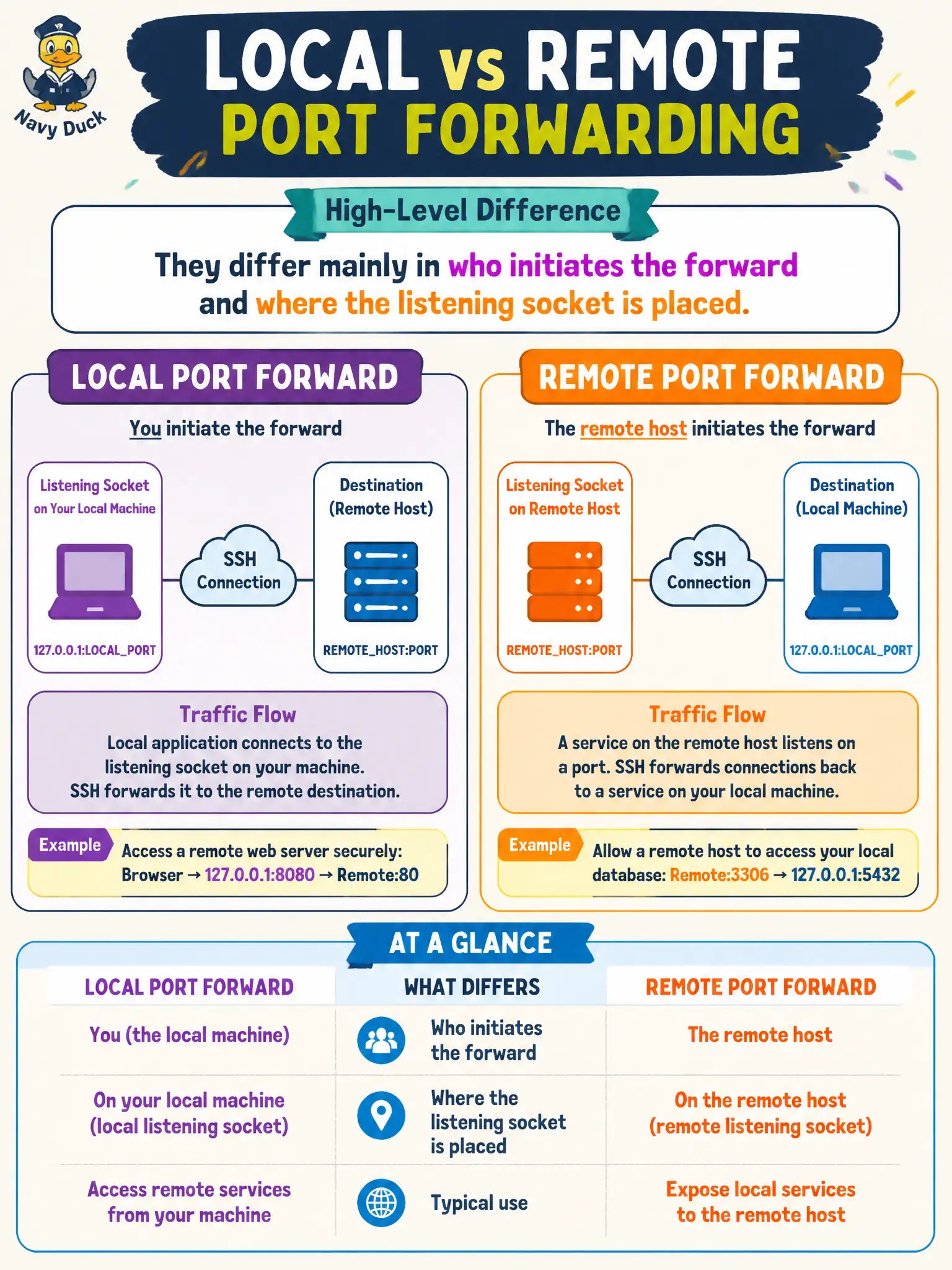
Local versus remote forwarding is mostly about which side opens the listening door and who walks through it first. One setup parks the listener near you; the other parks it on the far side so something over there can call back. Same family of idea, different direction and handshake.
Full Explanation
For a library IT lead, local and remote port forwards differ mainly in who initiates the forward and where the listening socket is placed—not in tool brand. Claiming local and remote forwards are identical erases that directionality and leads to broken access designs mid-engagement. Remote forwards do not always require ARP spoofing on the client LAN; that injects an unrelated disruptive technique. Asserting local forwards only work for UDP while remote forwards only work for ICMP is protocol nonsense that confuses transport with forward direction. Exam caveat: memorize the listen-side mental model rather than product CLI trivia. Operational check: before opening library forwards, write down which side listens, which side connects, which municipal host is the mid-point, and verify the chosen direction matches the reachability problem you are solving. In municipal operations, record the rationale in the engagement notes so future testers and city defenders understand which approach was chosen and which failure modes the rejected options would create for civic services. Re-validate the same judgment after the next change window so the control still holds under the city’s current tooling, identity posture, and RoE amendments.