
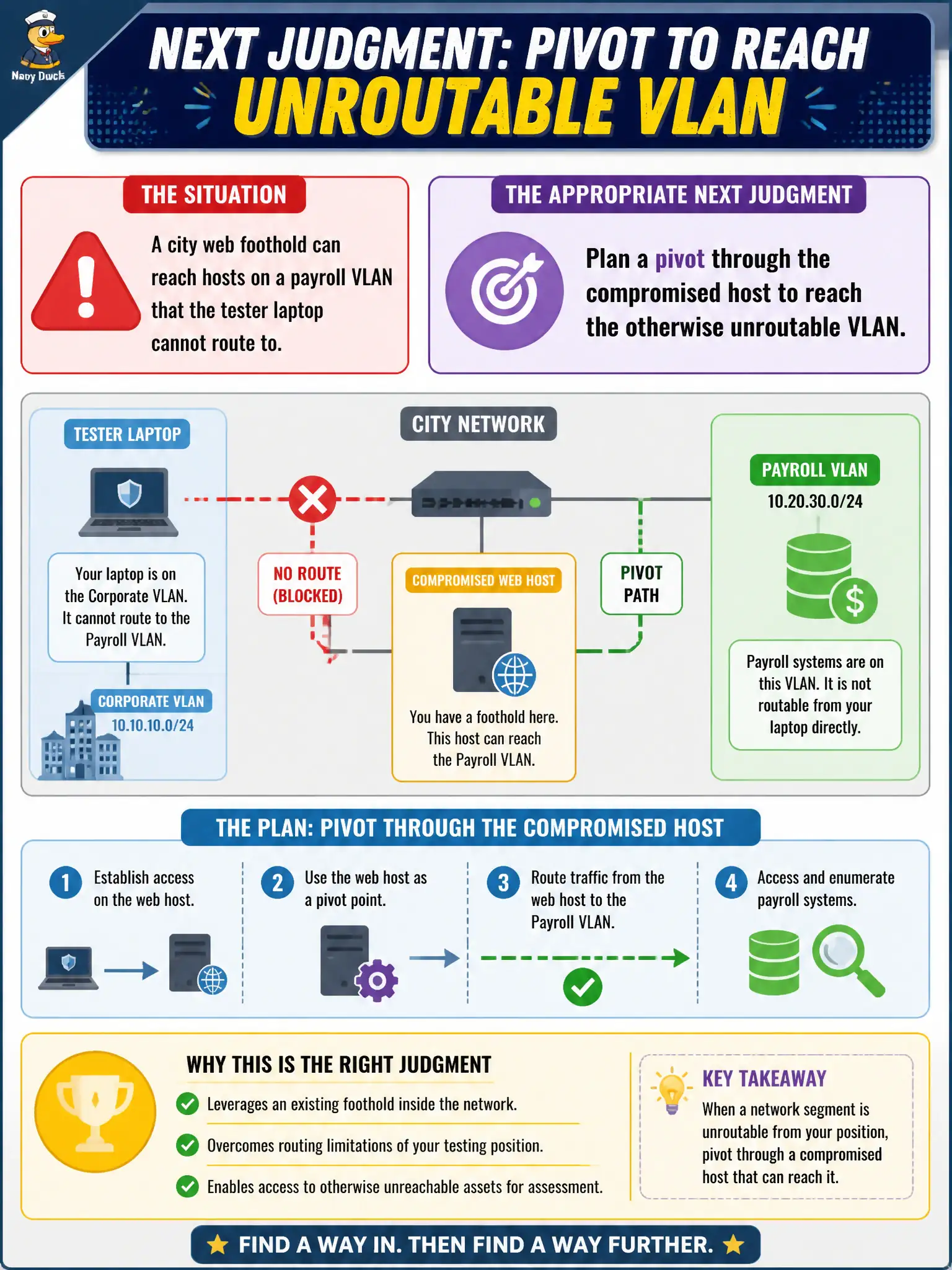
A city web foothold can reach hosts on a payroll VLAN that the tester laptop cannot route to. What is the appropriate next judgment?
Select an answer to reveal the explanation.
Short Explanation
Imagine your laptop is stuck on one side of a locked hallway, but the compromised city box has a key to the payroll wing. Pivoting means walking through that box instead of banging on walls from your own desk. Blind scanning from the wrong network position just wastes time and never opens the door.
Full Explanation
When a city web foothold can reach hosts on a payroll VLAN that the tester laptop cannot route to, the appropriate next judgment is to plan a pivot through the compromised host to reach the otherwise unroutable VLAN. Continuing to scan blindly from the laptop waiting for a direct route wastes time and misses the architectural reality the foothold revealed. Treating the payroll VLAN as forever unreachable abandons an in-scope path that may protect citizen payment data. Escalating privileges on the foothold only, while refusing to consider lateral reach, can be necessary later but does not replace the routing decision the question asks for. Exam caveat: pivoting is about path planning through authorized access, not automatic exploitation of every host on the far VLAN. Operational check: confirm payroll CIDRs are in the city RoE, choose a least-impact forward or tunnel method allowed by policy, inventory reachable services carefully, and document each hop before deeper testing. In municipal operations, record the rationale in the engagement notes so future testers and city defenders understand which approach was chosen and which failure modes the rejected options would create for civic services.