
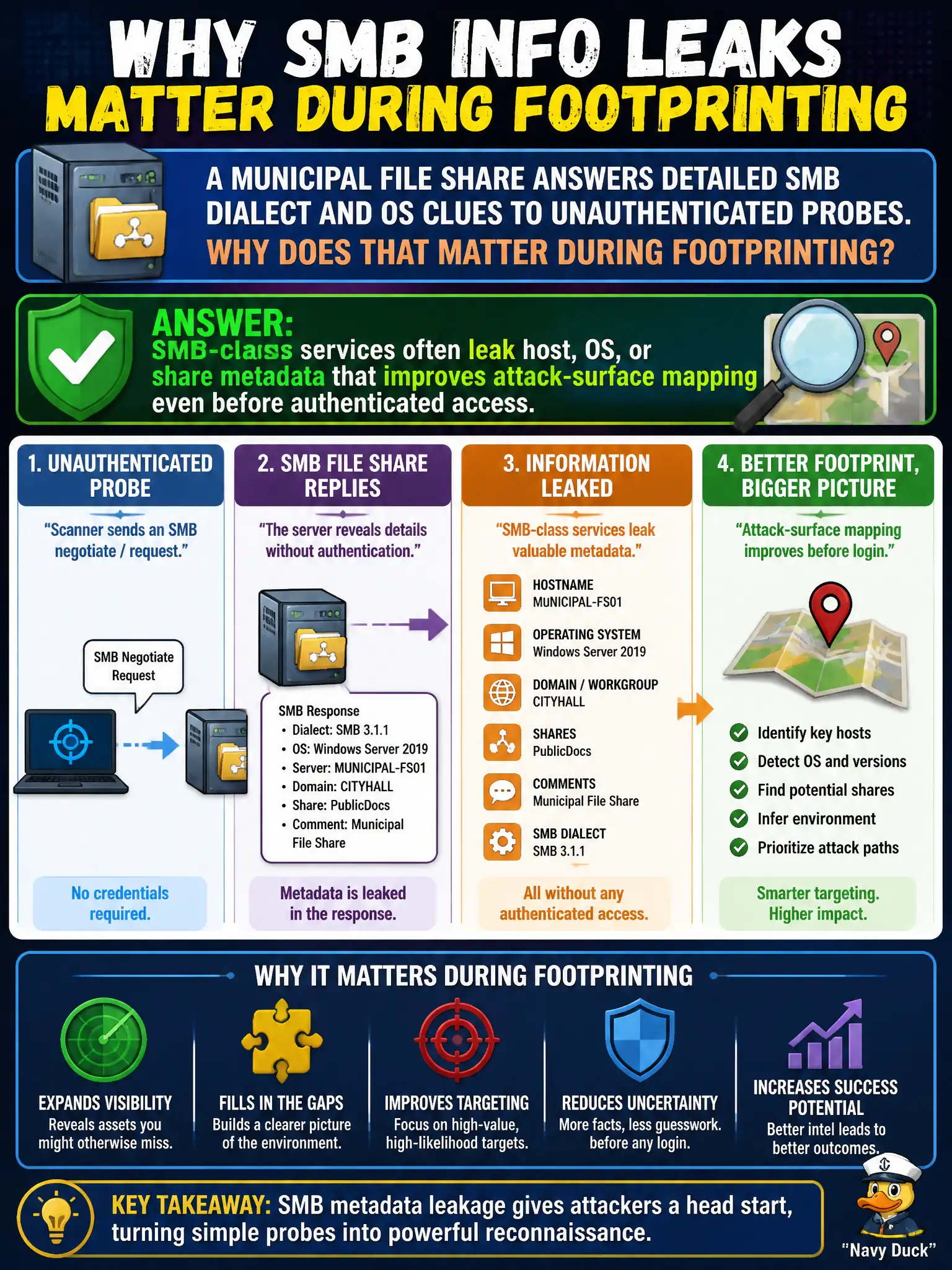
A municipal file share answers detailed SMB dialect and OS clues to unauthenticated probes. Why does that matter during footprinting?
Select an answer to reveal the explanation.
Short Explanation
Even without a login, SMB can gossip about the host personality — dialects, OS hints, share names. That gossip sketches the target before you ever get keys. Ignoring it leaves free intel on the table.
Full Explanation
If a municipal file share answers detailed SMB dialect and OS clues to unauthenticated probes, that matters because SMB-class services often leak host, OS, or share metadata that improves attack-surface mapping even before authenticated access. Unauthenticated SMB replies can contain useful metadata on many networks. Those clues are useful during footprinting, not only after stealing backup tapes. File-share footprinting is not exclusively a web-application concern and should not be skipped when SMB is in scope. Exam caveat: signing requirements and modern hardening may reduce leakage, but test and document what still exposes municipal hosts. Operational check: from an approved source, probe SMB within RoE, capture dialect/OS/share hints, add them to the host profile, and prioritize shares that suggest sensitive civic data for authorized deeper testing. Document the rationale in the municipal engagement notes so later civic responders know which boundary was honored and which failure modes the rejected options would create for public services. Document the rationale in the municipal engagement notes so later civic responders know which boundary was honored and which failure modes the rejected options would create for public services.