
A municipal tester mixes up staged and stageless payload delivery concepts during planning. Which statement captures the tradeoff at a high level—without providing a payload?
Select an answer to reveal the explanation.
Short Explanation
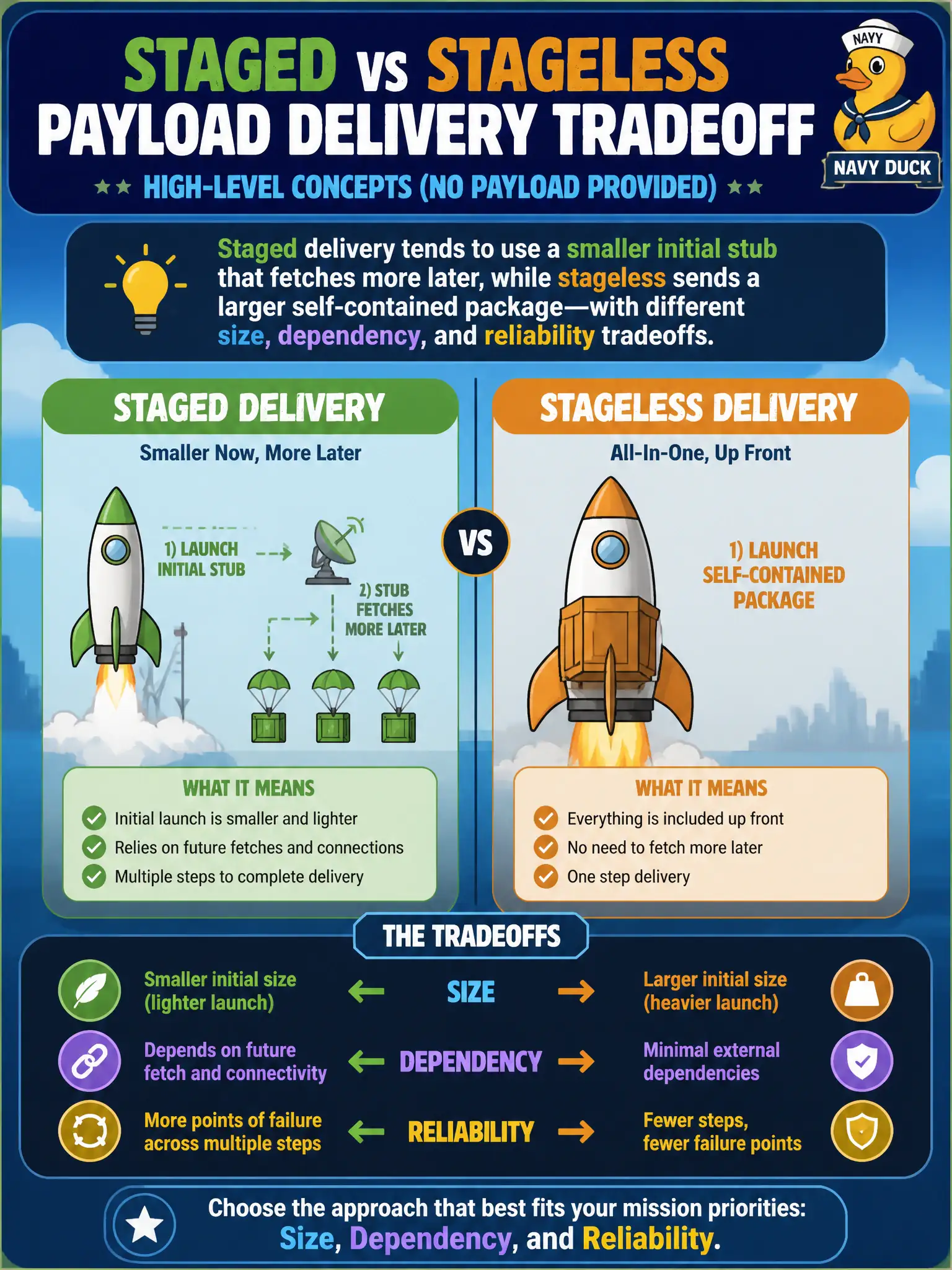
Staged is a trailer hitch that pulls the rest of the load afterward; stageless is one big suitcase up front. Same trip idea, different size and reliability tradeoffs—no recipe required.
Full Explanation
At a high level without providing a payload, staged delivery tends to use a smaller initial stub that fetches more later, while stageless sends a larger self-contained package—with different size, dependency, and reliability tradeoffs. Staged and stageless are not identical marketing synonyms. Stageless does not require installing a full desktop GUI on the target first. Legality is not split so that staged is only for Linux and stageless only for Windows. Exam caveat: municipal RoE, AV controls, and egress filters often influence which delivery class is feasible; discuss concepts, not evasion malware recipes. Operational check: choose a delivery class that fits host controls and authorized channels, document reliability and detection observations for the city, and avoid techniques explicitly forbidden by RoE. Document the rationale in the municipal engagement notes so later civic responders know which boundary was honored and which failure modes the rejected options would create for public services. Document the rationale in the municipal engagement notes so later civic responders know which boundary was honored and which failure modes the rejected options would create for public services.