
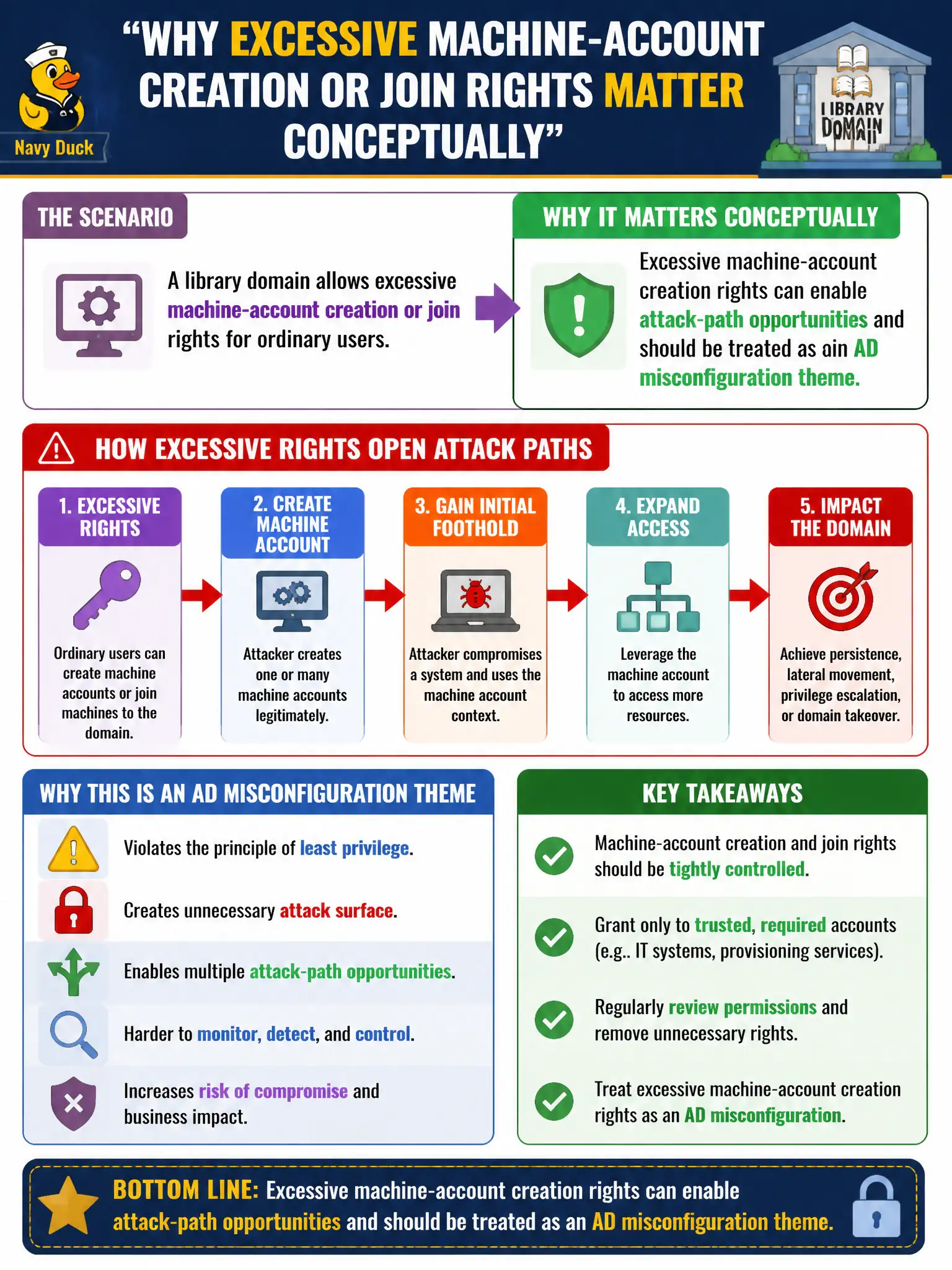
A library domain allows excessive machine-account creation or join rights for ordinary users. Why does that matter conceptually?
Select an answer to reveal the explanation.
Short Explanation
Letting everyone mint new computer accounts is like handing out unlimited building badges. Extra machine identities can become stepping stones. Cap those join rights unless there is a real business need.
Full Explanation
When a library domain allows excessive machine-account creation or join rights for ordinary users, that matters because excessive machine-account creation rights can enable attack-path opportunities and should be treated as an AD misconfiguration theme. Machine join rights are not limited to screensaver GPO effects. Unlimited computer joins do not inherently improve security via inventory visibility. Ordinary users can and do receive overly broad join rights in real deployments—the finding is not “impossible.” Exam caveat: discuss path-enablement conceptually without prescribing abuse steps. Operational check: review who can join computers to the domain, tighten to authorized provisioning groups, monitor anomalous machine account creation, and document residual risk until library IAM processes catch up. In municipal operations, record the rationale in the engagement notes so future testers and city defenders understand which approach was chosen and which failure modes the rejected options would create for civic services. Re-validate the same judgment after the next change window so the control still holds under the city’s current tooling, identity posture, and RoE amendments. Keep secret material and session artifacts in the approved vaulted workflow rather than chat paste or unprotected tickets used by mixed municipal teams.