
An FAA auditor reviewing Meridian Regional Airlines' predictive-maintenance program asks how the model determines which components are flagged for early inspection. The vendor supplying the model considers its exact feature-weighting scheme a trade secret and resists disclosing it in full. How should the AI project manager balance the auditor's request with the vendor's intellectual-property concerns?
Select an answer to reveal the explanation.
Short Explanation
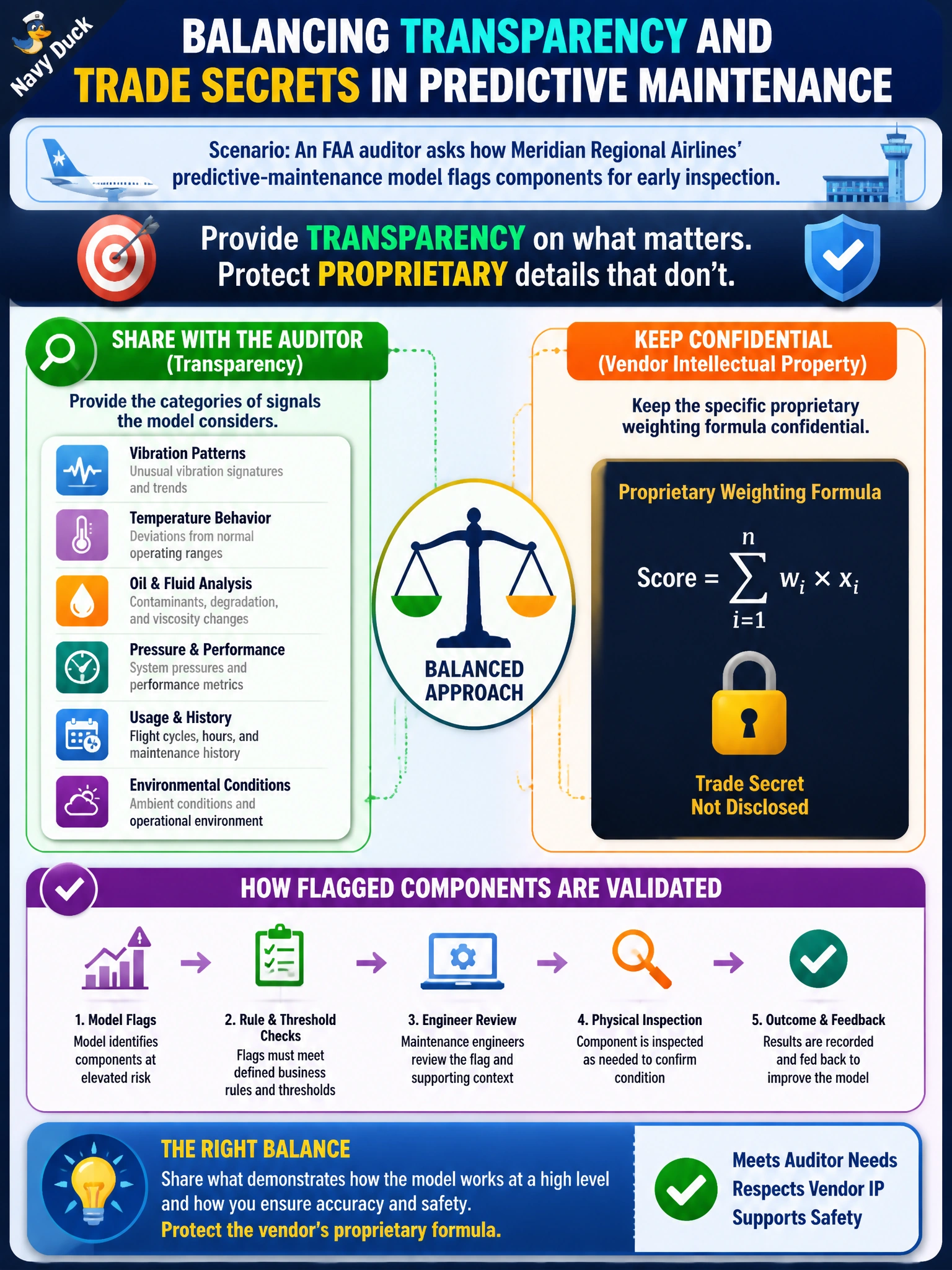
This is a genuine tug-of-war between two legitimate needs, and the answer is to give the regulator real substance — what signals matter, how flags get checked — without handing over the vendor's actual secret sauce. You can be transparent about the what without exposing the exact how.
Full Explanation
The correct answer strikes the balance CPMAI expects: giving the auditor meaningful transparency into the categories of signals the model considers and how a flagged component is validated before maintenance action, while the vendor's precise proprietary weighting formula stays confidential. Balancing transparency with intellectual property protection is a named Trustworthy AI task precisely because these two legitimate interests genuinely compete, and the resolution is rarely all-or-nothing. Refusing to explain anything fails the regulator's legitimate oversight need and would likely be unacceptable in a safety-critical, FAA-regulated context — 'it's proprietary' is not a complete answer to a safety regulator. Demanding the vendor publish its exact formula publicly overcorrects in the other direction, disregarding the vendor's legitimate IP interest and likely being unnecessary to satisfy the auditor's actual oversight question, which concerns safety assurance, not public disclosure. Terminating the vendor relationship treats a manageable tension as an irreconcilable conflict, discarding a working system and vendor partnership over a transparency question that a layered disclosure approach can resolve without severing the relationship at all. The layered approach — meaningful process transparency plus protected implementation detail — is the practical middle path a PM is expected to negotiate.