
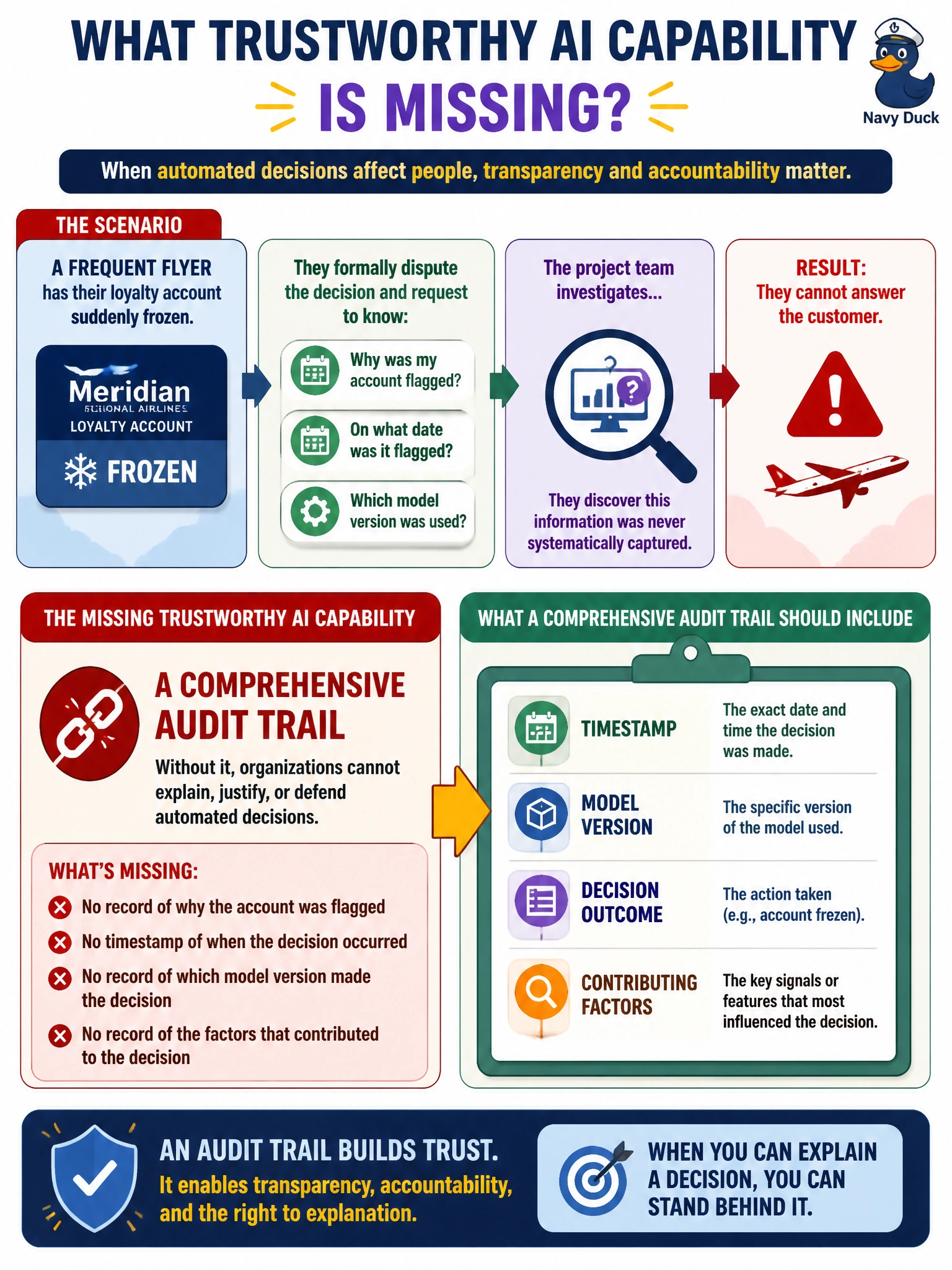
A frequent flyer whose loyalty account was frozen by Meridian Regional Airlines' fraud-detection model formally disputes the decision and requests to know exactly why the account was flagged, on what date, and by which model version. The project team discovers this information was never systematically captured. What Trustworthy AI capability is missing?
Select an answer to reveal the explanation.
Short Explanation
When someone disputes a decision and asks 'why, when, and by which version,' you need a paper trail, not a bigger dataset or a drift chart. That's what an audit trail is for — it's the receipt every automated decision should leave behind.
Full Explanation
The correct answer is the audit trail: creating comprehensive audit trails for accountability is a named Trustworthy AI task, and it is exactly what is missing here — a record of the model version, timestamp, and contributing factors behind each automated decision, so a disputed flag can be reconstructed and explained after the fact. Without that trail, the project cannot answer the passenger's specific questions or demonstrate the decision was made appropriately, which undermines accountability and dispute resolution alike. A model-drift dashboard tracks aggregate accuracy trends over time, which is a valuable production-monitoring tool but answers a different question — 'is the model still performing well overall' — not 'why was this one individual account flagged on this one date by this one model version,' which only a per-decision audit trail can answer; it is the closest-looking trap because both are production-monitoring concepts, but drift is about trend, not per-decision record-keeping. A prompt-engineering guide is unrelated; it concerns how staff phrase queries to a generative model, not how a classification decision from a fraud model is recorded for later review. A data augmentation pipeline addresses training-data volume and diversity, a Data for AI concern, and has no bearing on reconstructing why a specific historical decision was made.