
Meridian Regional Airlines' pilot union asks how the new crew-scheduling optimizer weighs seniority, duty-time limits, and disruption history when assembling a roster, since the union must sign off before the tool touches live schedules. The vendor's underlying optimization method is a proprietary constraint-solving algorithm the union does not need to understand. What is the appropriate transparency approach?
Select an answer to reveal the explanation.
Short Explanation
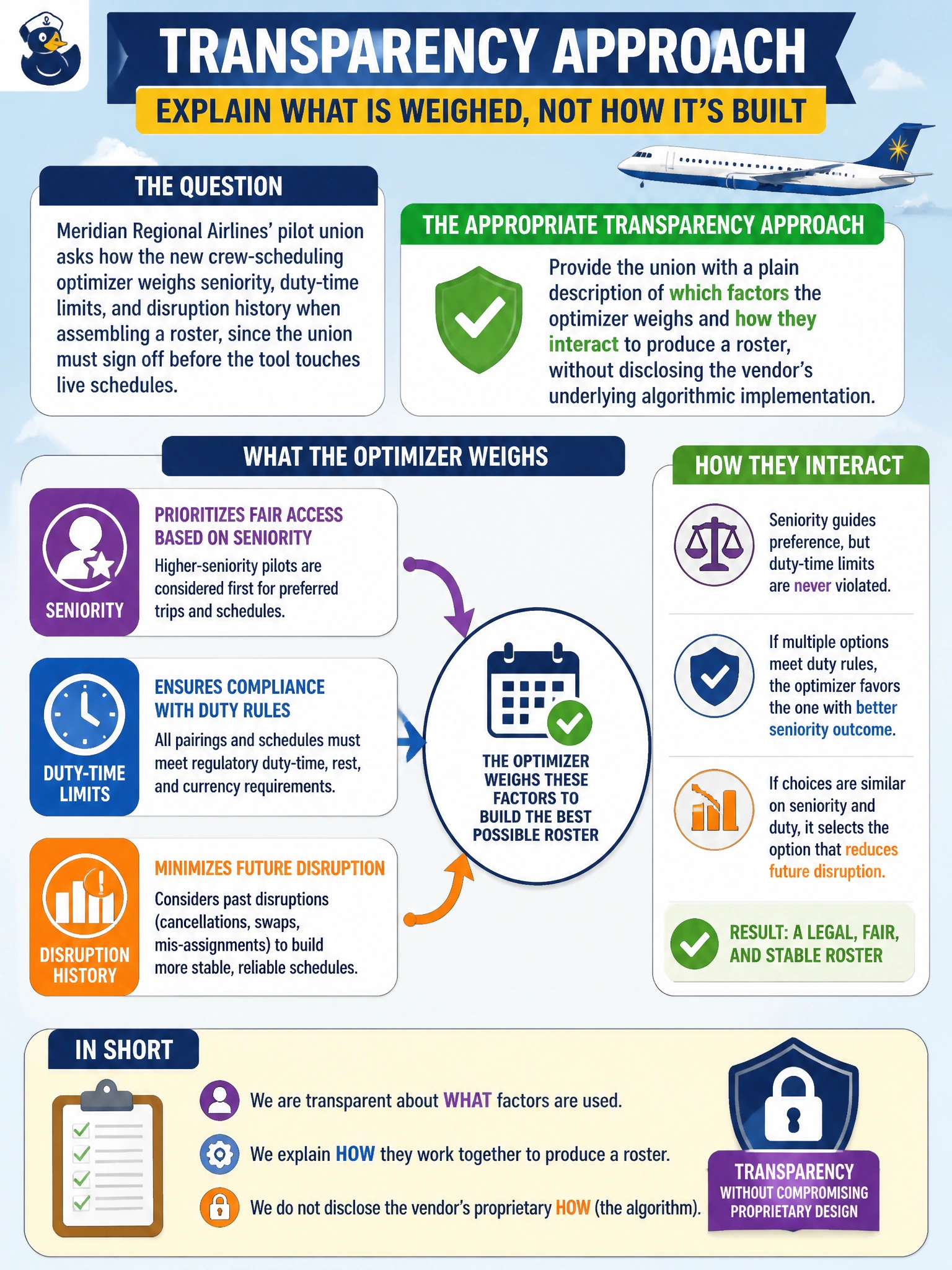
The union doesn't need the source code, they need to know what the machine cares about and how much — seniority, duty time, disruption history — explained in plain terms. That's the sweet spot: real transparency about decision factors, not a trade-secret dump and not a brush-off.
Full Explanation
The correct answer designs an appropriately transparent explanation: a plain-language account of which factors the optimizer weighs and how they interact to shape a roster, which gives the union genuine visibility into the decision logic without requiring disclosure of the vendor's proprietary implementation. Designing AI systems with appropriate transparency levels means matching the depth of disclosure to what the stakeholder actually needs to trust and consent to the system, not defaulting to either extreme. Refusing to discuss the algorithm at all fails the union's legitimate need to understand what factors govern their schedules before consenting to the tool touching live rosters, and stonewalling a stakeholder whose sign-off is required is a governance failure, not a confidentiality win. Handing over the full source code overshoots what is needed and unnecessarily surrenders the vendor's intellectual property; the union's concern is about factor weighting and fairness, not implementation detail, so full code disclosure solves a problem nobody has while creating a new one. A vague 'FAA compliant' answer is a non-answer that does not address what the union actually asked — which factors matter and how — and provides no real transparency at all. Postponing engagement until after the tool is live inverts the correct order entirely: the union's role in reviewing and signing off on a scheduling tool is a pre-deployment step precisely because of the collective-bargaining stakes involved.