
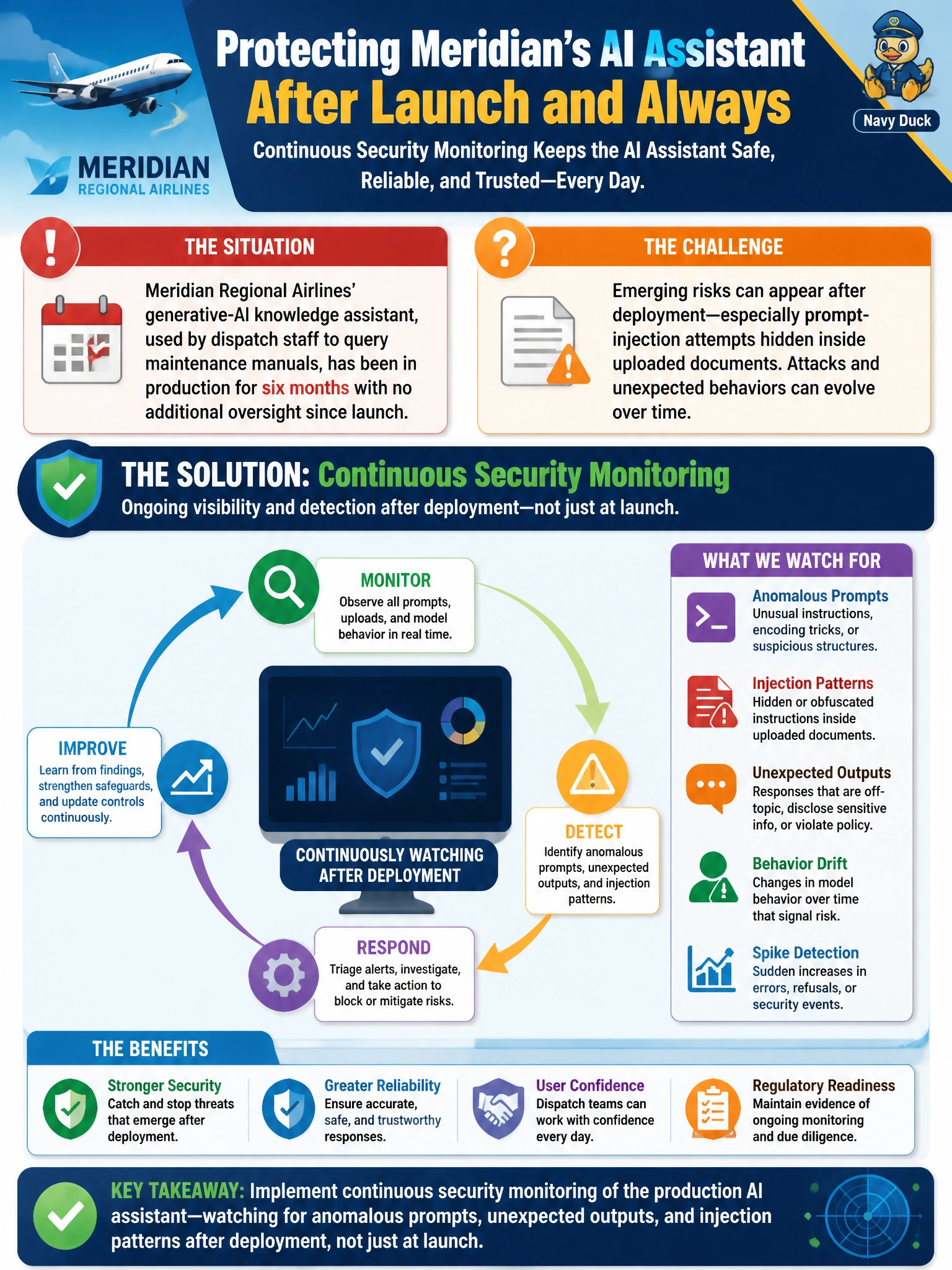
Meridian Regional Airlines' generative-AI knowledge assistant, used by dispatch staff to query maintenance manuals, has been in production for six months with no additional oversight since launch. The AI project manager wants to establish ongoing protection against emerging risks such as prompt-injection attempts hidden inside uploaded documents. What should be implemented?
Select an answer to reveal the explanation.
Short Explanation
Six months of silence isn't the same as six months of safety — threats evolve, and a security review from launch day is a snapshot, not a shield. The fix is ongoing monitoring that keeps watching after the ribbon-cutting, not a one-and-done check.
Full Explanation
The correct answer is to implement continuous security monitoring in production: watching for anomalous prompts, unexpected outputs, and injection-style patterns on an ongoing basis, because developing security monitoring for production AI systems is a distinct, named Trustworthy AI task separate from pre-launch review. Threats like prompt injection evolve after deployment, and a system with no oversight since launch has no way to detect a new attack technique that didn't exist, or wasn't anticipated, six months ago. A one-time pre-launch review is a trap precisely because it assumes risk is static; it addresses only the threats known at launch and provides no visibility into what is happening in production today. A disclaimer asking users to independently verify answers shifts the burden onto dispatch staff without actually detecting or stopping a manipulated response, and it does nothing to catch an injection attempt hidden inside an uploaded document before that document influences an answer. Restricting the assistant to read-only access is also a trap: 'read-only' limits what the system can write or change elsewhere, but it does not prevent a maliciously crafted document from manipulating the assistant's output when it is read and summarized — the injected instructions still reach the model and can still corrupt what dispatch staff are told, regardless of whether the assistant can write back to the manual itself.