
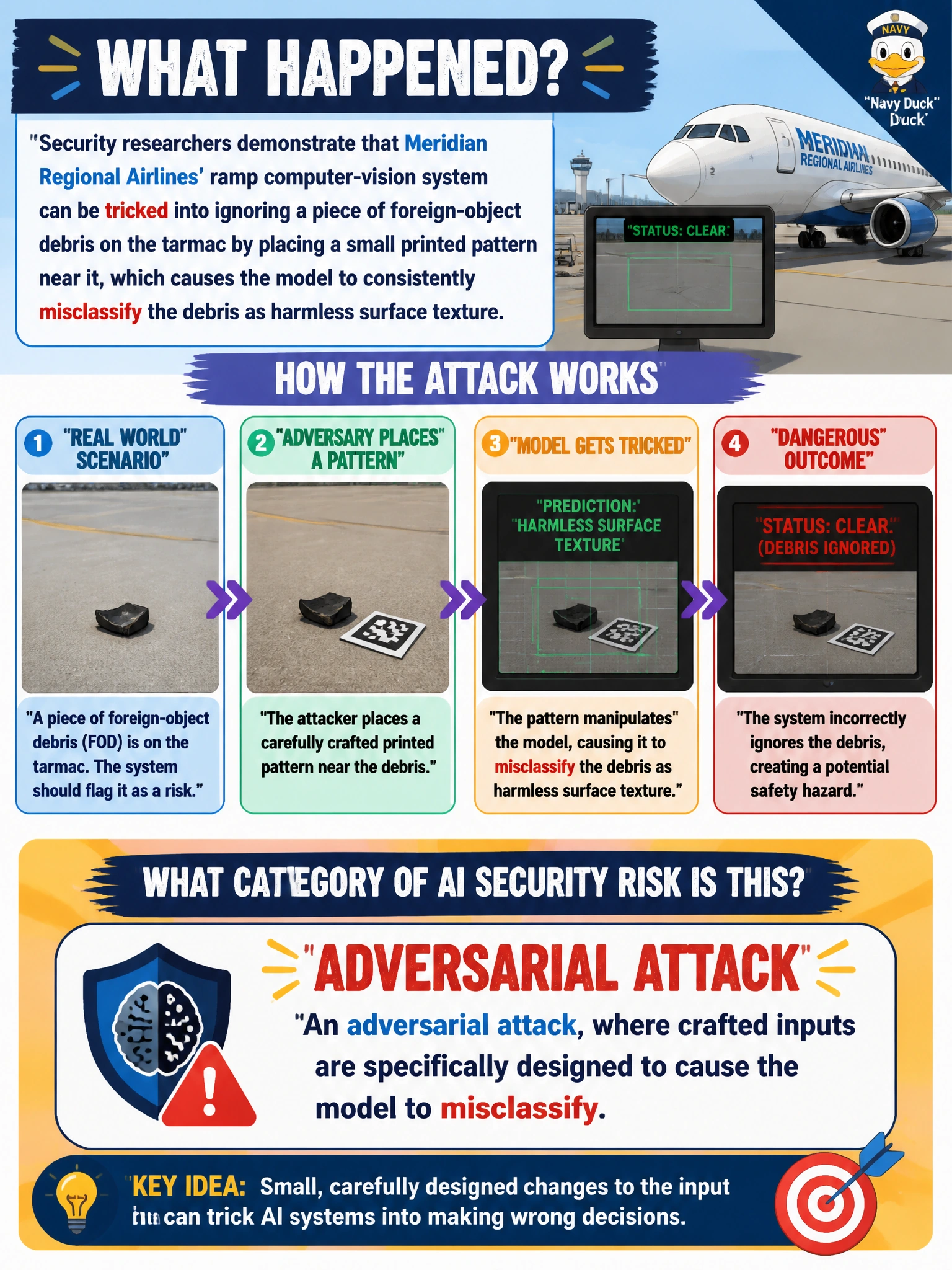
Security researchers demonstrate that Meridian Regional Airlines' ramp computer-vision system can be tricked into ignoring a piece of foreign-object debris on the tarmac by placing a small printed pattern near it, which causes the model to consistently misclassify the debris as harmless surface texture. What category of AI security risk does this demonstrate?
Select an answer to reveal the explanation.
Short Explanation
This isn't the model quietly getting worse over time or choking on new data — someone deliberately built a pattern to fool it, on purpose, and it worked exactly as they intended. That's the signature of an adversarial attack: a crafted input aimed straight at the model's blind spot.
Full Explanation
The correct answer is that this is an adversarial attack: a deliberately crafted input, the printed pattern, engineered specifically to exploit how the model represents 'harmless surface texture' so it consistently misclassifies debris it would otherwise catch. Defending against malicious and adversarial attacks is a named Trustworthy AI task, and this scenario is a textbook case — intentional manipulation of inputs to defeat a safety-relevant model, which is exactly the kind of AI-specific security threat traditional software security testing does not automatically cover. It is not a data privacy violation, because no personal data or consent obligation is implicated by a physical pattern placed near debris; privacy concerns individuals' data, not a model's classification behavior. It is not data drift, because drift describes a gradual, natural degradation in accuracy as the real-world distribution shifts over time from what the model was trained on, whereas this failure is immediate, reproducible, and deliberately engineered rather than a slow erosion of performance. It is not overfitting, because an overfit model fails broadly on real-world inputs it was never tuned to generalize to; here the model performs normally on ordinary debris and fails only against a specifically crafted trigger, which is the opposite signature. It is also not a GDPR issue, since GDPR governs personal data processing, and nothing about a physical adversarial pattern implicates a data-subject's personal information.