
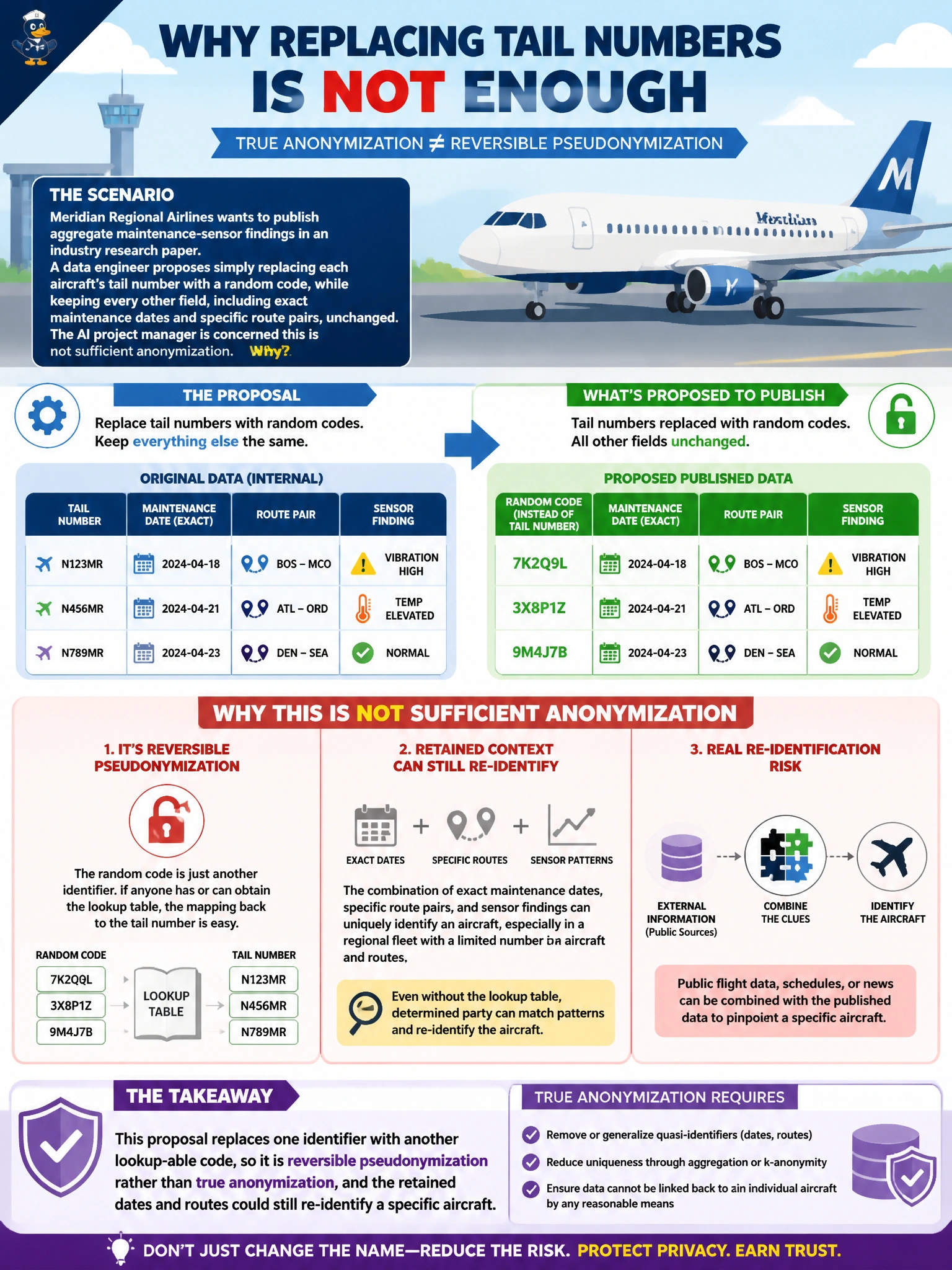
Meridian Regional Airlines wants to publish aggregate maintenance-sensor findings in an industry research paper. A data engineer proposes simply replacing each aircraft's tail number with a random code, while keeping every other field, including exact maintenance dates and specific route pairs, unchanged. The AI project manager is concerned this is not sufficient anonymization. Why is that concern valid?
Select an answer to reveal the explanation.
Short Explanation
Swapping a tail number for a random code doesn't erase the identity, it just hides it behind a lookup table somewhere — that's pseudonymization, not anonymization, and it's reversible if anyone gets that table. Worse, the leftover exact dates and routes are basically a fingerprint on their own.
Full Explanation
The correct answer captures both problems at once: replacing a tail number with a code that maps back to the original via a lookup table is pseudonymization, which is reversible and therefore weaker than true anonymization, and separately, the retained exact maintenance dates paired with specific route pairs form a distinctive combination that could still single out one particular aircraft even without its tail number — a classic re-identification risk from quasi-identifiers. The first distractor is simply wrong on the facts: removing one identifier while leaving highly specific, correlatable fields intact is a known-insufficient anonymization technique, not a sufficient one. The second distractor correctly names the quasi-identifier risk but stops short of naming the more fundamental issue that a reversible code lookup means the data was never truly anonymized to begin with — it understates the concern rather than misstating it, which makes it the closer but incomplete trap. The third distractor is a scope error: anonymization principles apply to any data where re-identification of a specific real-world entity (an aircraft, a route, potentially linkable to a person) creates risk, not only to passenger records. Effective data anonymization requires irreversibly removing or generalizing enough distinguishing detail that re-identification is not practically possible, which this proposal does not achieve.