
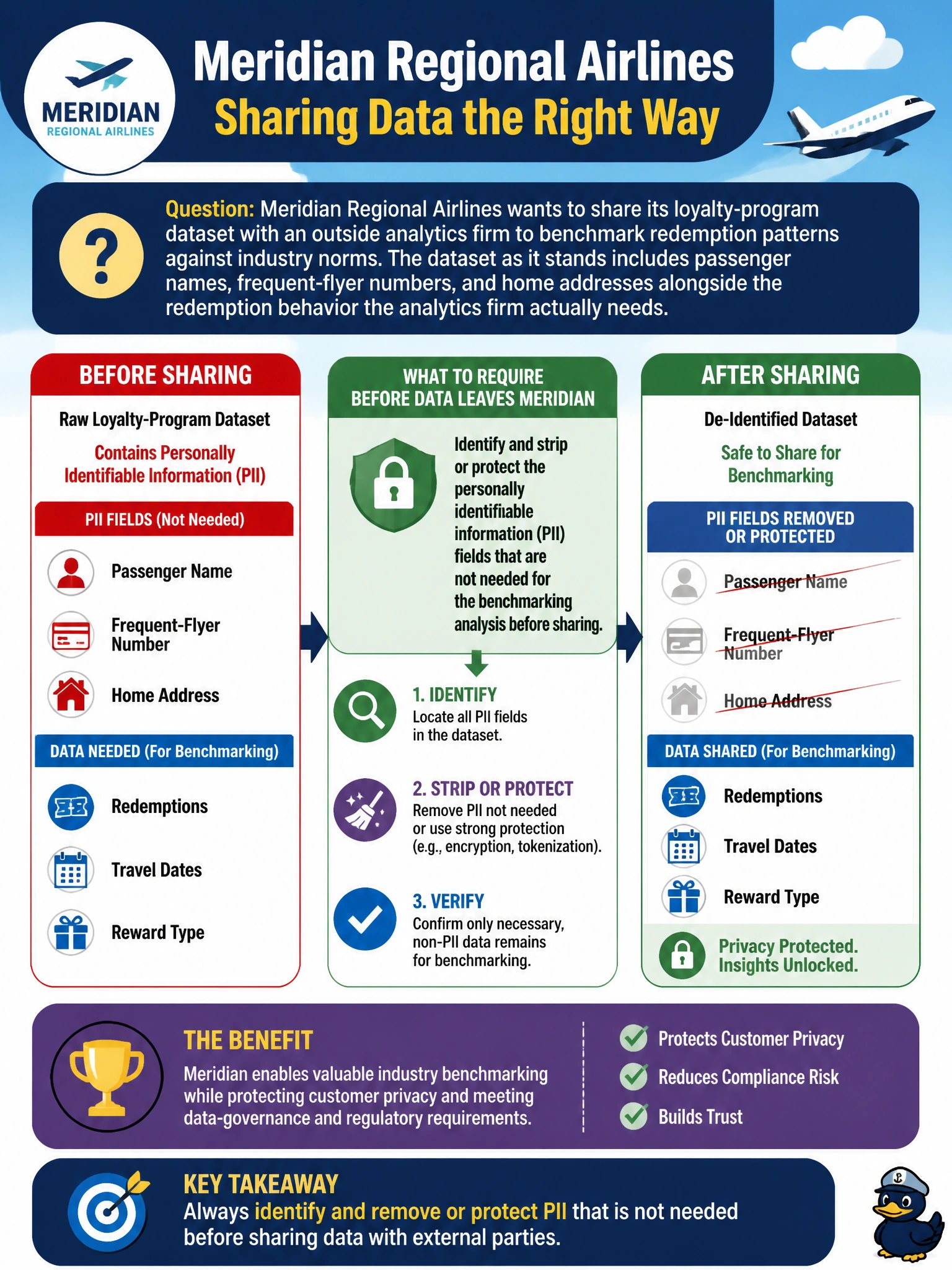
Meridian Regional Airlines wants to share its loyalty-program dataset with an outside analytics firm to benchmark redemption patterns against industry norms. The dataset as it stands includes passenger names, frequent-flyer numbers, and home addresses alongside the redemption behavior the analytics firm actually needs. What should the AI project manager require before the data leaves Meridian?
Select an answer to reveal the explanation.
Short Explanation
A confidentiality agreement is a promise about behavior, not a control on the data itself — if the file leaks, the PII leaks with it. The actual fix is to find every field that identifies a specific person, ask whether the analytics firm needs it, and strip or protect anything it doesn't.
Full Explanation
The correct answer is to identify and protect the personally identifiable information that isn't needed for the stated purpose — names, frequent-flyer numbers, addresses — before the data ever leaves Meridian, keeping only what the redemption-pattern benchmarking actually requires. Identifying and protecting PII is a named Trustworthy AI task, and it applies whenever data moves outside the organization's own controls, not just when a breach is suspected. Relying on a confidentiality agreement is a contractual safeguard, not a technical one; it governs what the vendor promises to do with the data, but does nothing to reduce the exposure if the data is mishandled, breached, or misused despite the agreement, and it does not satisfy the underlying obligation to minimize what identifiable data is shared in the first place. Removing only the passenger name while leaving the frequent-flyer number and home address intact is a partial and inadequate fix — a frequent-flyer number is itself a direct identifier tied to a specific account, and a home address alone can re-identify a person, so the dataset remains personally identifiable even without a printed name. Delaying the entire benchmarking initiative to let the vendor build an independent dataset abandons a legitimate, valuable analysis rather than solving the actual problem, which is a data-preparation step: strip or protect the unneeded PII fields and proceed.