
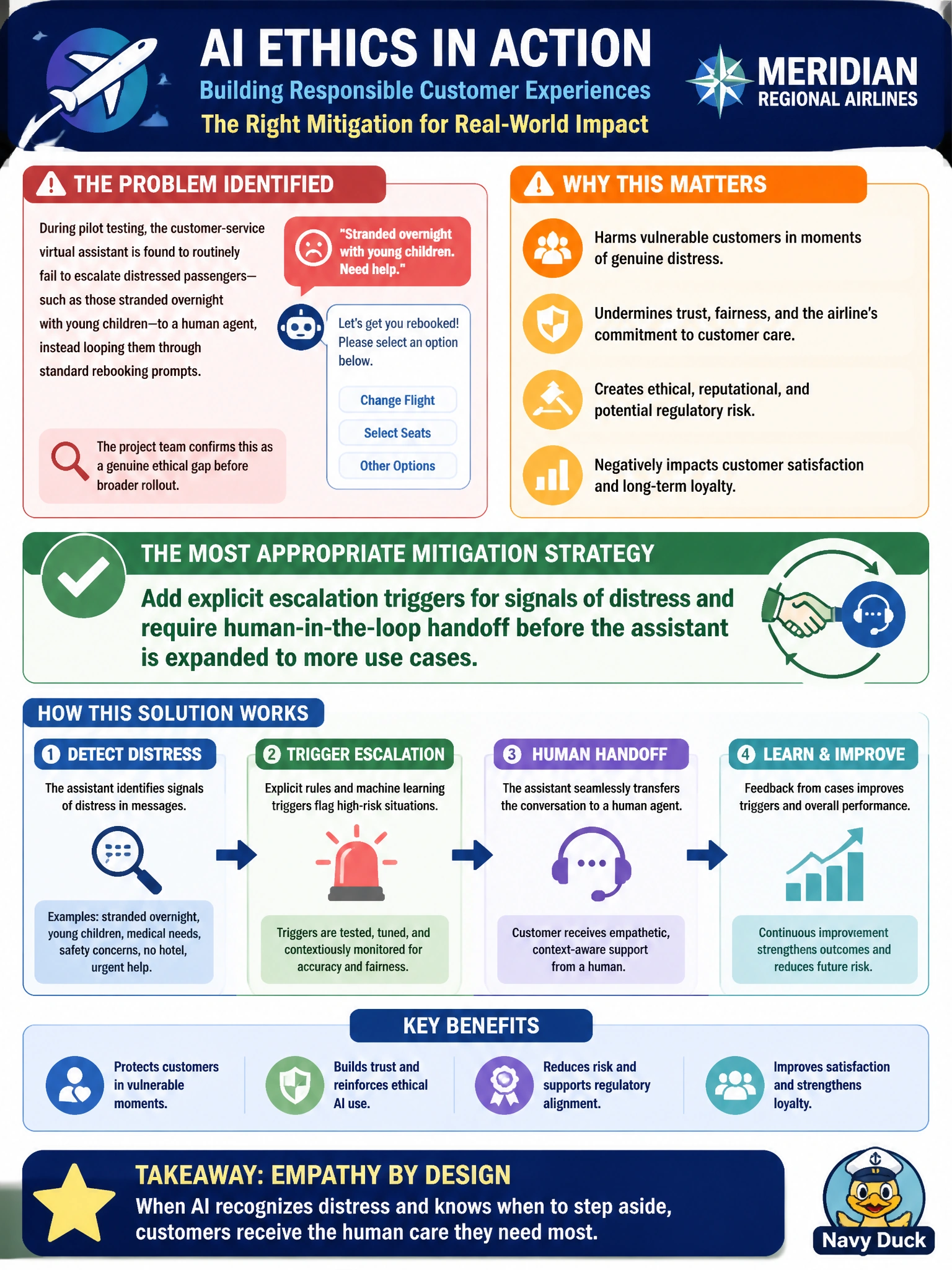
During pilot testing, Meridian Regional Airlines' customer-service virtual assistant is found to routinely fail to escalate distressed passengers, such as those stranded overnight with young children, to a human agent, instead looping them through standard rebooking prompts. The project team confirms this as a genuine ethical gap before broader rollout. What is the most appropriate mitigation strategy?
Select an answer to reveal the explanation.
Short Explanation
Finding the gap during the pilot is the whole point of piloting — now the job is to actually close it, not paper over it with a disclaimer or push it to the backlog. Add real escalation triggers and a human handoff before this thing touches more passengers.
Full Explanation
The correct answer implements a concrete mitigation strategy: adding explicit escalation triggers tied to distress signals and requiring human-in-the-loop handoff, then gating further rollout on that fix. This is the CPMAI expectation once an ethical gap is identified — mitigate it before scale increases exposure, not after. A disclaimer is not a mitigation; it transfers the risk to the passenger's awareness of a warning label instead of fixing the system's behavior, and it does nothing for a parent who never reads it while stranded overnight. Deferring the fix to a post-launch enhancement request treats a known harm to vulnerable customers as low priority, which contradicts the obligation to address unintended consequences before they compound at scale — every additional passenger who is not escalated is a real, avoidable failure, not a backlog item. Removing the rebooking feature entirely is an overcorrection that destroys the assistant's core value for the vast majority of passengers who are not in distress, when the actual defect is narrower: missing escalation logic for a specific signal, not the feature itself. The right-sized response fixes the specific failure mode without discarding the working parts of the system.