
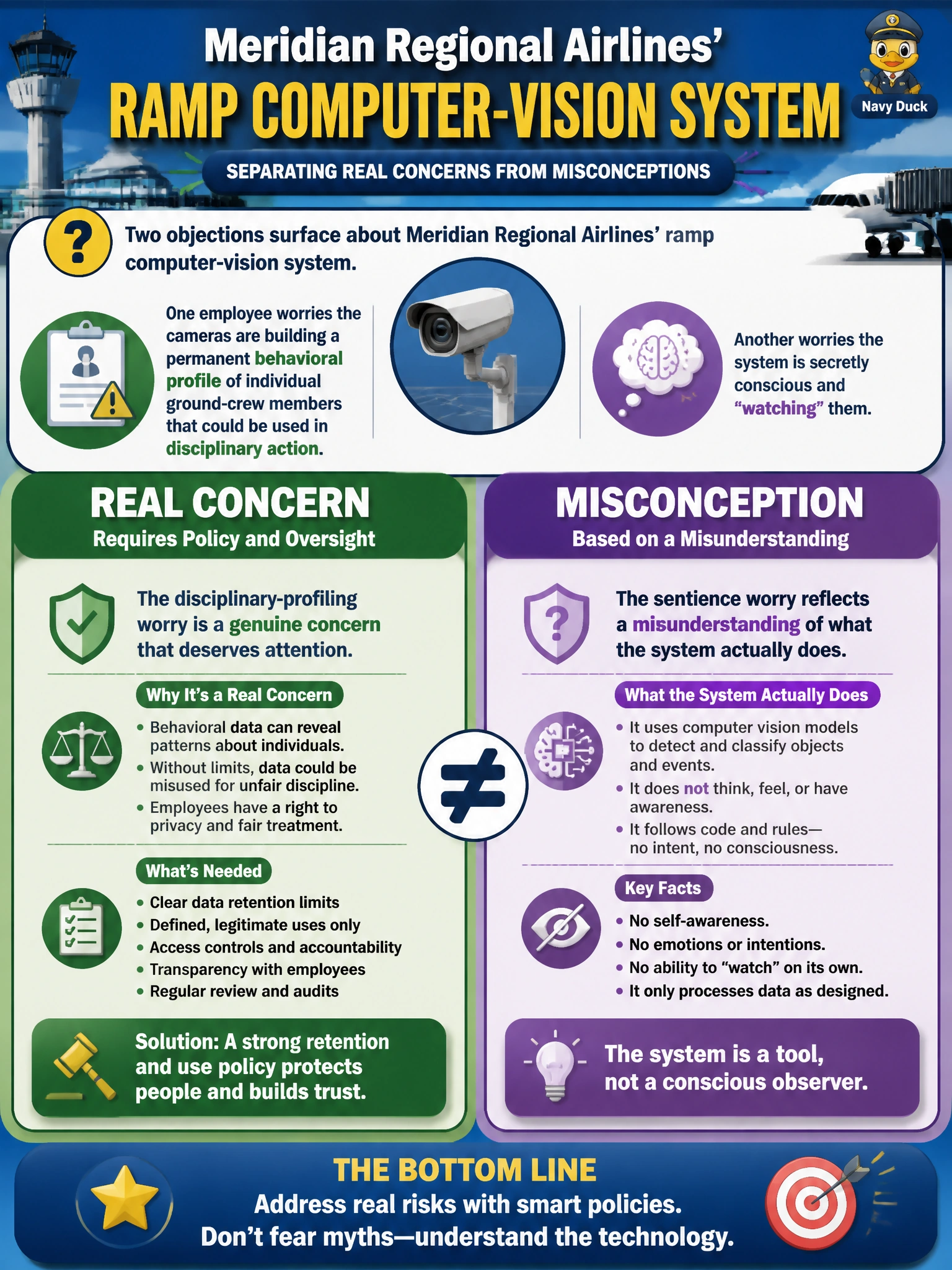
Two objections surface about Meridian Regional Airlines' ramp computer-vision system: one employee worries the cameras are building a permanent behavioral profile of individual ground-crew members that could be used in disciplinary action, and another worries the system is secretly conscious and 'watching' them. Which pairing correctly separates a real concern from a misconception?
Select an answer to reveal the explanation.
Short Explanation
One of these worries is about what the system technically can do (track and store data on a person), and the other is about what people imagine it can do (be aware). Same conversation, two very different fixes — a policy document for one, a plain explanation for the other.
Full Explanation
The correct answer treats the disciplinary-profiling worry as a real, evaluable concern — a computer-vision system genuinely can accumulate individual-level behavioral data over time, and without an explicit retention and use policy that data could plausibly be repurposed for discipline, which is a legitimate governance gap to close. The sentience worry, by contrast, reflects a misconception about what pattern-recognition computer vision actually is: a narrow AI system detecting predefined visual patterns, with no awareness, intent, or consciousness, and it should be corrected with a factual explanation rather than treated as a policy problem. The first distractor gets the sentience half right but wrongly dismisses the profiling concern as a misconception, when it is a legitimate data-governance risk. The second distractor incorrectly elevates the sentience worry to the same mitigation track as a real concern, which wastes governance effort on a non-issue and can undermine the team's credibility on the concerns that do matter. The third distractor inverts both halves — dismissing a real risk while proposing a governance fix for something that has no policy solution because it is not actually happening. Distinguishing real concerns from misconceptions, and responding to each appropriately, is itself a named Trustworthy AI task.