
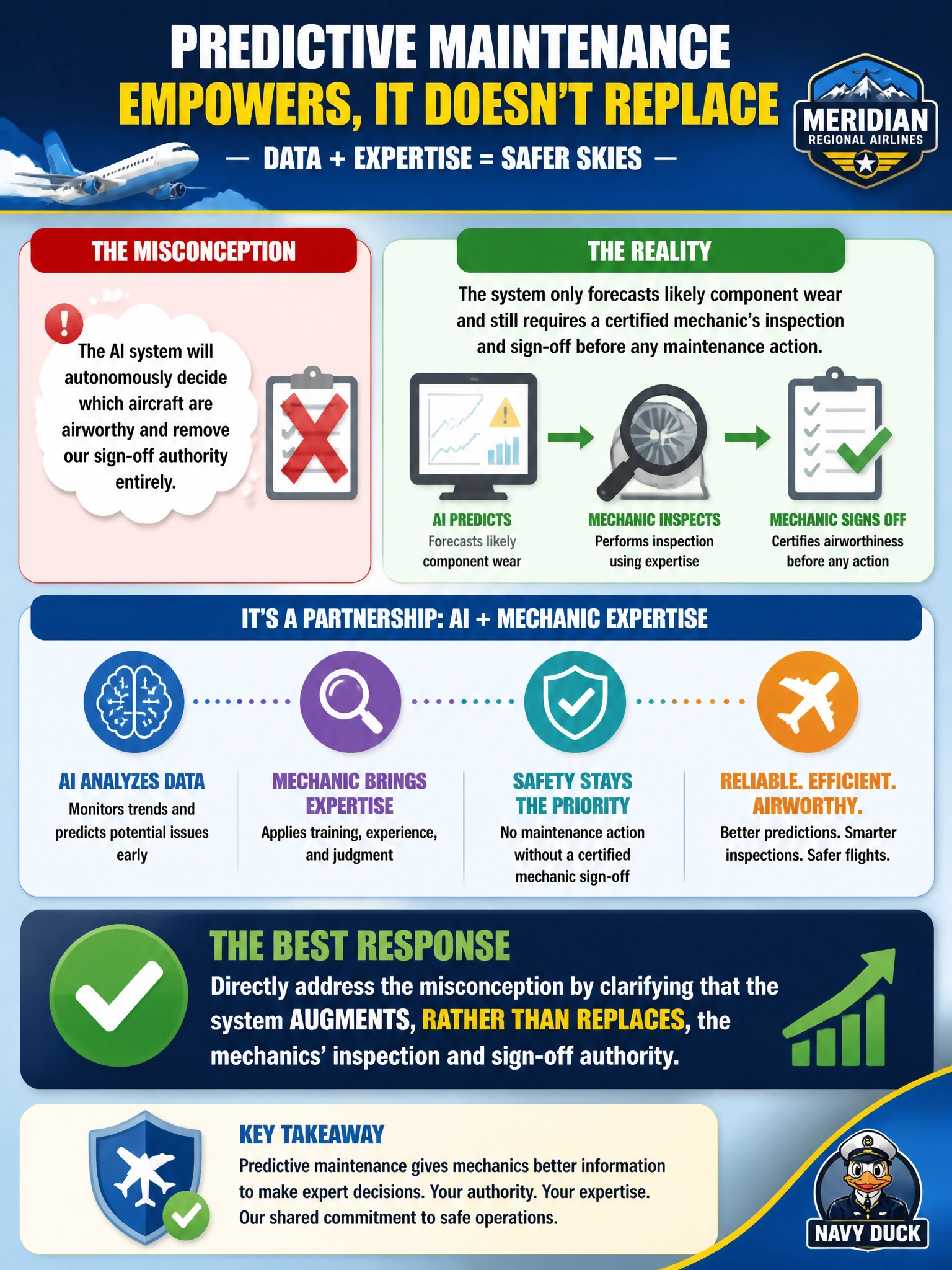
Mechanics at Meridian Regional Airlines are refusing to engage with a new predictive-maintenance rollout because they believe the AI system will autonomously decide which aircraft are airworthy and remove them from their sign-off authority entirely. The project manager knows the system only forecasts likely component wear and still requires a certified mechanic's inspection and sign-off before any maintenance action. What is the best response?
Select an answer to reveal the explanation.
Short Explanation
This is the classic 'AI is coming for my job' fear, and the fix isn't to argue it away — it's to name it plainly and show the receipts: the mechanic still signs the paperwork, the AI just gives them a heads-up. Debunking a myth means replacing it with the actual mechanism, not just saying 'don't worry.'
Full Explanation
The correct answer addresses common fears and misconceptions about AI directly, by explaining the actual mechanism: the system forecasts wear as a decision-support input, while airworthiness sign-off authority remains entirely with the certified mechanic. This is augmented intelligence in practice — AI extends human judgment rather than replacing it — and correcting the misconception with a concrete, specific explanation is exactly the CPMAI-expected response to unfounded fear. Ignoring the concern is wrong because unaddressed fear among the workforce actually operating the system predicts poor adoption regardless of the technology's merits; stakeholder trust is a project risk, not a soft-skills afterthought. Shrinking the system's scope to avoid components mechanics inspect solves the wrong problem — it treats a communication gap as a technical scoping issue and would gut the system's usefulness without resolving the underlying misunderstanding. Escalating to the FAA for a ruling on 'authority' status misapplies a real regulatory process to a fear that has no regulatory basis, since the system was never designed to hold sign-off authority in the first place. A generic 'don't worry' reassurance without explanation fails for the same reason silence fails: it doesn't replace the myth with the actual facts, so the misconception persists under the surface.