
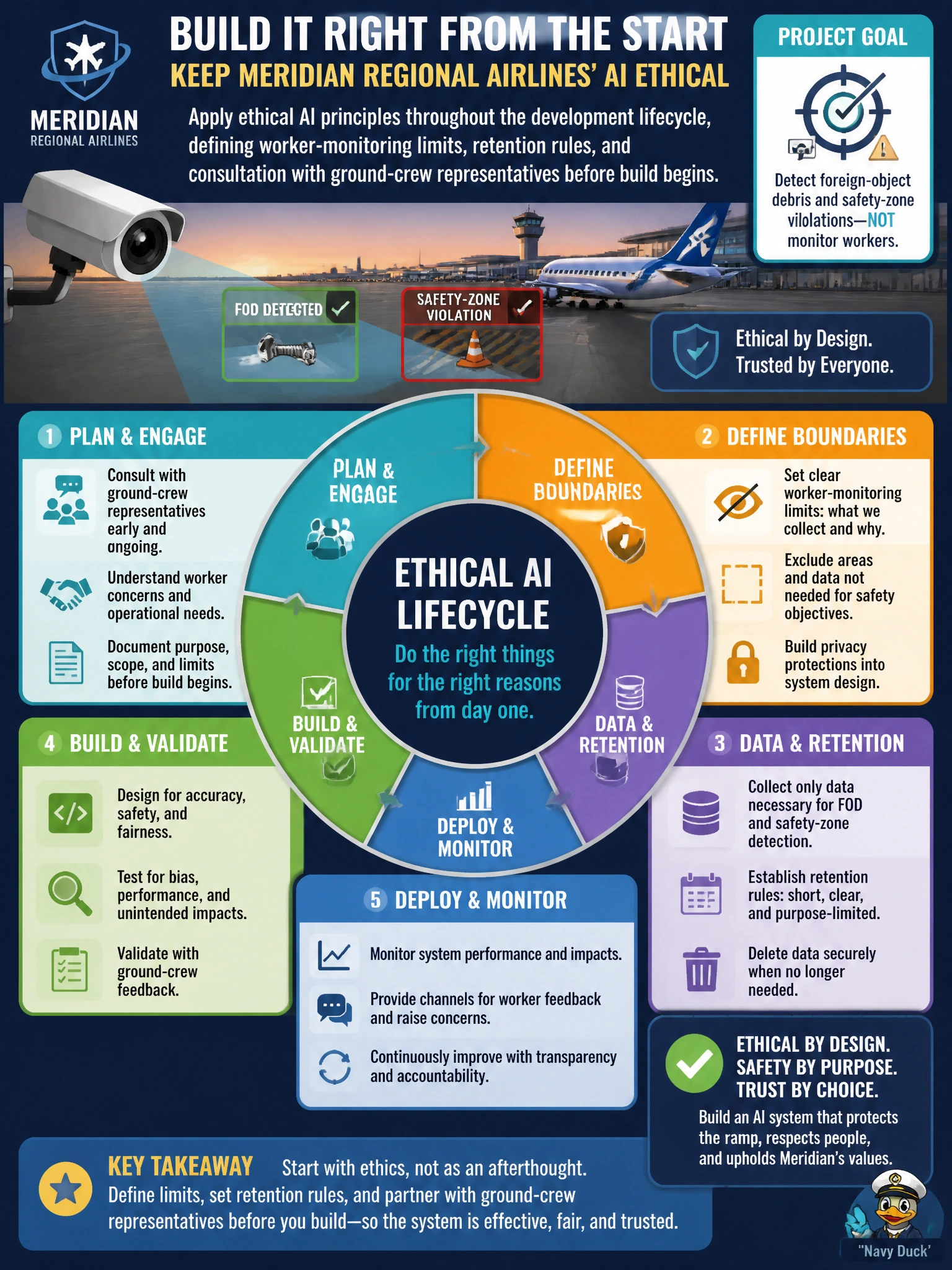
Meridian Regional Airlines is planning a computer-vision system that watches ramp areas for foreign-object debris and safety-zone violations, but the same camera feeds also capture ground-crew members constantly throughout their shift. The project sponsor asks how to keep the initiative ethically sound rather than addressing it only after complaints arise. What should the AI project manager do?
Select an answer to reveal the explanation.
Short Explanation
Ethics isn't a bolt-on you add after someone complains — it's a design input, same as requirements or a budget. The trick here is noticing the camera system has two purposes stacked on top of each other, and the PM has to plan for both from day one, not just the one that sounds good in the pitch deck.
Full Explanation
The correct answer applies ethical AI concepts throughout the development lifecycle — deciding upfront what worker data the system captures, how long it is retained, who can access it, and consulting affected ground-crew representatives before the system is built, not after. This is the CPMAI expectation that responsible AI is designed in from Business Understanding onward, not patched on post-launch. Waiting for complaints treats ethics as a reactive PR function rather than a project deliverable, and by the time complaints surface, trust and possibly union relations are already damaged. Delaying indefinitely for a court ruling is an overcorrection — it treats every ethical question as a legal one requiring a settled precedent, when many ethical risks (retention limits, consultation, transparency about purpose) can be resolved through project governance without waiting on litigation, and CPMAI explicitly frames these as project-management obligations, not legal advice. Proceeding unchanged because the 'primary purpose' is safety ignores that a system can serve its stated purpose and still create an unaddressed secondary risk — incidental worker surveillance — that a responsible AI framework is specifically meant to catch before it becomes a real concern rather than a hypothetical one.