
Meridian's PM is evaluating cloud-based machine learning services to host the cargo and passenger demand-forecasting model. Several vendor offerings are available. What is the most appropriate basis for selecting among them?
Select an answer to reveal the explanation.
Short Explanation
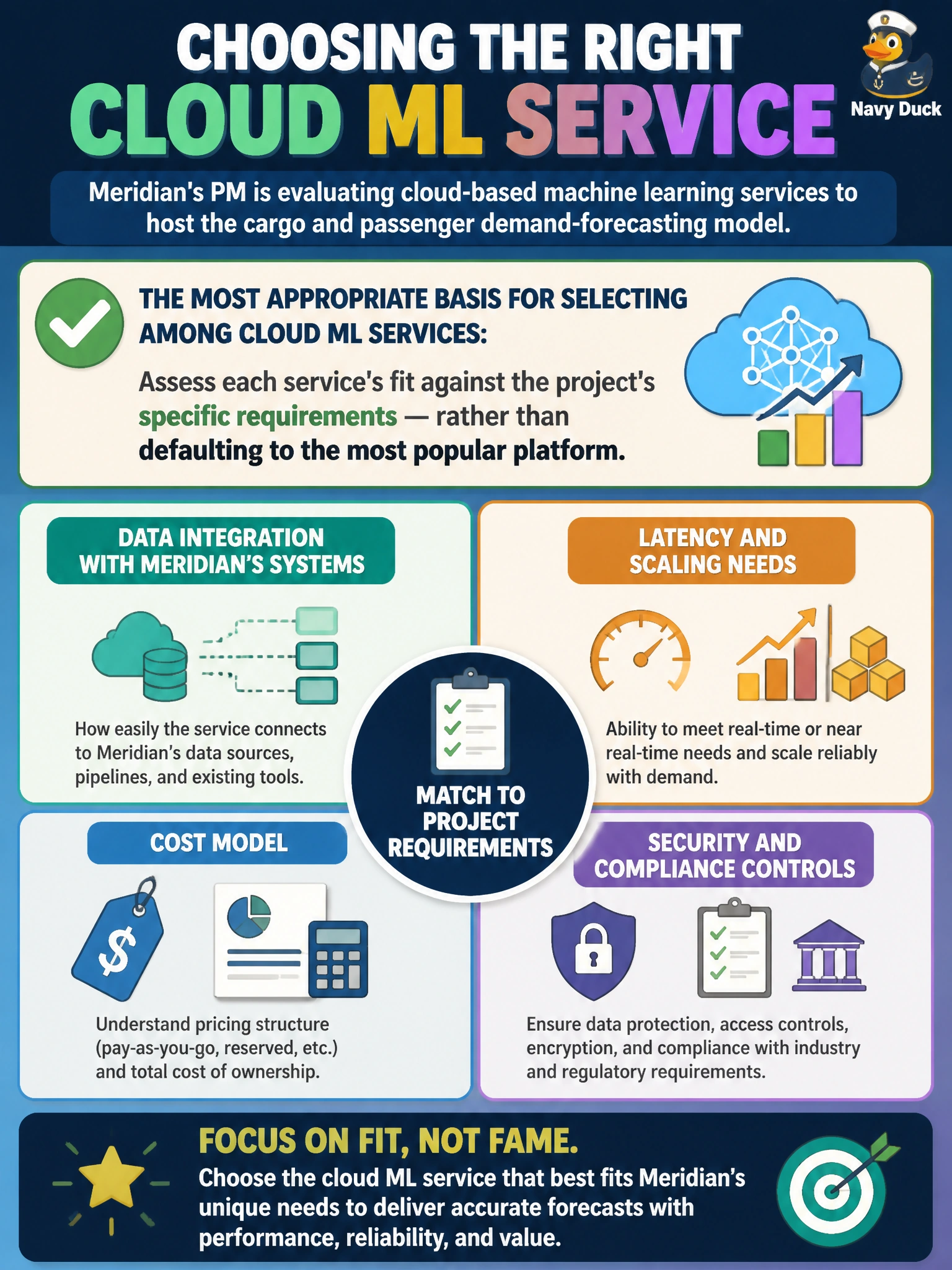
Picking a cloud ML service isn't about brand recognition or who pitched hardest — it's matching the tool to the job: does it plug into what Meridian already runs, is it fast enough, does the bill make sense, and does it meet the compliance bar. Popularity isn't on that checklist.
Full Explanation
CPMAI's guidance on selecting appropriate cloud-based machine learning services calls for evaluating platform capabilities against actual project requirements, not defaulting to a single criterion. For Meridian's demand-forecasting model, that means checking how well a service integrates with existing route, pricing and cargo-capacity systems, whether its latency and scaling characteristics fit forecasting cadence, what its cost model looks like at Meridian's data volume, and whether it satisfies the airline's security and regulatory obligations, including data protection considerations tied to European codeshare routes. Deferring to whichever vendor pitches hardest substitutes sales persuasion for requirements-based evaluation, which is exactly the vendor-hype risk CPMAI explicitly warns PMs to avoid. Choosing the newest service regardless of fit prioritizes novelty over suitability and risks adopting immature tooling for a business-critical forecasting function. Choosing purely on lowest price without checking functional or performance fit risks selecting a service that cannot actually meet the project's technical or compliance requirements, creating costly rework later.