
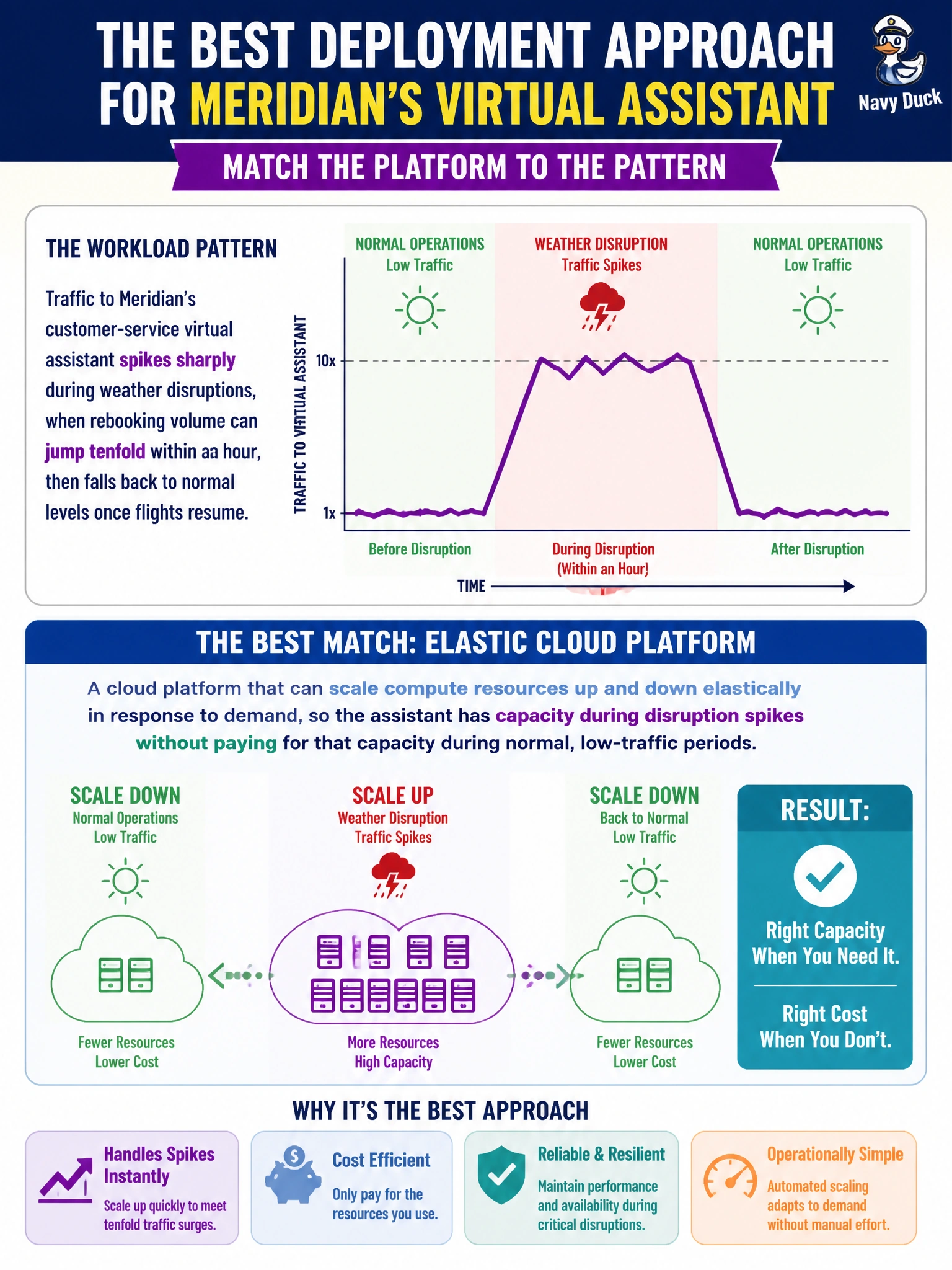
Traffic to Meridian's customer-service virtual assistant spikes sharply during weather disruptions, when rebooking volume can jump tenfold within an hour, then falls back to normal levels once flights resume. What deployment approach best matches this workload pattern?
Select an answer to reveal the explanation.
Short Explanation
A workload that's calm most days and a firehose during a snowstorm is exactly what cloud elasticity was built for — you don't buy a fleet of snowplows and park them all summer, you rent the extra capacity for the storm and give it back after.
Full Explanation
CPMAI names leveraging cloud platforms for scalable AI deployment as a distinct capability precisely for workloads like this one: demand that is highly variable and unpredictable in timing, driven here by weather disruption. Elastic cloud infrastructure lets Meridian's virtual assistant automatically provision additional compute during a tenfold rebooking spike and release it once volume normalizes, matching cost to actual demand rather than either under-provisioning (causing outages during the exact moments customers need the assistant most) or over-provisioning permanently. A fixed on-premise server sized for average traffic will be overwhelmed during the disruption spikes that matter most operationally — the scenario where the assistant is needed the most is where a static sizing choice fails hardest. Ignoring infrastructure planning entirely dismisses a real deployment-strategy decision the outline explicitly calls out. Permanently running at absolute peak capacity solves the spike problem but wastes resources every normal day, which is the opposite trade-off elastic cloud scaling is designed to avoid.