
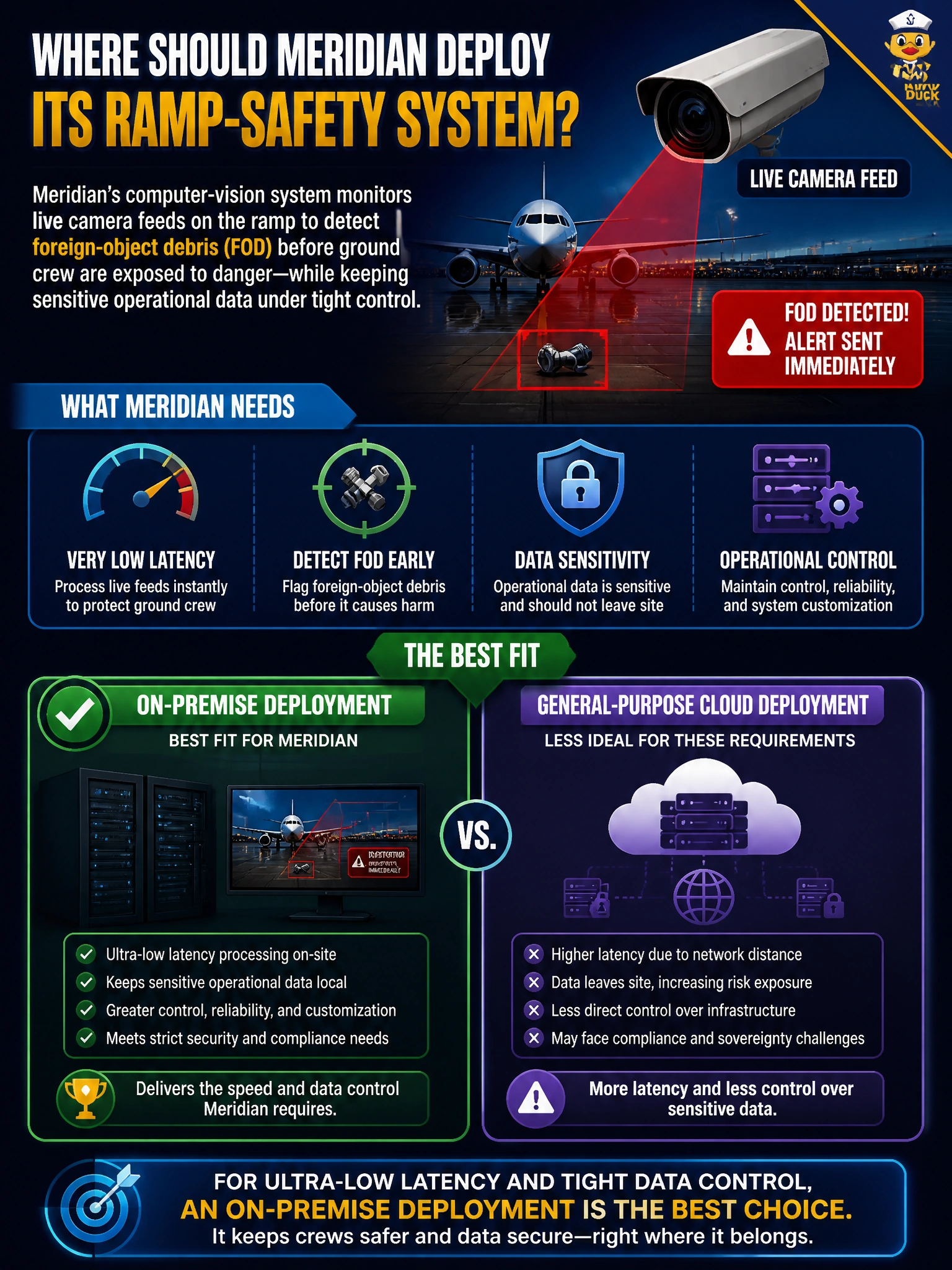
Meridian is deciding where to deploy its computer-vision ramp-safety monitoring system, which must process live camera feeds with minimal delay to flag foreign-object debris before ground crew are exposed to danger, and which touches operational data Meridian is reluctant to send off-site. What deployment approach best fits these requirements?
Select an answer to reveal the explanation.
Short Explanation
When milliseconds matter and you don't want ramp-camera data leaving the building, on-prem is the airline putting the server in its own closet instead of shipping the video around the internet and hoping the round trip is fast enough.
Full Explanation
CPMAI explicitly frames on-premise deployment as the fit for sensitive-data or high-performance latency needs, and this scenario has both: safety-critical, real-time debris detection where network round-trip delay to a distant cloud region could mean the difference between an alert arriving in time or too late, plus operational camera-feed data the airline prefers to keep in its own environment rather than routing externally. On-premise infrastructure, sited close to the ramp cameras, minimizes network hops and gives Meridian direct control over where the data lives. Choosing a distant public cloud region purely on cost ignores the latency requirement entirely and could introduce exactly the delay a safety-critical system cannot tolerate. Assuming deployment location doesn't matter contradicts a core Managing AI concept — where a model runs materially affects latency, data control, and reliability, which is why deployment strategy is its own evaluated task. A generic serverless, pay-per-invocation setup optimizes for cost and elastic scaling, not for the deterministic low latency this safety use case demands, and ignoring latency when choosing it is a planning failure.