
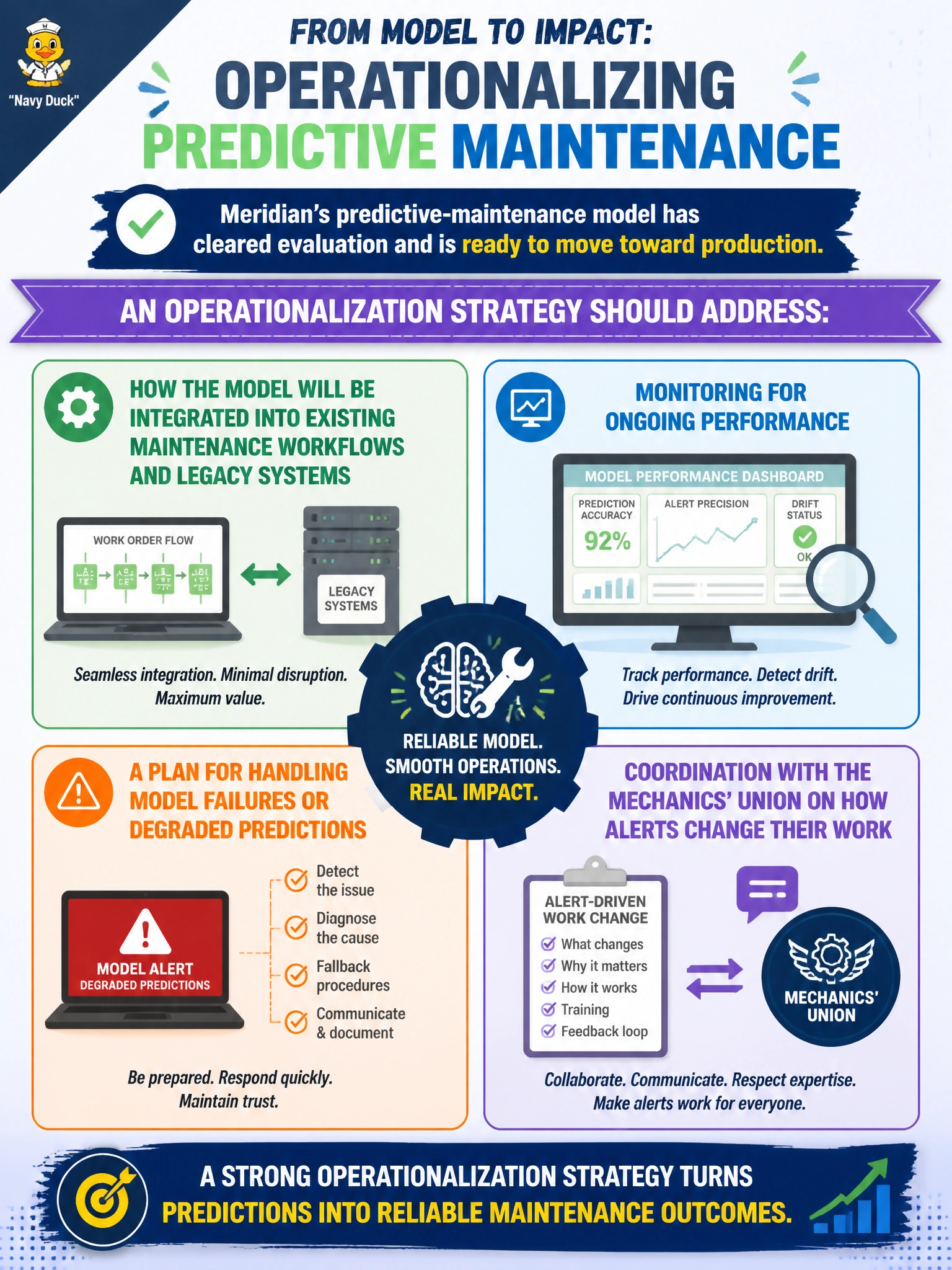
Meridian's predictive-maintenance model has cleared evaluation and is ready to move toward production. The PM is developing an operationalization strategy. Which set of concerns most appropriately belongs in that strategy?
Select an answer to reveal the explanation.
Short Explanation
Getting a model into production is the easy part on paper — the real strategy is everything around it: does it talk to the old systems, who watches it once it's live, what happens when it's wrong, and did the people whose job changes get a say. Skip any of those and 'deployed' doesn't mean 'working'.
Full Explanation
An operationalization strategy, per CPMAI's Deploying Models for Production Environments task, extends well beyond the accuracy number that cleared evaluation. It must address integration with existing (often legacy) maintenance systems so predictions actually reach the people scheduling work, ongoing production monitoring to catch degradation or drift after launch, a defined fallback or escalation plan when the model produces low-confidence or clearly wrong predictions, and — given Meridian's regulated, unionized workforce — consultation with the mechanics' union on how maintenance alerts change day-to-day work and sign-off responsibilities. Reducing readiness to the accuracy score alone ignores everything about how the model will actually function inside operations, which is the whole point of operationalization planning as distinct from model evaluation. Re-running full training on every deployment conflates deployment with retraining and would be operationally wasteful and unnecessary for routine releases. Treating deployment as a one-time event with no update plan contradicts CPMAI's explicit call for procedures covering model updates and version control as part of managing AI in production.