
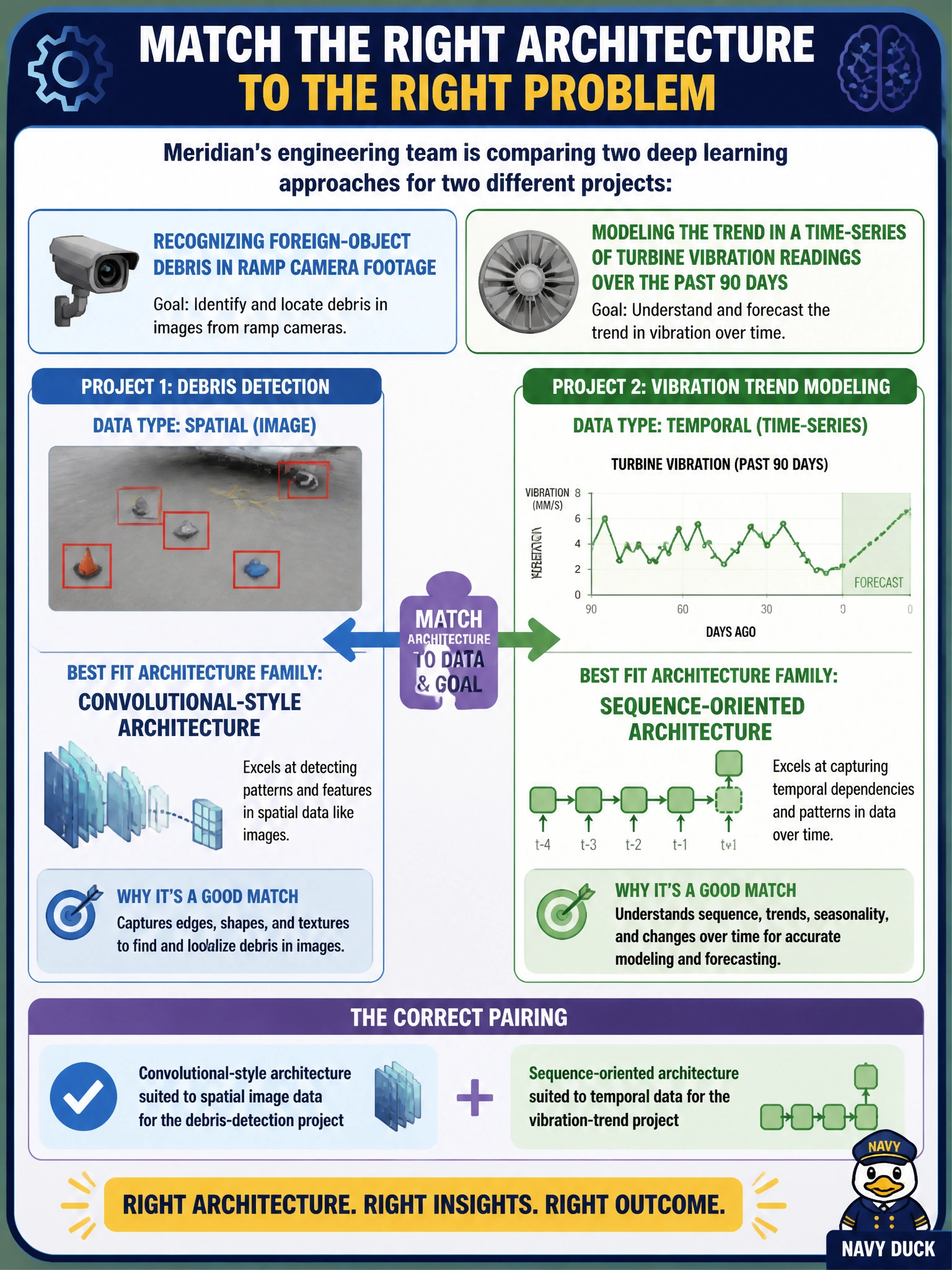
Meridian's engineering team is comparing two deep learning approaches for two different projects: recognizing foreign-object debris in ramp camera footage, and modeling the trend in a time-series of turbine vibration readings over the past 90 days. Which pairing correctly matches architecture family to problem for a PM sizing the two efforts?
Select an answer to reveal the explanation.
Short Explanation
Small dataset plus giant fancy model is a classic overfitting trap — like memorizing the answer key for one test instead of learning the subject.
Full Explanation
Convolutional-style architectures are designed to exploit spatial structure (nearby pixels relating to each other), which fits debris detection in camera footage, while sequence-oriented architectures are designed to capture temporal order and trend, which fits the 90-day vibration time series — matching architecture family to data structure is a real PM-level judgment that affects staffing and timeline estimates for each project. Using a convolutional architecture for both is wrong because it ignores that the vibration data's meaning comes from its order over time, not spatial adjacency — a convolutional network is not naturally suited to that structure. Using a sequence-oriented architecture for both is wrong for the mirror-image reason: individual camera frames are fundamentally spatial, and treating frames as an arbitrary sequence discards the spatial relationships that matter for detecting debris in a single image. Claiming neither needs deep learning and simple ensembles suffice is an unsupported blanket claim — the PM's job is to evaluate what the data and business requirement call for, not default to the simplest option regardless of fit.