
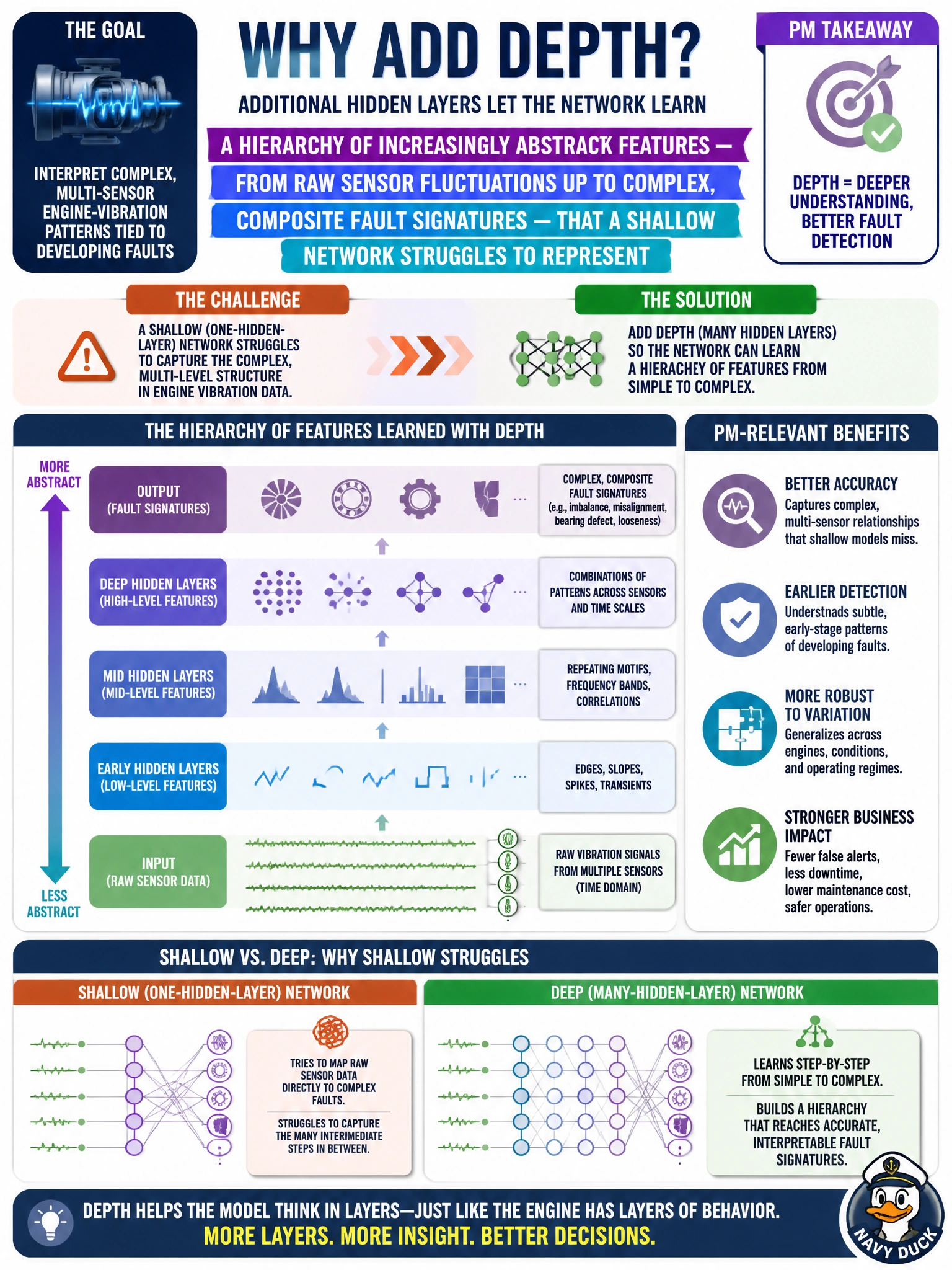
Meridian's dispatch team is asking the data science team to move beyond a shallow one-hidden-layer network to a deep architecture with many hidden layers for interpreting complex, multi-sensor engine-vibration patterns tied to developing faults. What is the PM-relevant justification for adding depth?
Select an answer to reveal the explanation.
Short Explanation
Depth just means the network builds understanding in layers, like stacking Lego bricks into something recognizable instead of one flat piece.
Full Explanation
Depth (multiple hidden layers) allows a deep learning model to build up hierarchical feature representations — early layers might capture simple fluctuations, later layers combine those into higher-order patterns that correspond to actual fault signatures — which is exactly the kind of composite pattern engine-vibration fault detection requires and a shallow network may not capture well. Claiming depth is added to make the model deliberately slower and more expensive is wrong and reflects vendor hype rather than sound justification — a PM should push back on any recommendation whose stated benefit is cost or complexity itself. Claiming depth guarantees no overfitting is wrong and backward — deeper models with more parameters are generally more prone to overfitting without enough data and proper regularization, which is a real project risk to plan for. Claiming depth removes the need for labeled data is wrong — the scenario describes a supervised fault-detection task that still requires labeled examples of past faults regardless of network depth.