
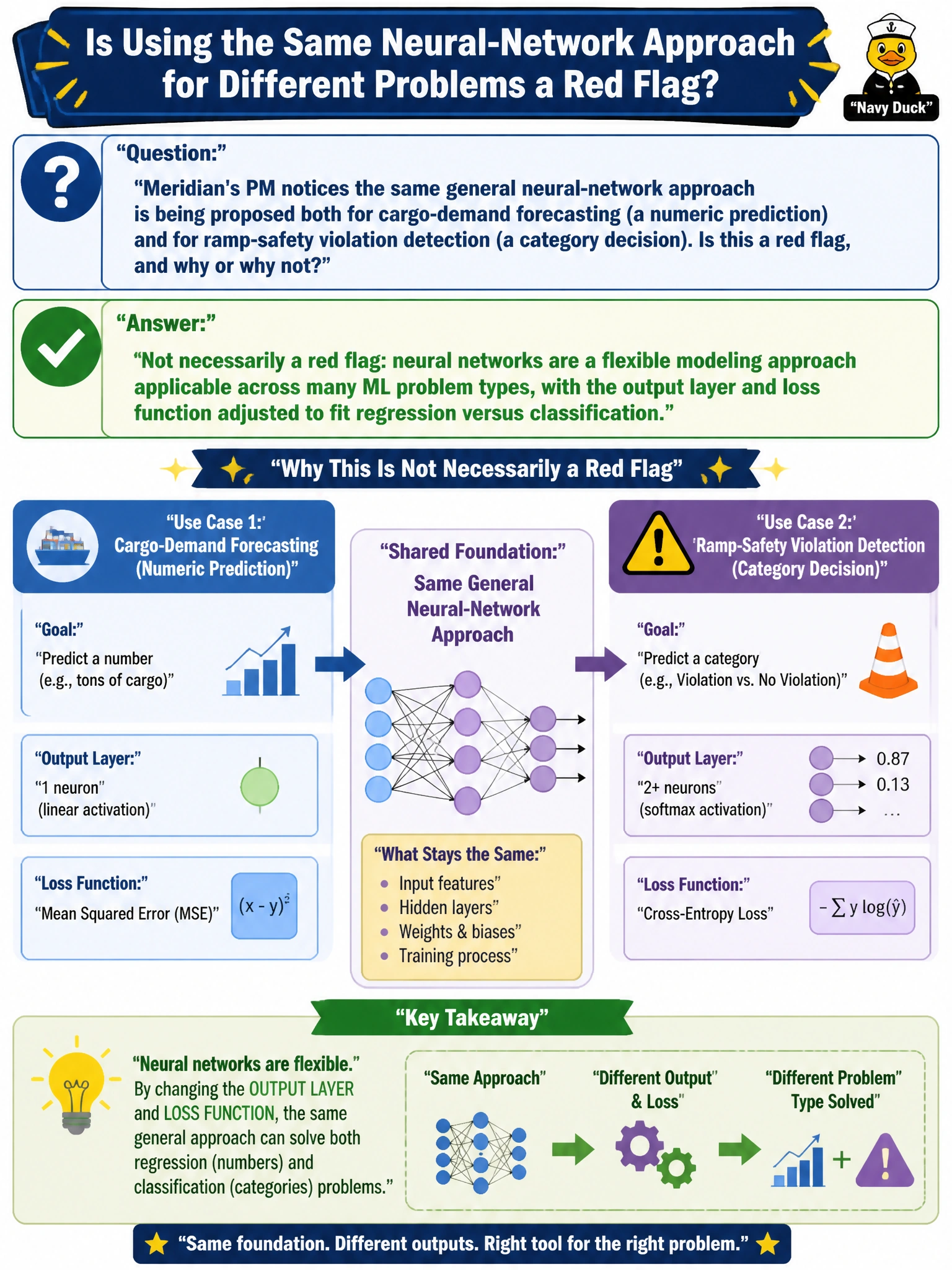
Meridian's PM notices the same general neural-network approach is being proposed both for cargo-demand forecasting (a numeric prediction) and for ramp-safety violation detection (a category decision). Is this a red flag, and why or why not?
Select an answer to reveal the explanation.
Short Explanation
Same engine, different steering wheel — the network family stays flexible, it's just the output gauge (a number vs. a category) that changes per job.
Full Explanation
It is not automatically a red flag — neural networks are broadly applicable across classification, regression, and other problem types; what changes between the two Meridian use cases is typically the output layer configuration and loss function (a single numeric output for demand, a category probability for violation detection), not the fundamental architecture family. Claiming a network can never be reused across problem types is wrong and contradicts one of neural networks' genuine strengths that a PM should be able to cite when justifying shared tooling or platform investment. Claiming both problems secretly use reinforcement learning is wrong — nothing in the scenario describes a sequential agent-environment reward loop for either use case; both are one-shot predictions from input to output. Claiming demand forecasting must use clustering is wrong because forecasting a numeric quantity from historical patterns is a regression problem, not an unsupervised grouping task. The PM's real due diligence here is confirming the team has tailored the output layer and evaluation metric to each problem, not rejecting shared architecture on principle.