
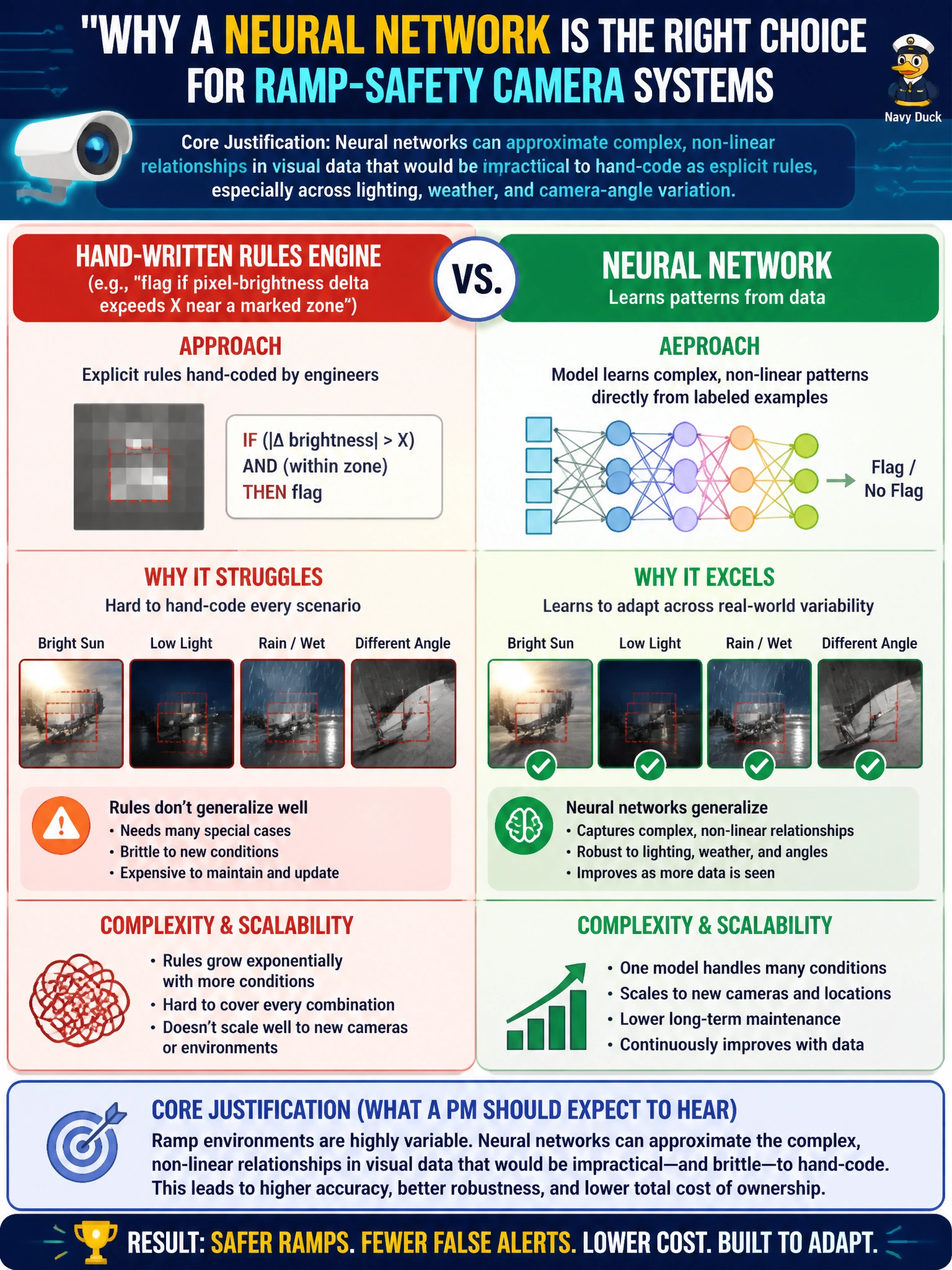
Meridian's data science team recommends a neural network over a hand-written rules engine (e.g., "flag if pixel-brightness delta exceeds X near a marked zone") for the ramp-safety camera system. What is the core justification a PM should expect to hear?
Select an answer to reveal the explanation.
Short Explanation
Neural nets are good at messy, curvy, "it depends on 40 things" problems that a rulebook could never keep up with — that's the whole pitch over hand-written rules.
Full Explanation
Neural networks are strong function approximators — with enough training examples they can learn the complex, non-linear boundary between "safe" and "unsafe" across the huge variation in ramp lighting, weather, and camera angle that a hand-written rules engine would struggle to enumerate. Claiming neural networks need no training data is backward — they typically need substantially more labeled data than a rules engine, which needs none. Claiming a guaranteed lower false-positive rate is wrong because no technique guarantees performance in every case; it depends on data quality and evaluation, not the algorithm family alone. Claiming neural networks are easier to audit is wrong and is actually the opposite of a well-known trade-off — rules engines are typically more transparent and easier to explain, while neural networks are comparatively harder to interpret, which a PM should flag as a trustworthiness consideration, not a selling point.