
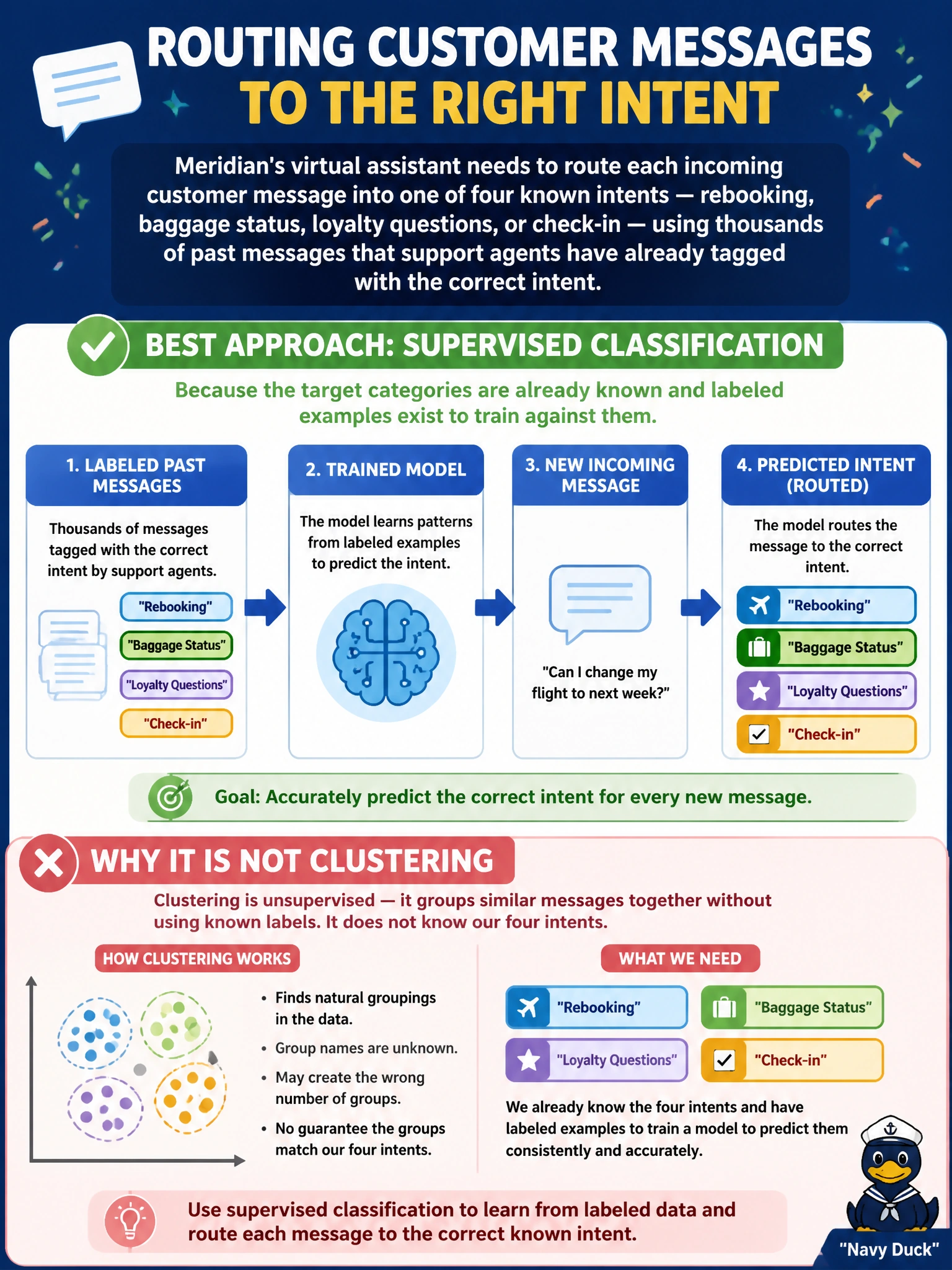
Meridian's virtual assistant needs to route each incoming customer message into one of four known intents — rebooking, baggage status, loyalty questions, or check-in — using thousands of past messages that support agents have already tagged with the correct intent. Which approach best fits, and why is it not clustering?
Select an answer to reveal the explanation.
Short Explanation
Labeled examples plus known categories equals classification, every time — clustering would be throwing away the answer key you already have in your desk drawer.
Full Explanation
This is supervised classification: the four intent categories are already defined and thousands of labeled examples exist, so the model learns a mapping from message text to a known label rather than discovering groups on its own. Clustering would throw away the labeled data Meridian already has and risks producing groupings that don't line up with the four intents the support team actually needs to act on — clustering is the right tool only when no labels exist, which isn't the case here. Reinforcement learning is wrong because there's no sequential action/reward loop being described — this is a single-step prediction task with existing ground truth. An ensemble of clustering models is wrong for the same reason as clustering alone — it's still unsupervised and ignores the labeled data. For the PM, recognizing labeled data plus known categories as the signal for classification (not clustering) keeps the data-prep phase focused on validating label quality rather than tuning a similarity metric.