
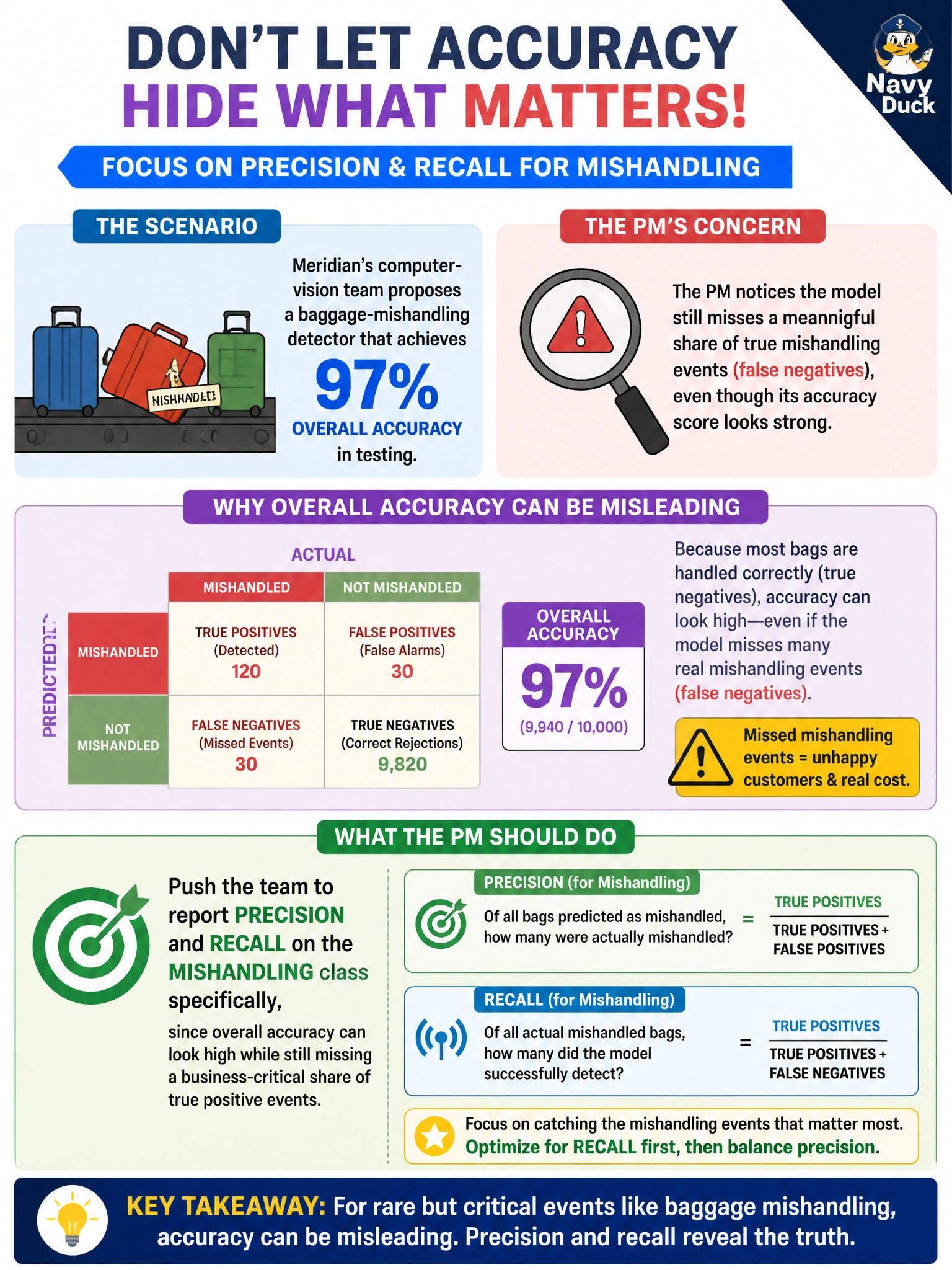
Meridian's computer-vision team proposes a baggage-mishandling detector that achieves 97% overall accuracy in testing. The PM reviewing the results notices the model still misses a meaningful share of true mishandling events (false negatives), even though its accuracy score looks strong. What should the PM do?
Select an answer to reveal the explanation.
Short Explanation
97% accuracy on a rare event is a magic trick — the model can miss almost every real mishap and still ace the scoreboard. Look at precision/recall on the class you actually care about.
Full Explanation
A PM has to evaluate algorithm performance against the actual business requirement, not just a headline metric — with a rare event like baggage mishandling, overall accuracy can stay high even while the model misses many of the true incidents that matter most, so precision and recall (or a similar metric) on the mishandling class itself is the meaningful check. Accepting the raw accuracy figure is wrong precisely because it hides the false-negative problem the PM already noticed. Rejecting classification in favor of clustering is wrong because clustering doesn't produce a mishandled/not-mishandled decision at all — the task genuinely is classification, the evaluation approach is the problem, not the algorithm family. Switching to reinforcement learning is wrong because there's no sequential agent-environment reward loop here; that's a mismatch of technique to task, not a fix for a skewed metric. This is exactly the kind of judgment call — evaluating algorithm performance against business requirements — a CPMAI PM is expected to catch.