
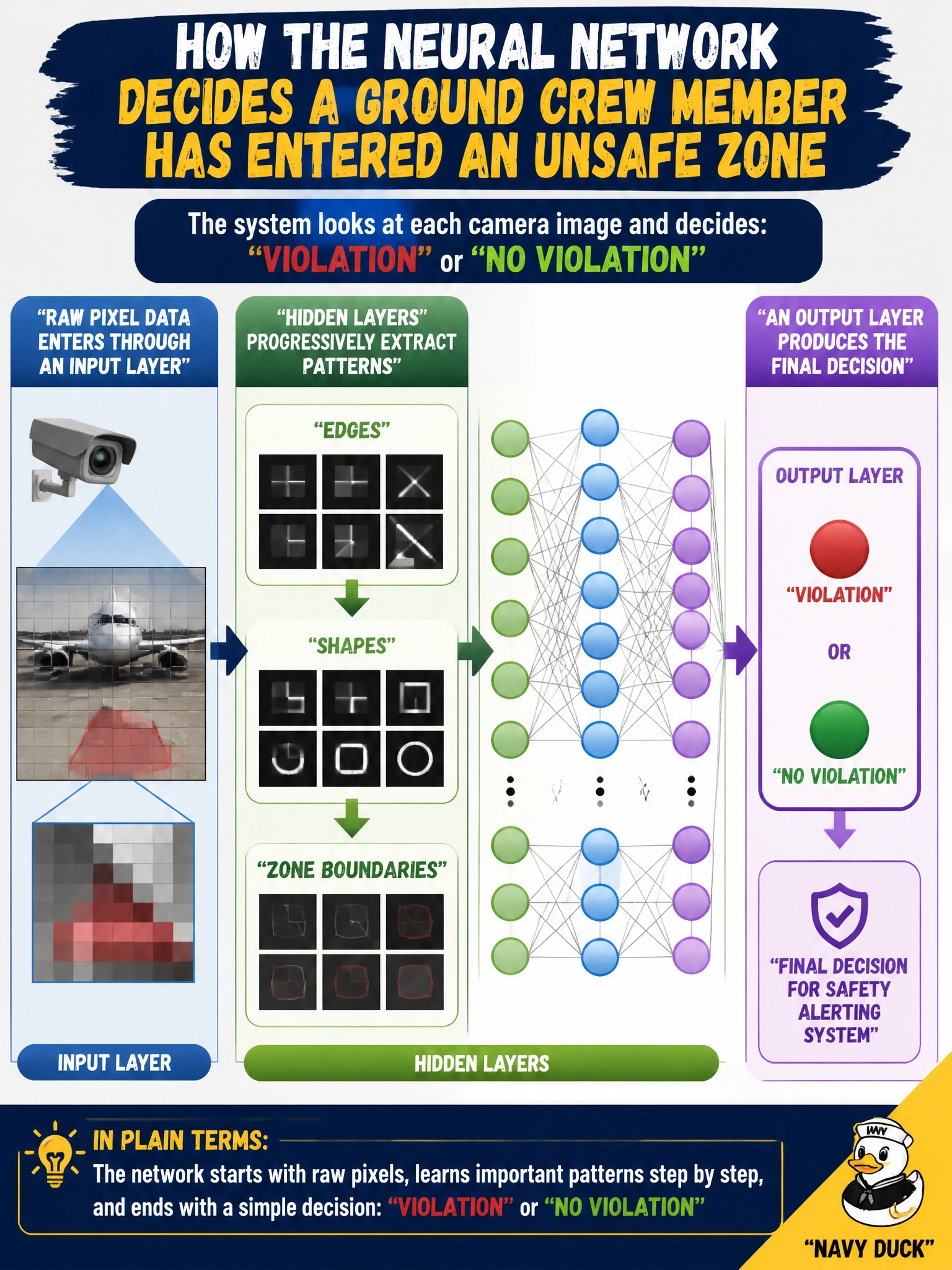
At a Go/No-Go review for the ramp-safety camera system, a Meridian union representative asks the PM to explain, in plain terms, how the neural network decides a ground crew member has entered an unsafe zone. Which explanation correctly describes the basic structure the PM should reference?
Select an answer to reveal the explanation.
Short Explanation
Input layer eats pixels, hidden layers spot patterns, output layer makes the call — that's the whole plumbing diagram, no lookup table, no magic.
Full Explanation
A basic feedforward/deep neural network takes raw input (here, pixel data) through an input layer, passes it through one or more hidden layers of nodes that learn to represent increasingly complex patterns, and produces a result at the output layer -- that structural description is accurate and is the level of understanding a PM needs to explain the system credibly to stakeholders. A lookup-table description is wrong because it describes memorization, not learning generalizable patterns -- a network trained this way could not handle a ramp scene it hadn't seen before, which defeats the purpose. Describing it as clustering frames into groups is wrong because that's an unsupervised technique unrelated to how a trained classifier makes a single-frame decision, and no such grouping step occurs at inference. Saying there's a single layer with no intermediate processing is wrong because it omits the hidden layers that let the network learn hierarchical features -- without them, most real-world ramp scenes couldn't be distinguished reliably. Getting this structure right lets a PM answer stakeholder questions without either oversimplifying or misrepresenting the system.