
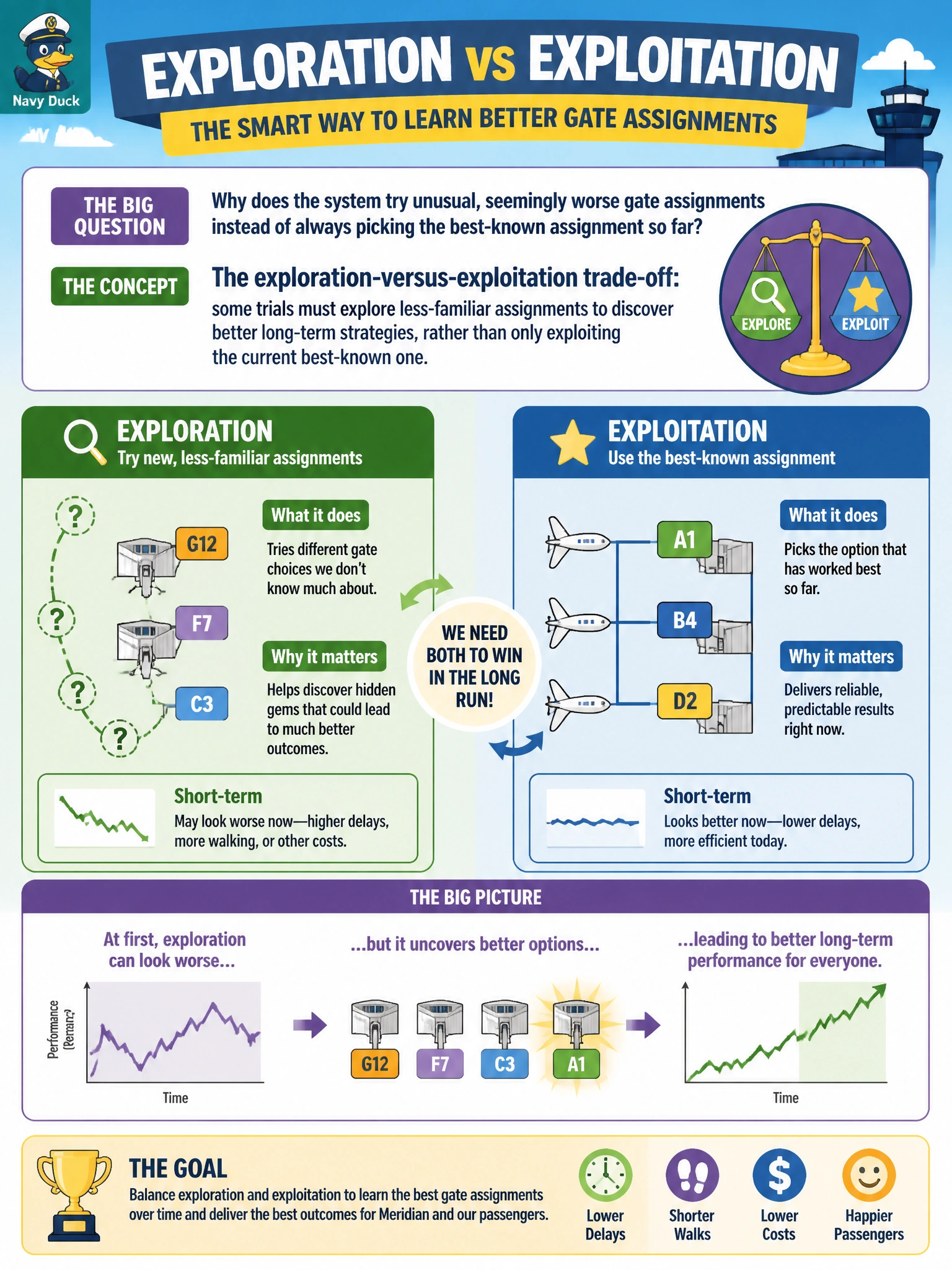
During a review of the gate-scheduling reinforcement learning project, a Meridian ops director asks why the data science team keeps letting the system try unusual, seemingly worse gate assignments instead of always picking the best-known assignment so far. What concept should the PM use to explain this design choice?
Select an answer to reveal the explanation.
Short Explanation
Exploration vs. exploitation is just "do I order my usual lunch or try the new food truck?" Occasionally trying the weird option is how you find out it's actually better.
Full Explanation
This is the exploration-versus-exploitation trade-off, a core reinforcement learning concept: if the agent only ever exploits the currently best-known gate assignment, it can get stuck in a locally good but globally suboptimal strategy, so some exploration of untested assignments is necessary to find better long-term policies. Overfitting is wrong because that describes a model fitting training noise so tightly it fails to generalize — it isn't about choosing which action to try next. Data drift is wrong because that describes the statistical properties of incoming data changing over time, unrelated to why an RL agent samples unfamiliar actions. Ensemble diversity is wrong because no separate models are being combined here — this is a single agent's action-selection strategy. For a PM, understanding this trade-off matters when setting expectations with ops stakeholders: some "worse" simulated trials are the mechanism by which the system gets better, not a bug to eliminate.