
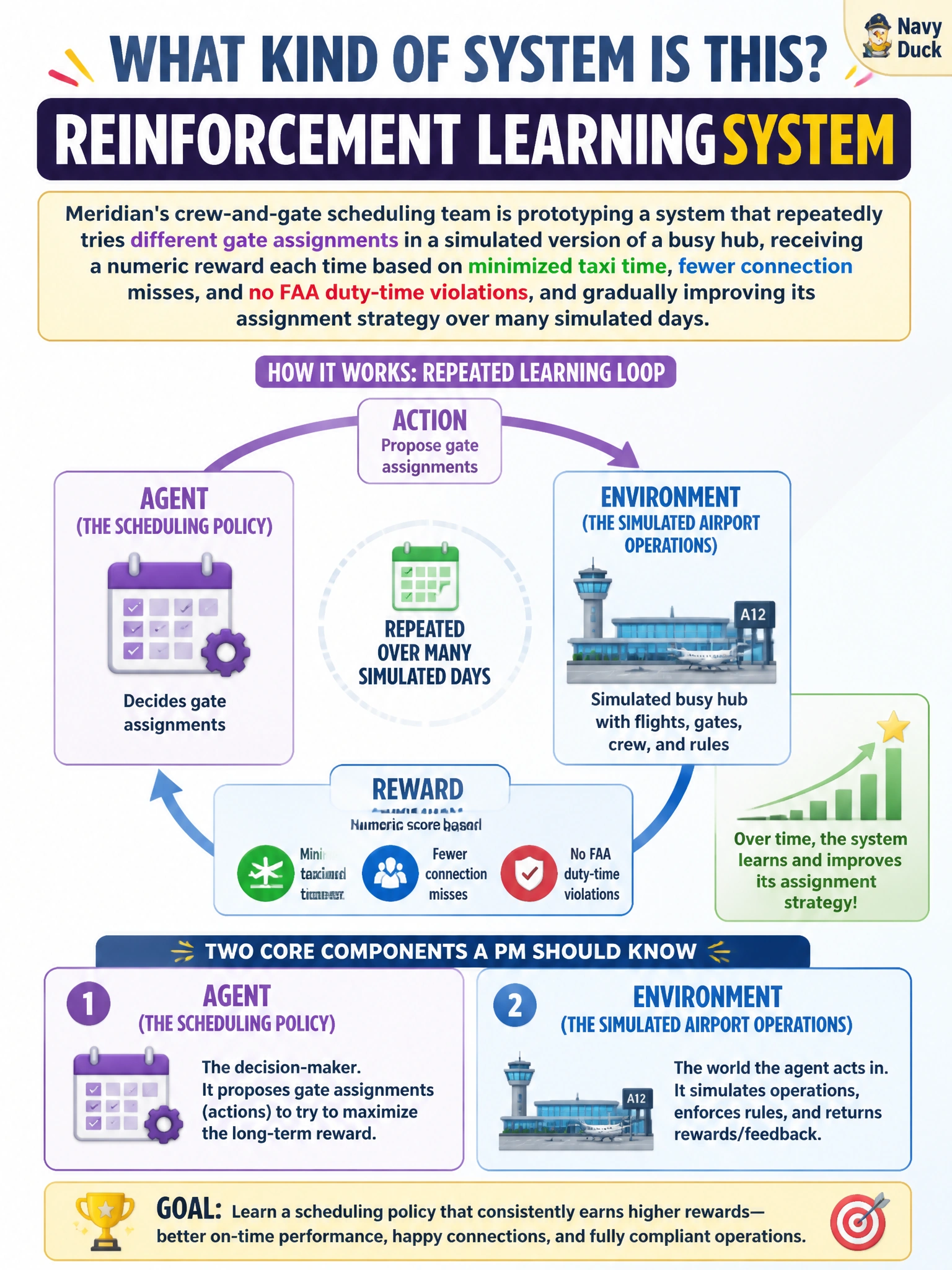
Meridian's crew-and-gate scheduling team is prototyping a system that repeatedly tries different gate assignments in a simulated version of a busy hub, receiving a numeric reward each time based on minimized taxi time, fewer connection misses, and no FAA duty-time violations, and gradually improving its assignment strategy over many simulated days. What kind of system is this, and what are its two core components a PM should be able to name?
Select an answer to reveal the explanation.
Short Explanation
This is reinforcement learning: an agent bumping around a flight-sim for gates, getting a cookie (or a smack) each try. Agent = the decision-maker, environment = the sandbox it's playing in.
Full Explanation
This is reinforcement learning: an agent (the gate-assignment policy Meridian is training) takes actions inside an environment (the simulated hub) and learns from a reward signal accumulated over repeated episodes, rather than from a fixed set of labeled correct answers. Supervised classification is wrong because there's no static labeled dataset of "correct" gate assignments being matched — the system is discovering good behavior through trial and error. Clustering is wrong because nothing is grouping unlabeled examples; this is sequential decision-making. Generative AI is wrong because the system isn't producing new content from a prompt — it's optimizing a control policy against a reward function. As PM, naming the agent and environment correctly matters because RL projects need a working simulator before touching live operations, and the Go/No-Go criteria for this phase should center on simulated reward performance, not accuracy in the classification sense.