
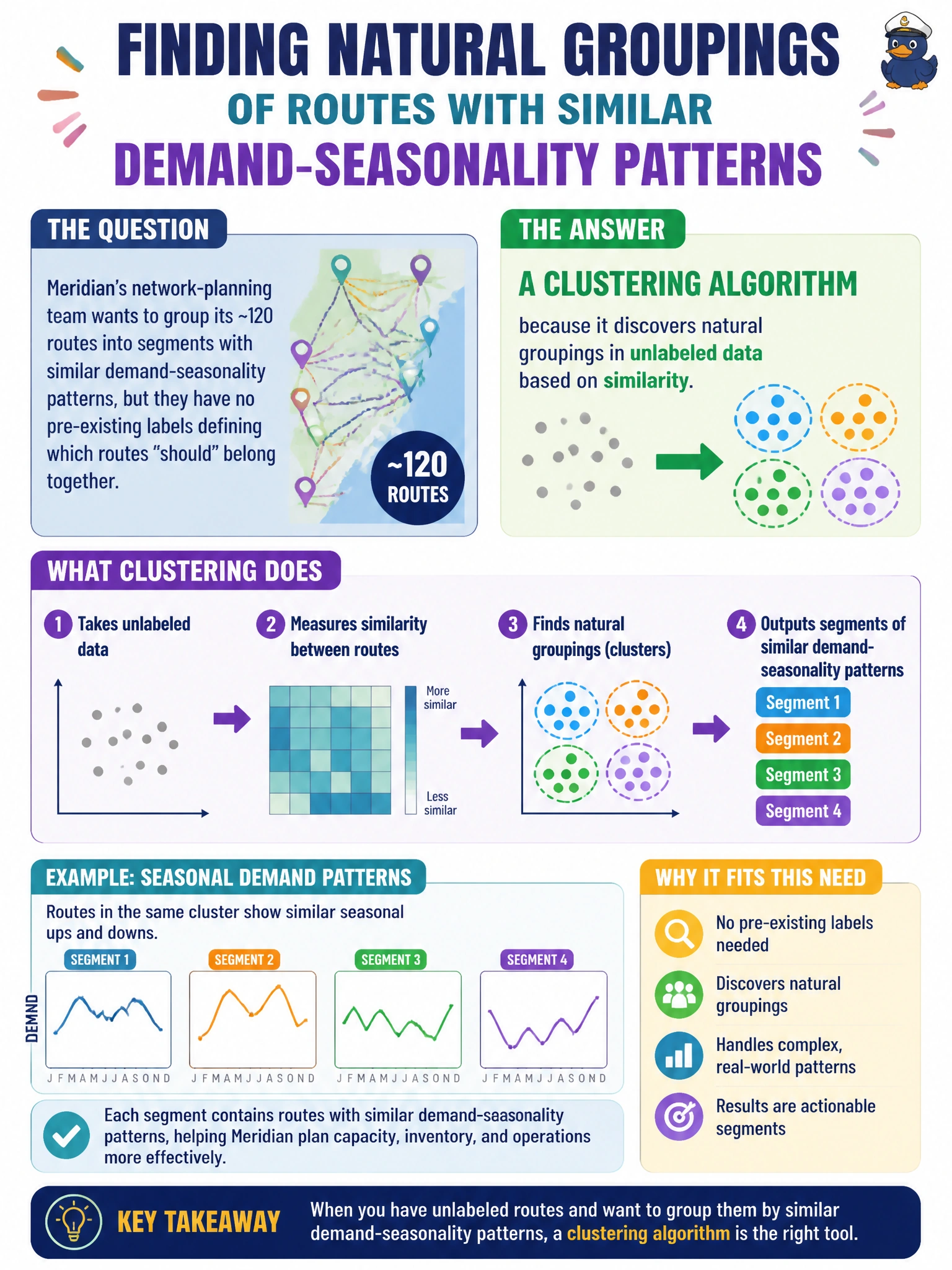
Meridian's network-planning team wants to group its ~120 routes into segments with similar demand-seasonality patterns, but they have no pre-existing labels defining which routes "should" belong together. Which type of algorithm fits this need?
Select an answer to reveal the explanation.
Short Explanation
No labels, no problem — clustering just lets the routes sort themselves into look-alike piles. You're not telling it the answer, you're asking it to notice one.
Full Explanation
Clustering is exactly this scenario: unsupervised discovery of structure in data with no predefined labels — the routes group themselves by demand-pattern similarity, and the network-planning team interprets the resulting segments afterward. Classification is wrong because classification requires known target categories established in advance from labeled examples, and none exist here. Reinforcement learning is wrong because there's no sequential decision-making agent receiving rewards — this is a single pass over historical demand data, not trial-and-error control. Ensemble is wrong because the scenario doesn't describe combining multiple models' predictions; it describes finding an unlabeled grouping. For a PM, recognizing this as clustering matters for staffing and Go/No-Go criteria: unlike classification, there's no simple "accuracy" metric — evaluation has to rely on cluster-quality measures and business interpretation of what each segment means.