
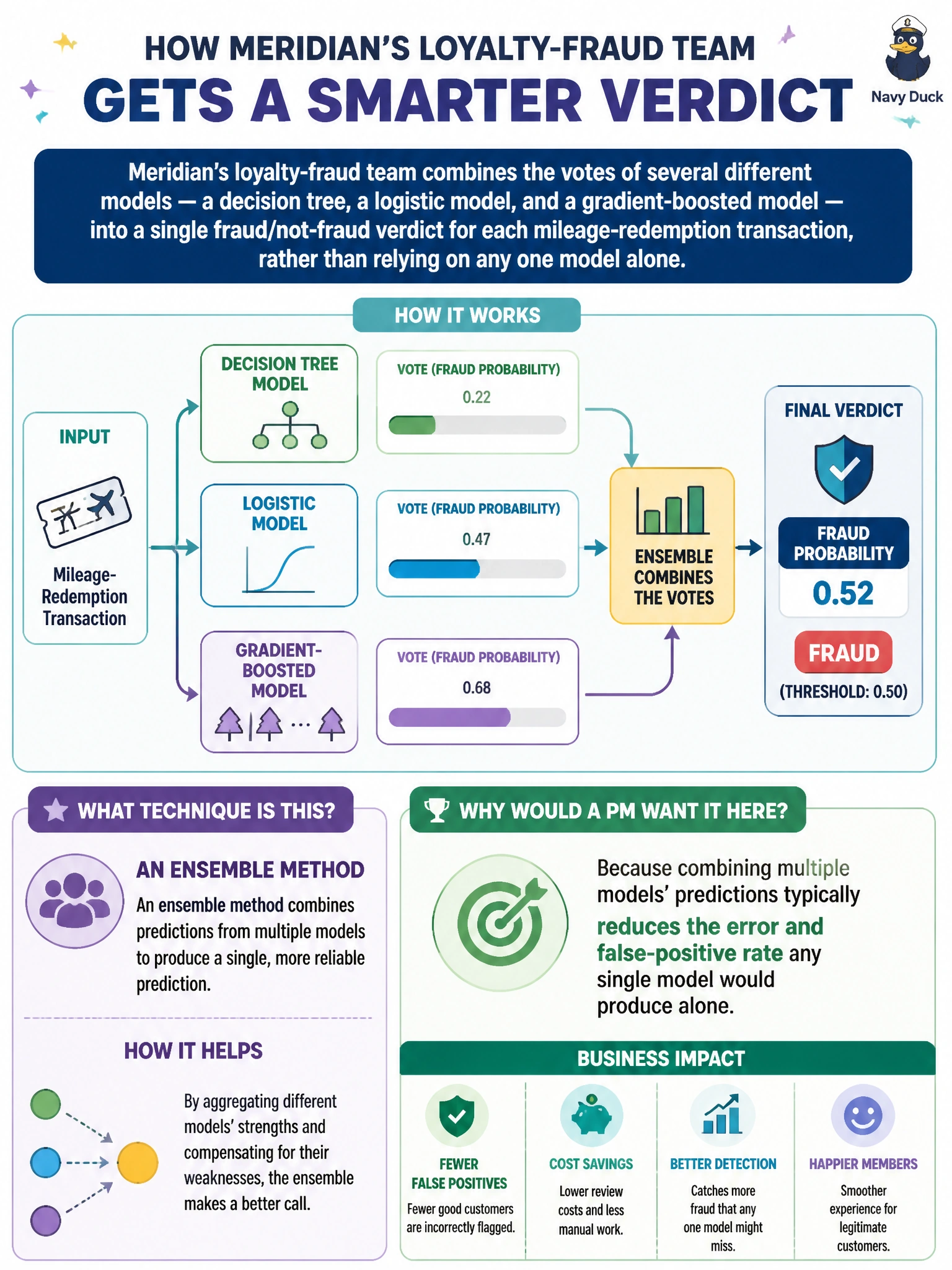
Meridian's loyalty-fraud team combines the votes of several different models — a decision tree, a logistic model, and a gradient-boosted model — into a single fraud/not-fraud verdict for each mileage-redemption transaction, rather than relying on any one model alone. What technique is the team using, and why would a PM want it here?
Select an answer to reveal the explanation.
Short Explanation
An ensemble is just "ask a committee, not one guy." Three flawed models voting together usually beat any one of them alone — that's the whole trick.
Full Explanation
This is an ensemble method — multiple models vote or are blended, and the combined result is typically more accurate and more stable than any single model, which matters directly to Meridian's finance team because fewer false positives means fewer legitimate loyalty members getting incorrectly flagged. Clustering is wrong because nothing here is grouping unlabeled transactions into discovered segments — each model is independently trained on the same fraud/not-fraud labels. Reinforcement learning is wrong because there's no sequential agent-environment reward loop; these are static classifiers voting on a single prediction. Dimensionality reduction is wrong because the technique here doesn't reduce the number of input features — it combines the outputs of multiple already-trained models. As PM, knowing "ensemble" is the right word helps you scope the eval plan to compare against the best single model, not just accept the ensemble on faith.