
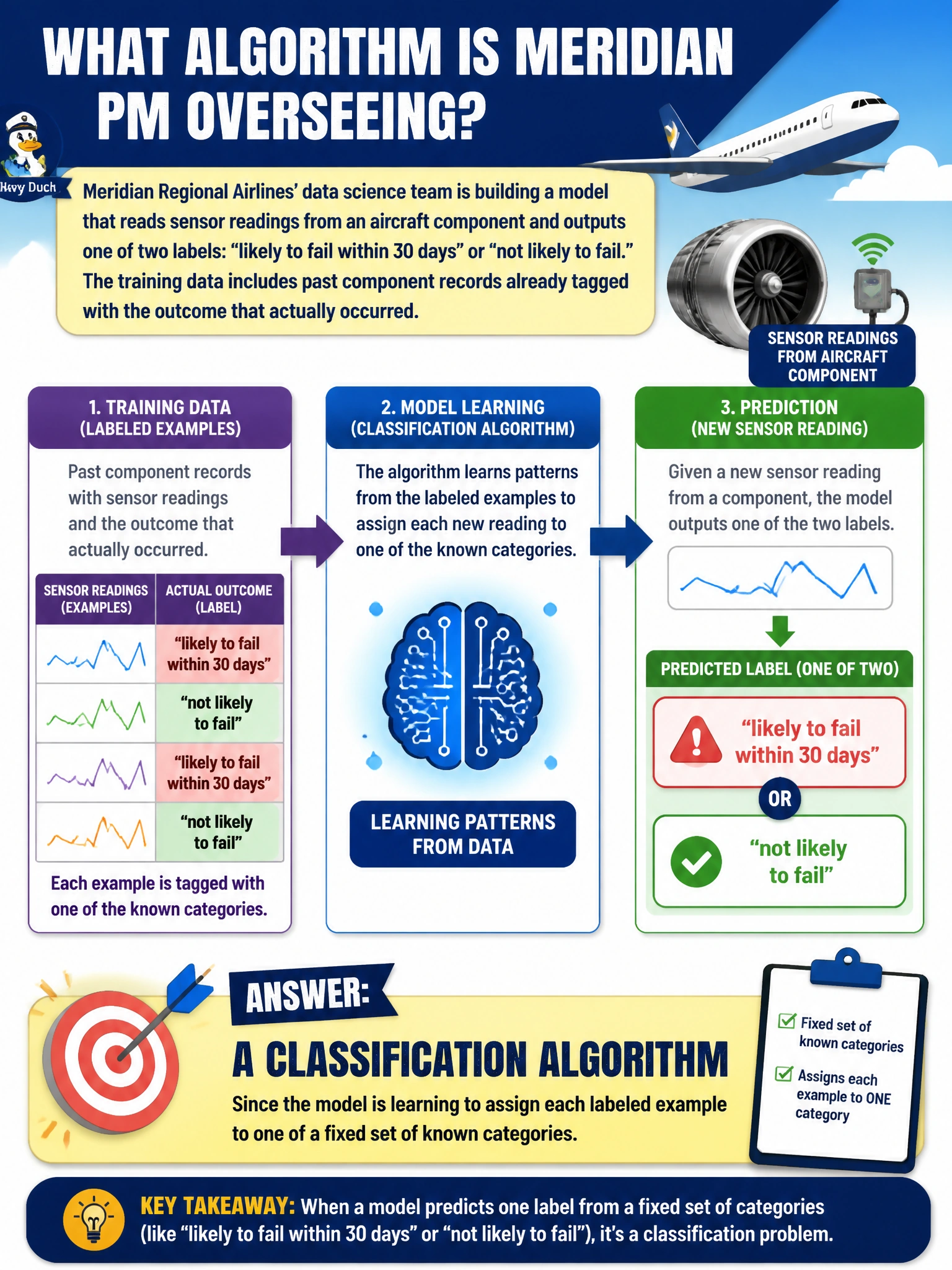
Meridian Regional Airlines' data science team is building a model that reads sensor readings from an aircraft component and outputs one of two labels: "likely to fail within 30 days" or "not likely to fail." The training data includes past component records already tagged with the outcome that actually occurred. Which type of algorithm is Meridian's PM overseeing here?
Select an answer to reveal the explanation.
Short Explanation
Labels already exist for every past example, so this is classification, plain and simple — think of it like sorting mail into bins you already know the names of, not inventing new bins.
Full Explanation
This is textbook supervised classification: labeled historical outcomes ("failed" / "did not fail") plus a fixed set of target categories. Clustering is wrong because clustering has no labels to learn from — it discovers groupings on its own; here Meridian already knows the outcome for every past example. Reinforcement learning is wrong because there's no agent taking sequential actions and collecting a reward over time — this is a one-shot prediction from existing data, not trial-and-error learning. Generative AI is wrong because the output is a category label, not new synthesized content. For a PM, the practical takeaway is: if your business need is "predict the outcome category for a scenario using labeled history," ask the data science team to size it as classification work, which shapes the labeling effort, evaluation metrics (precision/recall on the failure class), and timeline you should expect.