
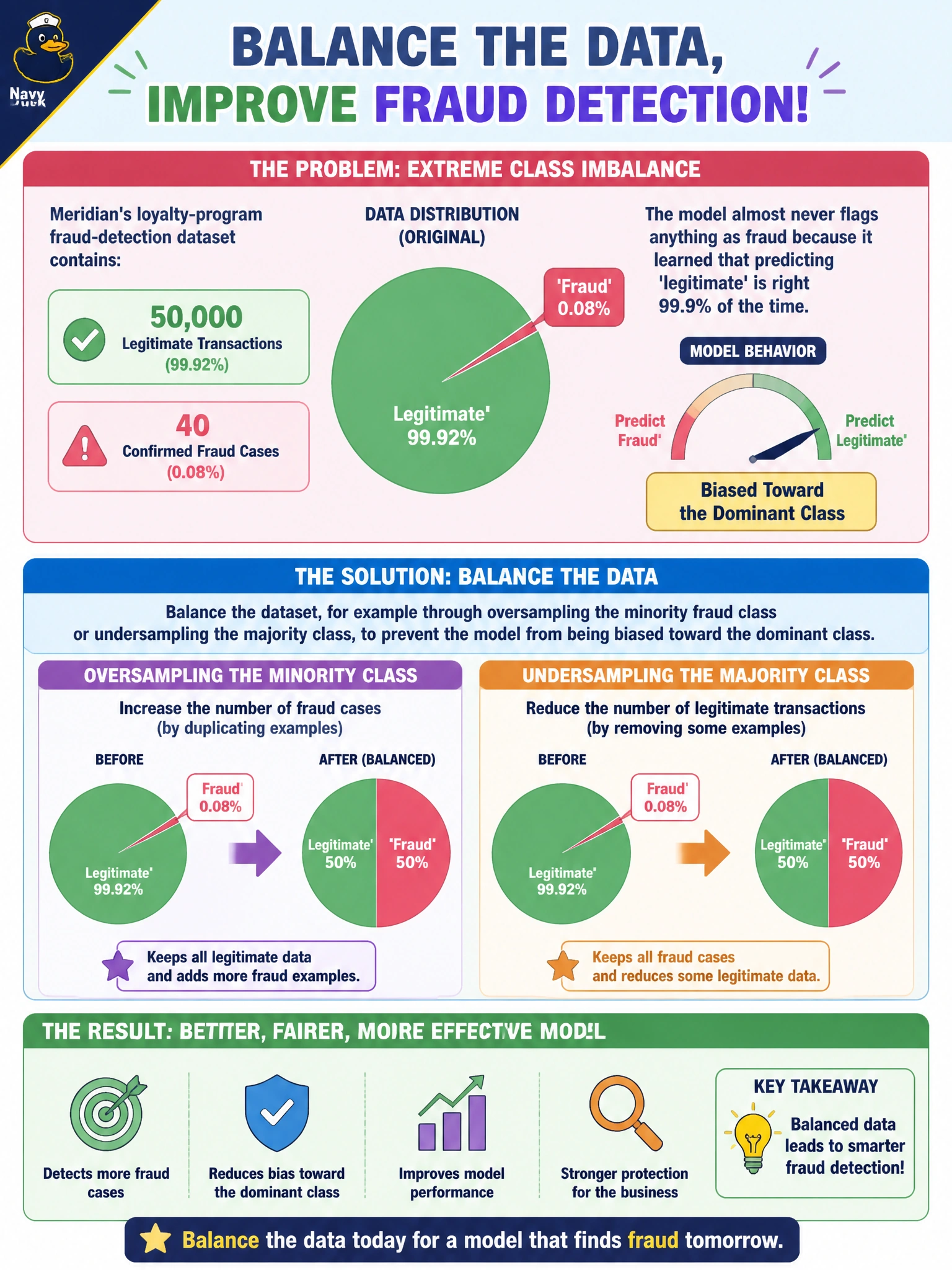
Meridian's loyalty-program fraud-detection dataset contains 50,000 legitimate transactions but only 40 confirmed fraud cases, and the resulting model almost never flags anything as fraud because it learned that predicting 'legitimate' is right 99.9% of the time. What should the data preparation team do to address this?
Select an answer to reveal the explanation.
Short Explanation
A model that's almost never seen fraud will almost never predict fraud — it's just following the odds. Balancing the classes, oversampling the rare case or undersampling the common one, forces the model to actually learn what fraud looks like instead of learning to ignore it.
Full Explanation
Balancing datasets to prevent bias in model training addresses exactly this scenario: severe class imbalance (40 fraud cases vs. 50,000 legitimate) causes a model to learn a trivially high-accuracy but practically useless strategy of always predicting the majority class. Techniques like oversampling the minority class, undersampling the majority class, or synthetic minority generation give the model meaningful exposure to the rare but critical fraud pattern. Option B worsens the existing imbalance by adding more of the already-dominant class, making the bias problem more severe, not less. Option C avoids diagnosing the problem rather than fixing it; removing the accuracy metric doesn't change the model's actual behavior or its failure to catch fraud, and a PM still needs some evaluation metric appropriate to imbalanced classification. Option D assumes the imbalance will self-correct through repetition, which it will not — the underlying class distribution in the training data doesn't change just by re-running training on the same skewed dataset. For the exam, this class-imbalance / bias-in-training-data scenario is one of the most concrete, checkable facts in the Data for AI domain — recognize it whenever accuracy looks deceptively high but a rare, important class is being ignored.