
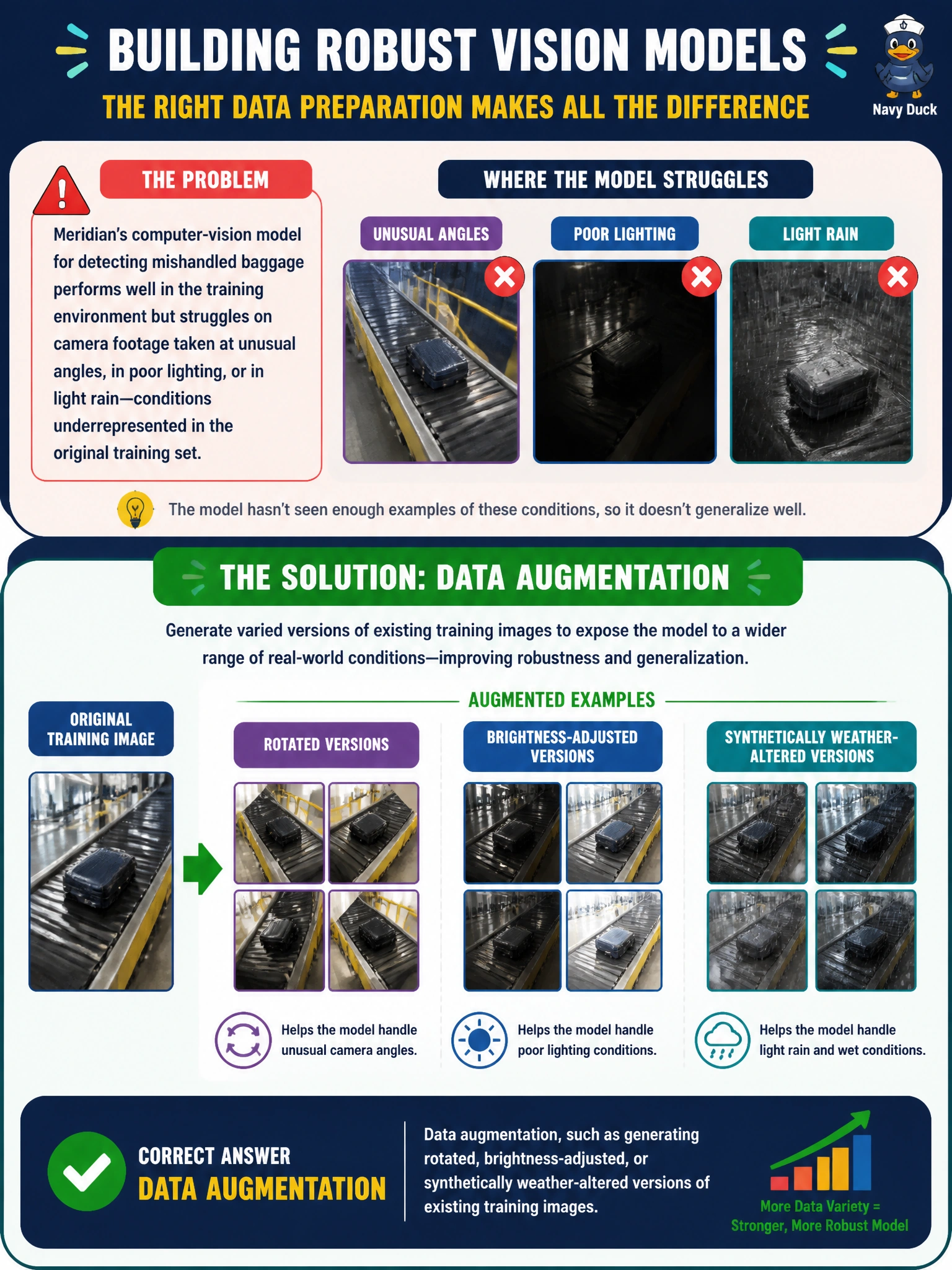
Meridian's computer-vision model for detecting mishandled baggage performs well in the training environment but struggles on camera footage taken at unusual angles, in poor lighting, or in light rain, conditions underrepresented in the original training set. Which technique should the data preparation team apply to make the model more robust to these conditions?
Select an answer to reveal the explanation.
Short Explanation
If the model's only ever seen clean, well-lit, straight-on footage, of course it stumbles on rain and odd angles. Data augmentation manufactures those underrepresented conditions from what you already have, so the model gets exposed to them before it meets them for real.
Full Explanation
Data augmentation applies transformations to existing training data — rotation, brightness/contrast adjustment, synthetic weather effects, cropping — to increase the diversity of conditions a model is exposed to during training, directly improving robustness to underrepresented real-world scenarios like unusual angles, poor lighting, or rain. This is the correct fix for Meridian's computer-vision gap because the underlying problem is insufficient variety in the training examples, not a labeling, identity, or governance issue. Option B, master data management, addresses cross-system identity reconciliation (as in the Q152 passenger-identity scenario), which is unrelated to image variety or model robustness. Option C, lineage documentation, would help an auditor trace an image's history but does nothing to improve the model's performance under new conditions. Option D, a data management plan, governs retention and access policy, not model robustness to visual variation. For the exam, augmentation is specifically the technique for improving robustness against underrepresented conditions, most classically illustrated with computer-vision scenarios like this one.