
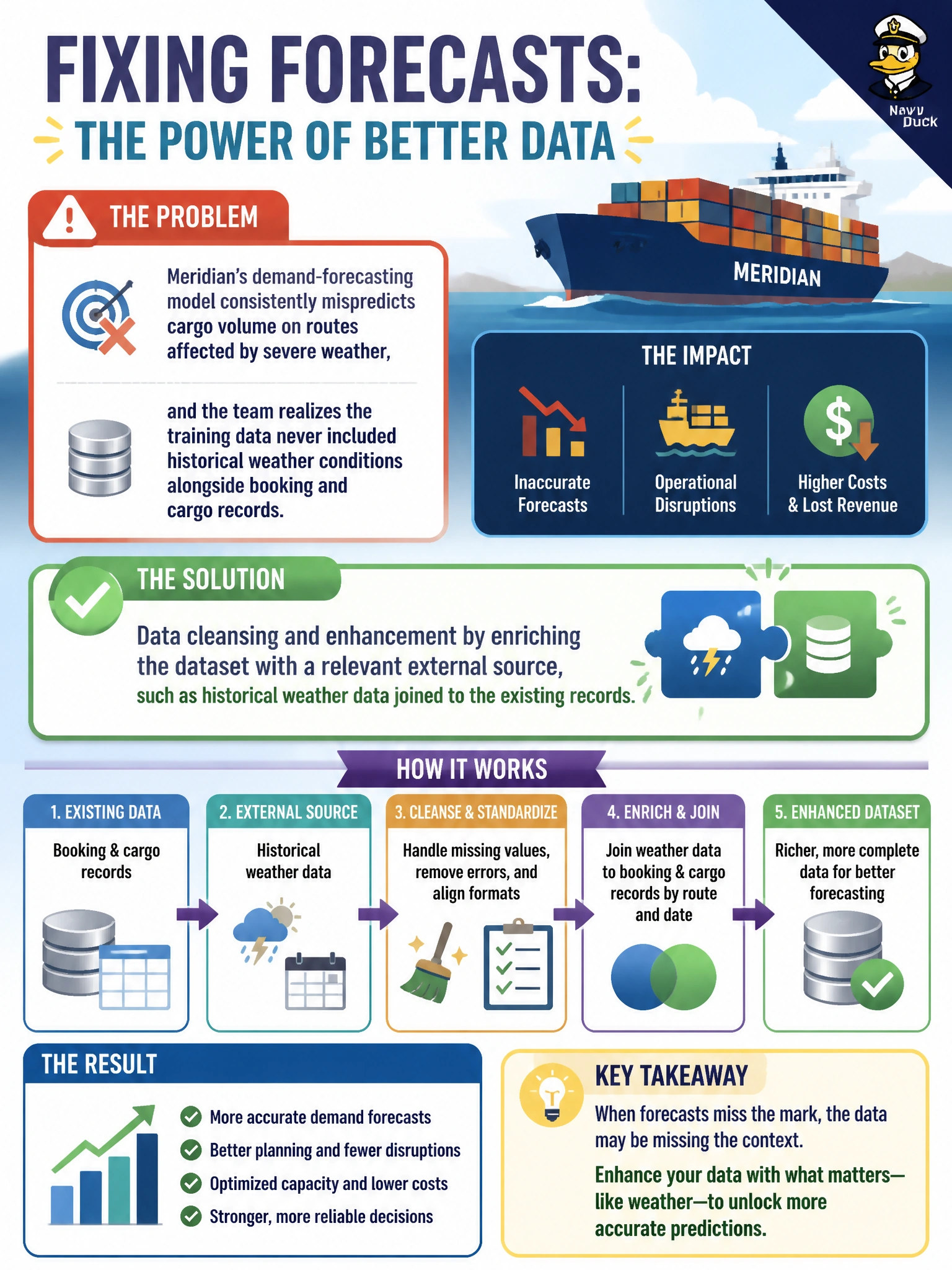
Meridian's demand-forecasting model consistently mispredicts cargo volume on routes affected by severe weather, and the team realizes the training data never included historical weather conditions alongside booking and cargo records. What data preparation technique addresses this gap?
Select an answer to reveal the explanation.
Short Explanation
The model wasn't wrong about weather — it never saw weather data at all. Enrichment is the fix: join in the external data source the model was missing, so it actually has the signal it needs to learn the pattern.
Full Explanation
Data cleansing and enhancement includes enriching a dataset with relevant external sources when a gap is identified — here, joining historical weather data to booking and cargo records so the model has the signal needed to learn the weather-demand relationship it was previously blind to. This is a targeted, diagnosable data preparation fix once the missing-variable root cause is identified. Option A misapplies data augmentation (a Task 4 enabler covered in the next question) which is about generating synthetic training examples, typically for image/vision tasks, and doesn't address a missing external variable in tabular/time-series data. Option C would reduce data volume without addressing the actual gap (missing weather variable), likely worsening the model's ability to learn seasonal or weather patterns from too little history. Option D removes the very data points where the model's error is concentrated, discarding useful signal instead of fixing the underlying gap through enrichment. For the exam, distinguish enhancement/enrichment (adding a missing relevant variable from an external source) from augmentation (generating synthetic variations of existing examples), tested next.