
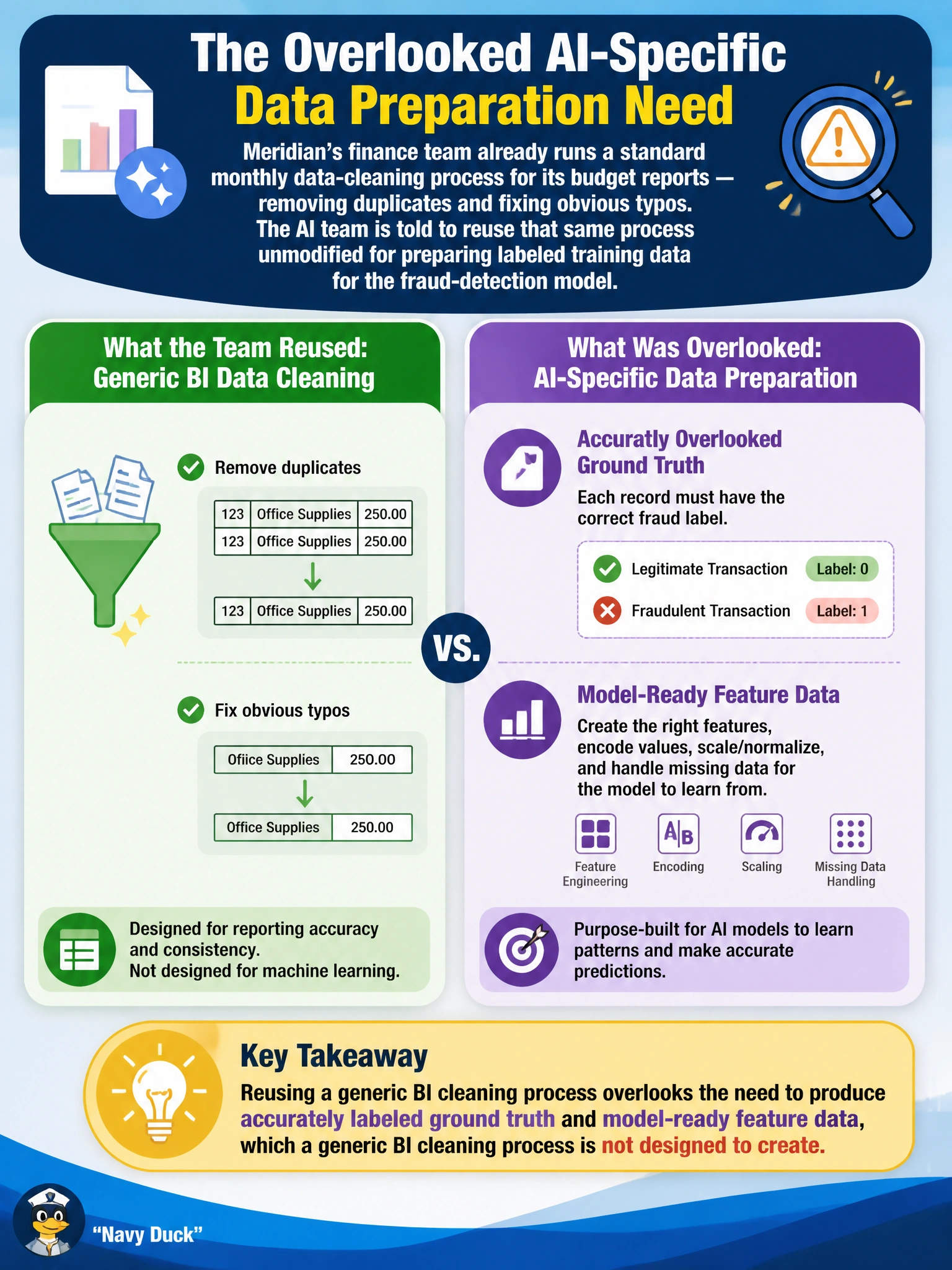
Meridian's finance team already runs a standard monthly data-cleaning process for its budget reports — removing duplicates and fixing obvious typos. The AI team is told to reuse that same process unmodified for preparing labeled training data for the fraud-detection model. What AI-specific data preparation need does this reuse overlook?
Select an answer to reveal the explanation.
Short Explanation
Cleaning a budget report and preparing labeled training data are not the same job. A generic BI cleanup catches typos and duplicates, but it was never built to produce the accurate labels and model-ready features a fraud-detection model actually needs to learn from.
Full Explanation
AI-specific data preparation needs go beyond generic cleaning: they include producing accurately labeled ground truth (e.g., confirmed fraud vs. legitimate transactions) and transforming data into model-ready features, neither of which a standard BI-report cleaning process (deduplication, typo correction) is designed to do. Reusing the finance team's process unmodified would leave the fraud-detection model without the labels and feature structure it needs to learn. Option A incorrectly assumes generic BI cleaning is sufficient, missing the labeling and feature-engineering gap that is specifically called out as an AI-specific need. Option C is a nonsensical overcorrection — numeric data (transaction amounts, timestamps) is often essential model input, not something to remove. Option D confuses data preparation with reporting output format; a printed report is irrelevant to what a model consumes for training. For the exam, remember AI data preparation is a superset of generic data cleaning — it must also address labeling requirements and feature readiness, which is what distinguishes it from ordinary BI hygiene work.