
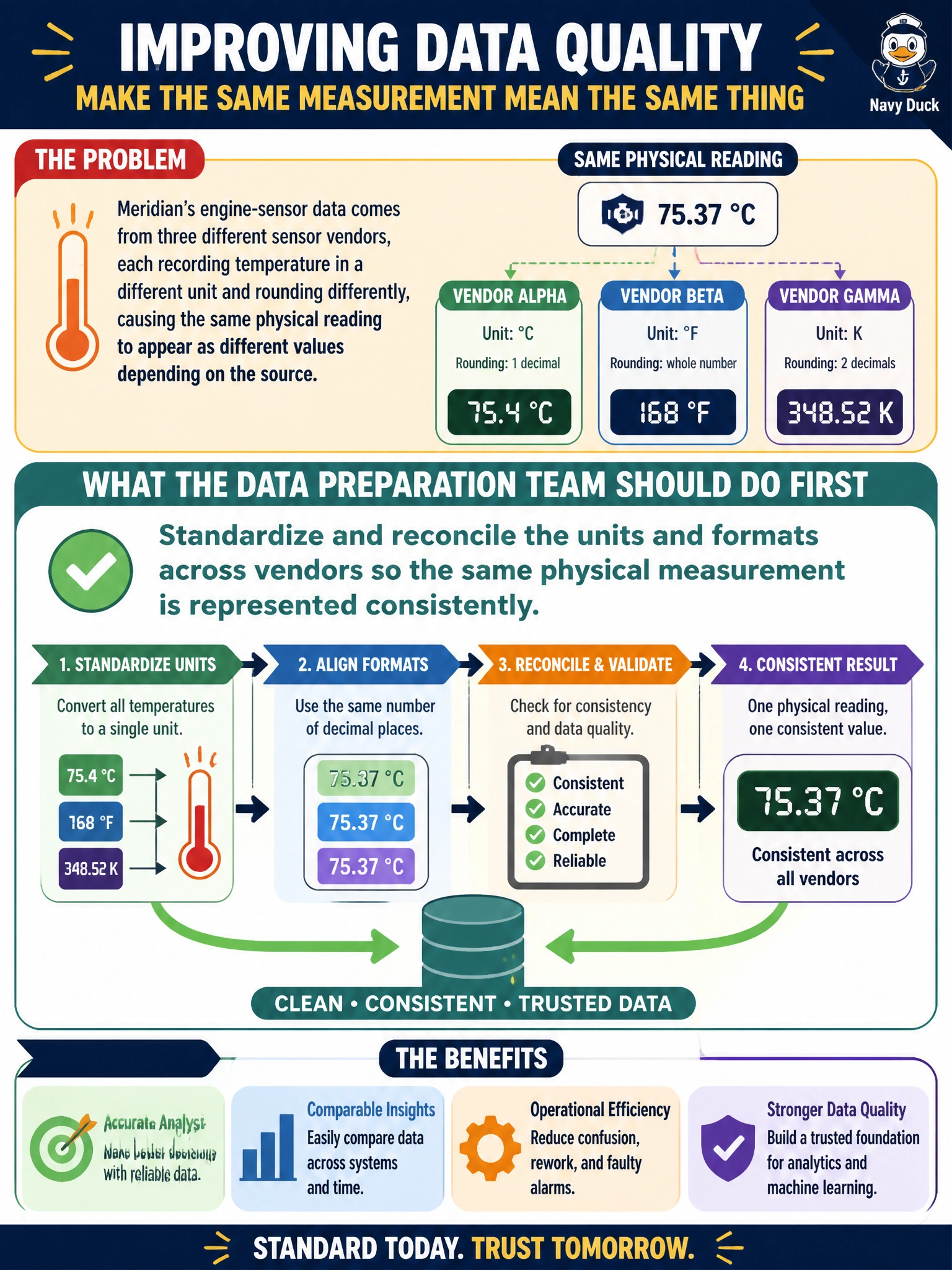
Meridian's engine-sensor data comes from three different sensor vendors, each recording temperature in a different unit and rounding differently, causing the same physical reading to appear as different values depending on the source. What should the data preparation team do first to improve data quality?
Select an answer to reveal the explanation.
Short Explanation
A model can't tell the difference between 'a real temperature change' and 'vendor B measures in different units.' Standardize the units first, or you're training the model on noise you created yourself.
Full Explanation
Improving data quality and accuracy includes standardizing formats and units across heterogeneous sources so the same physical measurement is represented consistently, which is essential before the sensor data from three vendors can be meaningfully combined. Without this step, the model can't distinguish genuine physical variation from artifacts of inconsistent measurement, corrupting the signal it's trying to learn. Option A is a common and costly misconception — models do not automatically infer and correct unit-conversion errors; they treat inconsistent scales as noise or, worse, as meaningful signal, degrading accuracy. Option C throws away two-thirds of the available sensor data unnecessarily when the actual problem, unit inconsistency, is directly fixable through standardization. Option D is impractical and would stall the entire initiative indefinitely on a vendor hardware decision outside the project's control, when standardization can be handled in the data preparation pipeline instead. For the exam, standardization/reconciliation is the concrete method for improving data quality, distinct from cleansing (removing errors) and augmentation (adding synthetic examples), both tested separately in this task.