
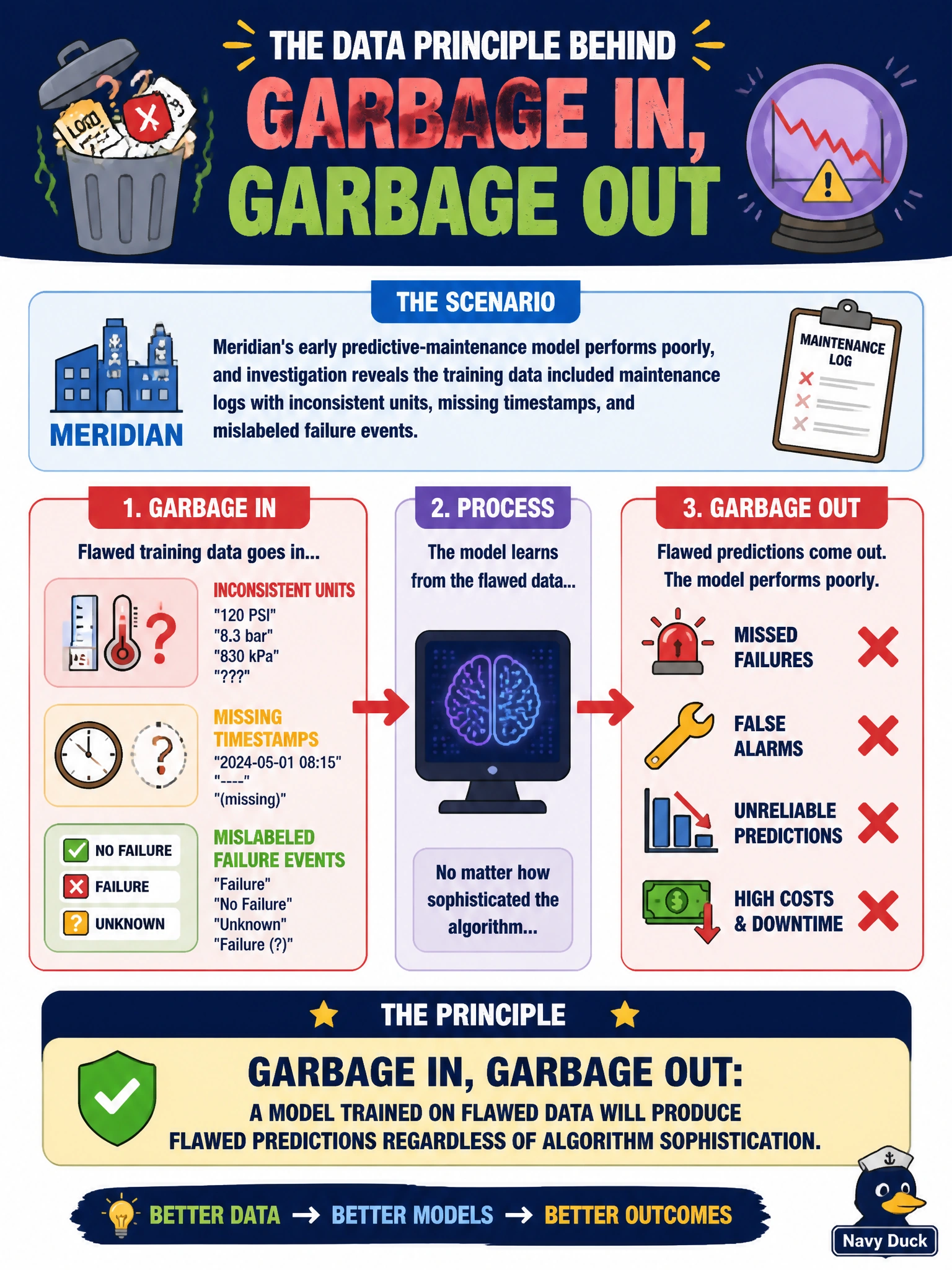
Meridian's early predictive-maintenance model performs poorly, and investigation reveals the training data included maintenance logs with inconsistent units, missing timestamps, and mislabeled failure events. Which principle explains why the model's poor performance traces directly back to this training data?
Select an answer to reveal the explanation.
Short Explanation
No amount of algorithm sophistication rescues a model trained on inconsistent units and mislabeled failures — garbage in, garbage out. It's the single most-quoted principle in this domain for exactly this reason.
Full Explanation
'Garbage in, garbage out' (GIGO) is the principle that a model's output quality is fundamentally bounded by its input data quality — inconsistent units, missing timestamps, and mislabeled failure events in Meridian's maintenance logs will degrade predictions no matter how sophisticated the chosen algorithm is. This is a core, explicitly named risk in the Data for AI domain and a common cause of underperforming pilot projects. Option B, the Turing Test, is an unrelated AI-fundamentals concept about human-indistinguishability of output, not a data-quality principle. Option C, the seven patterns of AI, concerns matching a business need to a use-case pattern (conversational, predictive, etc.), not diagnosing why a model underperforms due to bad training data. Option D, the DIKUW pyramid, describes the data-to-wisdom progression used in Business Understanding scoping, not a data-quality diagnostic. For the exam, GIGO is the go-to answer whenever a scenario traces poor model performance specifically back to flawed input data rather than model choice — a frequently tested root-cause pattern.