
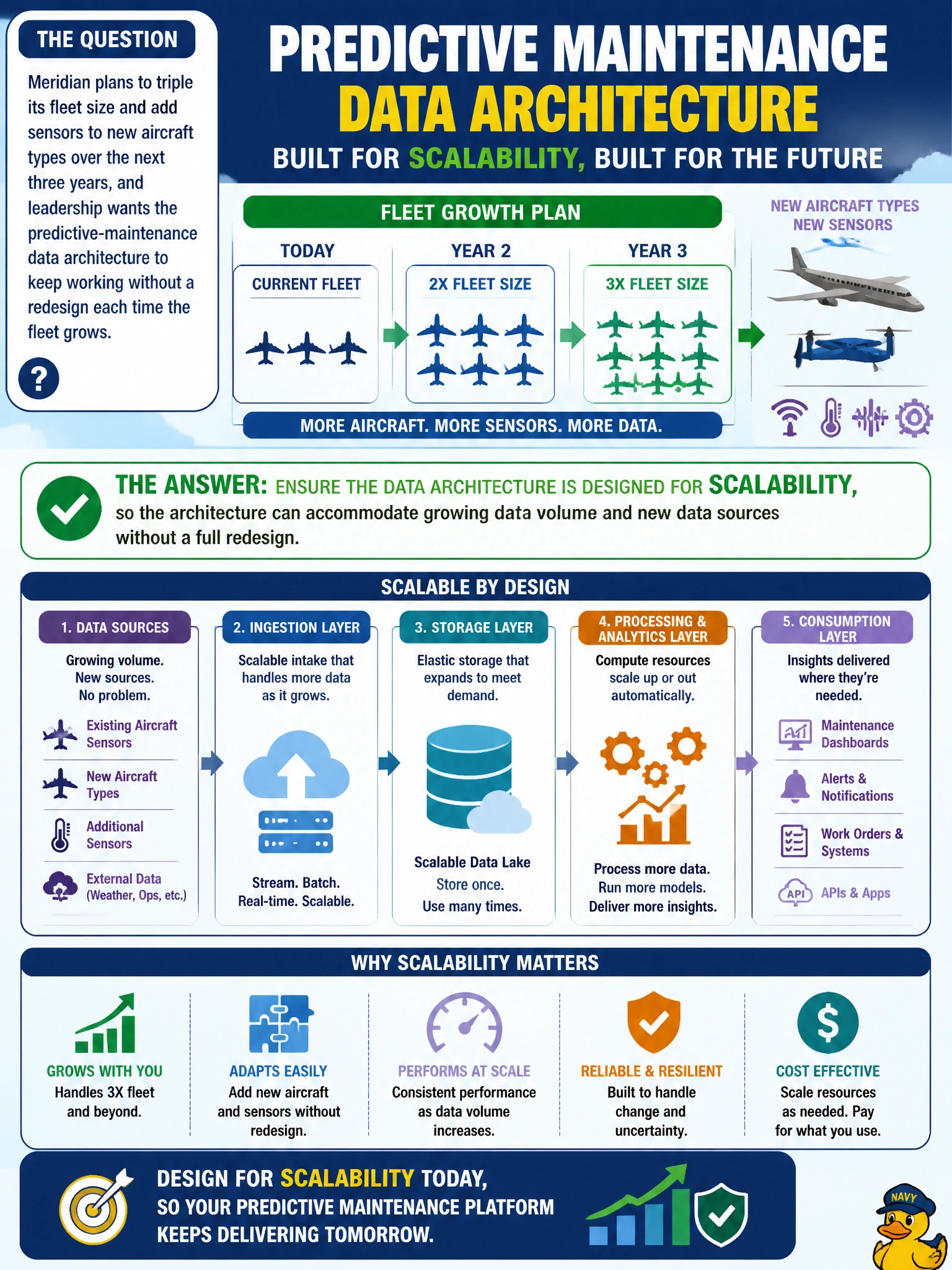
Meridian plans to triple its fleet size and add sensors to new aircraft types over the next three years, and leadership wants the predictive-maintenance data architecture to keep working without a redesign each time the fleet grows. What should the PM ensure the data architecture is designed for?
Select an answer to reveal the explanation.
Short Explanation
If leadership already told you the fleet's tripling, building for today's data volume only guarantees a redesign scramble later. Scalable architecture means growth is a capacity question, not a rebuild-from-scratch event.
Full Explanation
Designing scalable data architectures for growing datasets means anticipating future volume and variety — new aircraft types, more sensors, more data sources — so the system can expand (e.g., via partitioning, horizontal scaling, flexible schemas) without requiring a full architectural rebuild each time. Meridian's stated three-year fleet growth plan is exactly the kind of forward-looking requirement a PM must factor into architecture decisions now. Option A guarantees repeated disruptive rebuilds, which is costly and risks recurring project delays timed to each growth milestone. Option C is directly contradicted by the stated business plan and would leave the architecture obsolete almost immediately. Option D optimizes for the wrong variable; minimizing today's cost while ignoring growth typically leads to a more expensive, disruptive re-architecture later, which is a worse total outcome. For the exam, scalability planning is the forward-looking counterpart to the 'construct pipelines optimized for AI workloads' enabler — one addresses today's workload shape, the other addresses tomorrow's growth.