
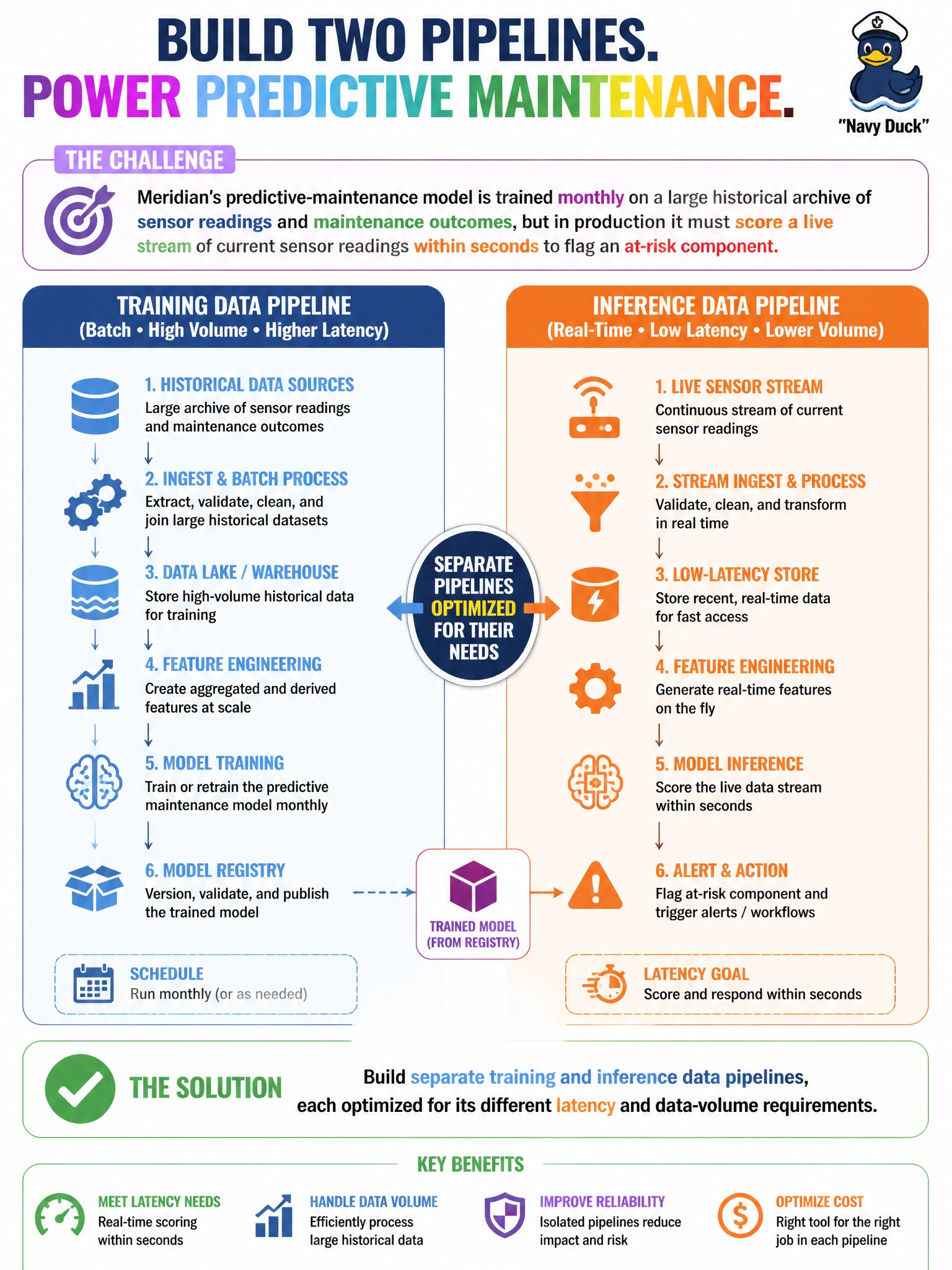
Meridian's predictive-maintenance model is trained monthly on a large historical archive of sensor readings and maintenance outcomes, but in production it must score a live stream of current sensor readings within seconds to flag an at-risk component. What should the data engineering team build to support both needs?
Select an answer to reveal the explanation.
Short Explanation
Training wants to chew through a huge historical archive at its own pace; inference needs an answer in seconds off the latest reading. Those are two different jobs with two different speed requirements, so they get two different pipelines.
Full Explanation
Training and inference have fundamentally different data needs: training processes large historical batches with no strict latency requirement, while inference must score live or near-live data within tight latency bounds. Building separate, purpose-optimized pipelines for each is a named CPMAI Data for AI enabler precisely because a single undifferentiated pipeline usually fails one of the two use cases. Option A ignores this mismatch and risks either slow inference (if built like a batch training pipeline) or inadequate historical processing (if built like a lean inference pipeline). Option C is wrong because relying on stale cached data for inference would mean the model scores against outdated readings, defeating the goal of catching an at-risk component quickly. Option D wrongly assumes historical data becomes irrelevant post-deployment, when in fact it remains essential for retraining, drift monitoring, and model iteration. For the exam, this training/inference pipeline split is one of the most concretely testable Data for AI facts — expect scenario questions that hinge on recognizing which pipeline a described data flow belongs to.