
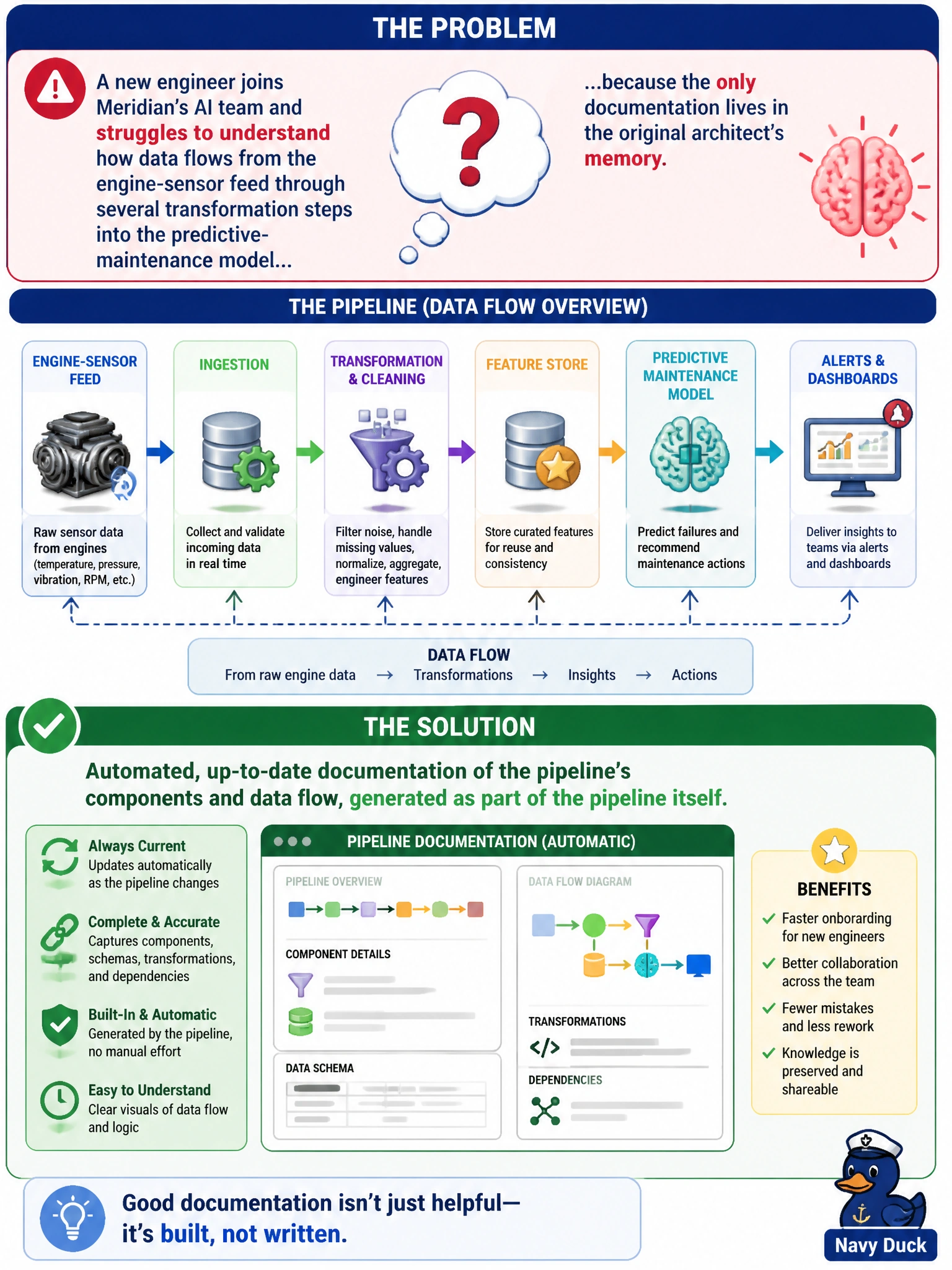
A new engineer joins Meridian's AI team and struggles to understand how data flows from the engine-sensor feed through several transformation steps into the predictive-maintenance model, because the only documentation lives in the original architect's memory. What should the team have created to prevent this?
Select an answer to reveal the explanation.
Short Explanation
If the pipeline only exists in one person's head, that's not documentation, that's a single point of failure. Automated docs generated alongside the pipeline keep the picture current without relying on anyone's memory or availability.
Full Explanation
Creating automated documentation of data pipeline components means the pipeline's structure, transformations, and data flow are captured and kept current programmatically (e.g., auto-generated data catalogs, lineage diagrams tied to the pipeline code), not left to depend on one person's tribal knowledge. Meridian's scenario is the direct consequence of skipping this: institutional knowledge trapped in one architect's head, which doesn't scale as the team grows and creates risk if that person is unavailable. Option B is an unrealistic and fragile 'solution' that doesn't address the underlying documentation gap and offers no protection if it fails. Option C avoids the symptom by refusing to grow the team, which isn't a sustainable governance response and ignores the actual problem. Option D provides a documentation artifact that is neither automated nor kept up to date as the pipeline evolves, reintroducing the same staleness risk. For the exam, tie automated pipeline documentation back to data lineage (Task 2) — lineage is what the documentation should be capturing and keeping current.