
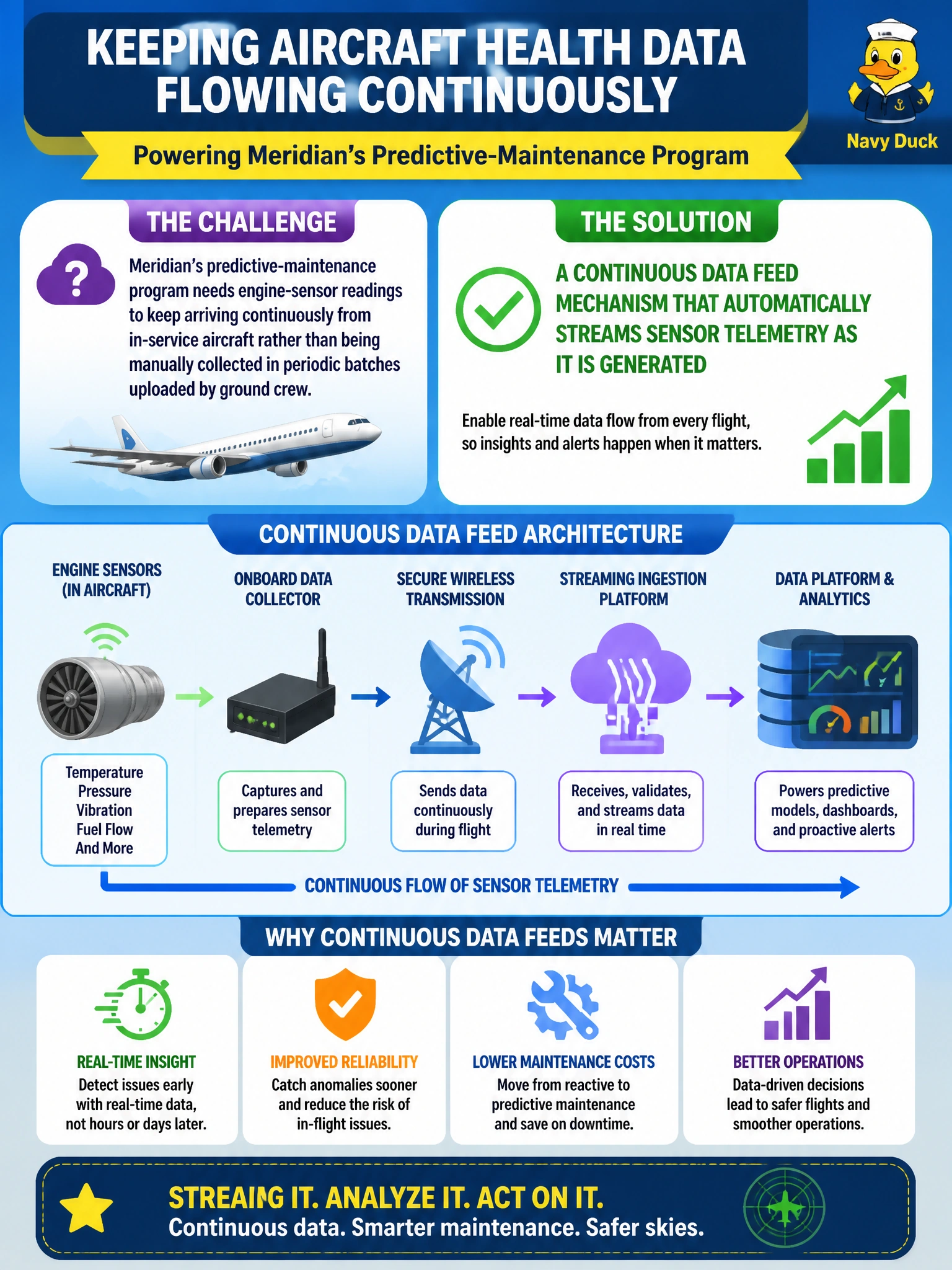
Meridian's predictive-maintenance program needs engine-sensor readings to keep arriving continuously from in-service aircraft rather than being manually collected in periodic batches uploaded by ground crew. What should the data engineering team design to support this need?
Select an answer to reveal the explanation.
Short Explanation
If the business need is 'we want to know the moment something drifts out of range,' a manual quarterly upload defeats the purpose before you even start. The pipeline has to feed itself continuously.
Full Explanation
Designing data feed mechanisms for continuous data flow means building automated ingestion — telemetry streaming from aircraft sensors directly into the pipeline as it's generated — rather than relying on periodic manual uploads. This is foundational to predictive maintenance, where the value proposition is catching an anomaly before scheduled maintenance would have caught it; a quarterly or monthly manual process reintroduces exactly the delay predictive maintenance is meant to eliminate. Option A and Option D both describe manual, infrequent processes that undercut the initiative's core purpose and reintroduce human bottlenecks and transcription error. Option C provides no ongoing data flow at all, which would leave the model static and unable to detect new patterns as the fleet ages or conditions change. For the exam, recognize 'continuous data feed' as a specific, named data-engineering deliverable distinct from the broader pipeline construction (next enabler) — feed mechanism design is about how data enters the system in the first place.