
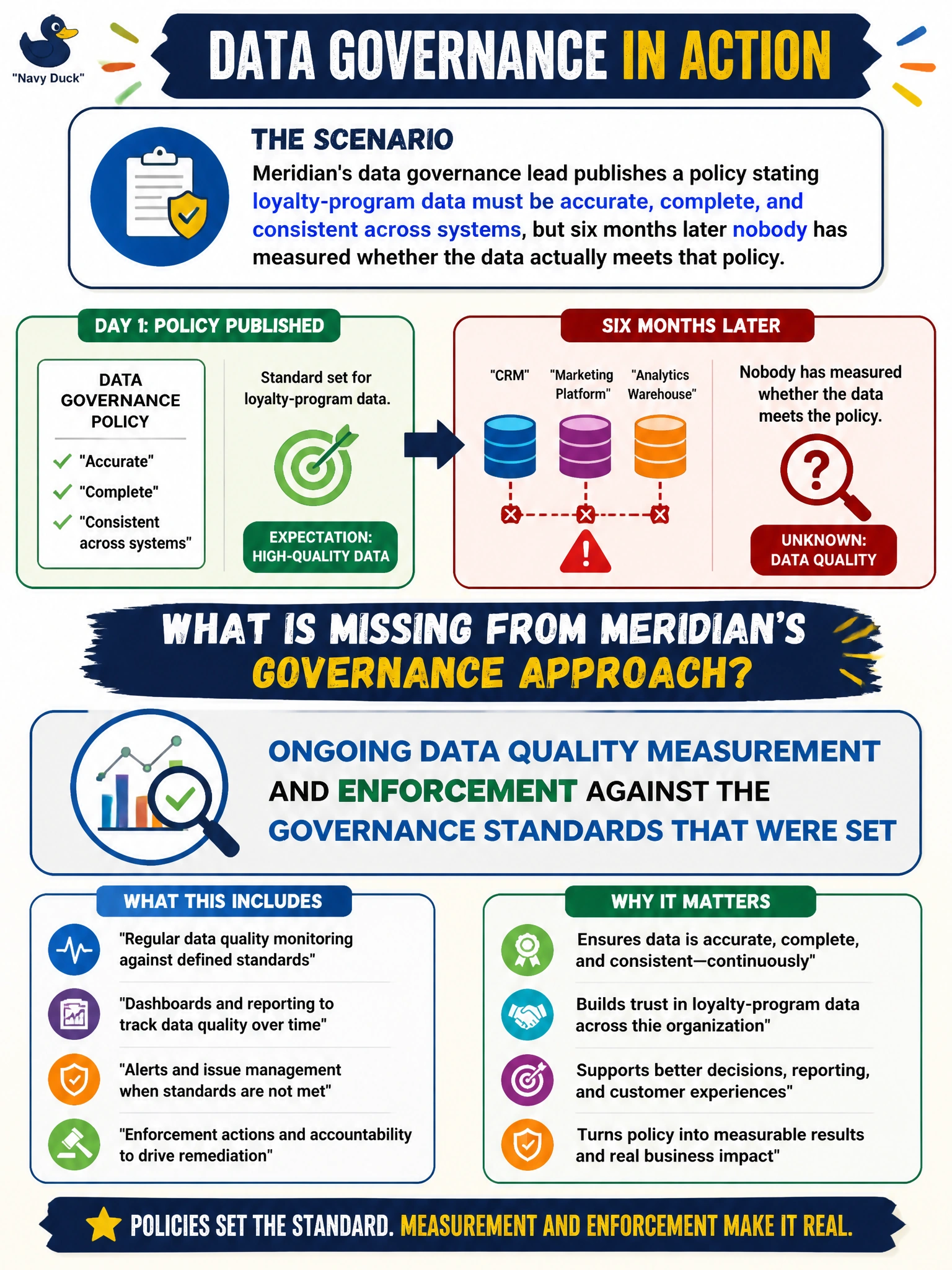
Meridian's data governance lead publishes a policy stating loyalty-program data must be accurate, complete, and consistent across systems, but six months later nobody has measured whether the data actually meets that policy. What is missing from Meridian's governance approach?
Select an answer to reveal the explanation.
Short Explanation
Writing the policy is only step one. Governance without measurement is just a document nobody checks against — the PM has to close the loop by actually assessing whether the data meets the standard that was set.
Full Explanation
Data governance sets the policy (what 'good' data should look like); data quality management is the ongoing practice of measuring, monitoring, and enforcing data against that policy. Meridian has the first without the second — a published standard nobody is verifying against, which means drift and quality problems go undetected indefinitely. Option A is factually wrong per the stem; the policy already exists, so the gap isn't policy creation but follow-through. Option C misdiagnoses a governance and process failure as a model or architecture problem, which a new model would not fix — bad data feeding a new model produces the same result. Option D is an unrelated marketing action with no bearing on data governance or quality. For the exam, keep the distinction sharp: governance defines the rules and roles (stewardship, lineage, management plans, MDM); ongoing quality measurement is what proves the rules are actually being followed — a gap in the latter is a very commonly tested failure pattern.