
Meridian's data engineers are building the ingestion-to-model pipeline for the customer-service chatbot and want it optimized specifically for AI workloads rather than reused unmodified from an existing generic reporting-ETL pipeline. What distinguishes an AI-optimized pipeline from a standard business-reporting ETL pipeline in this context?
Select an answer to reveal the explanation.
Short Explanation
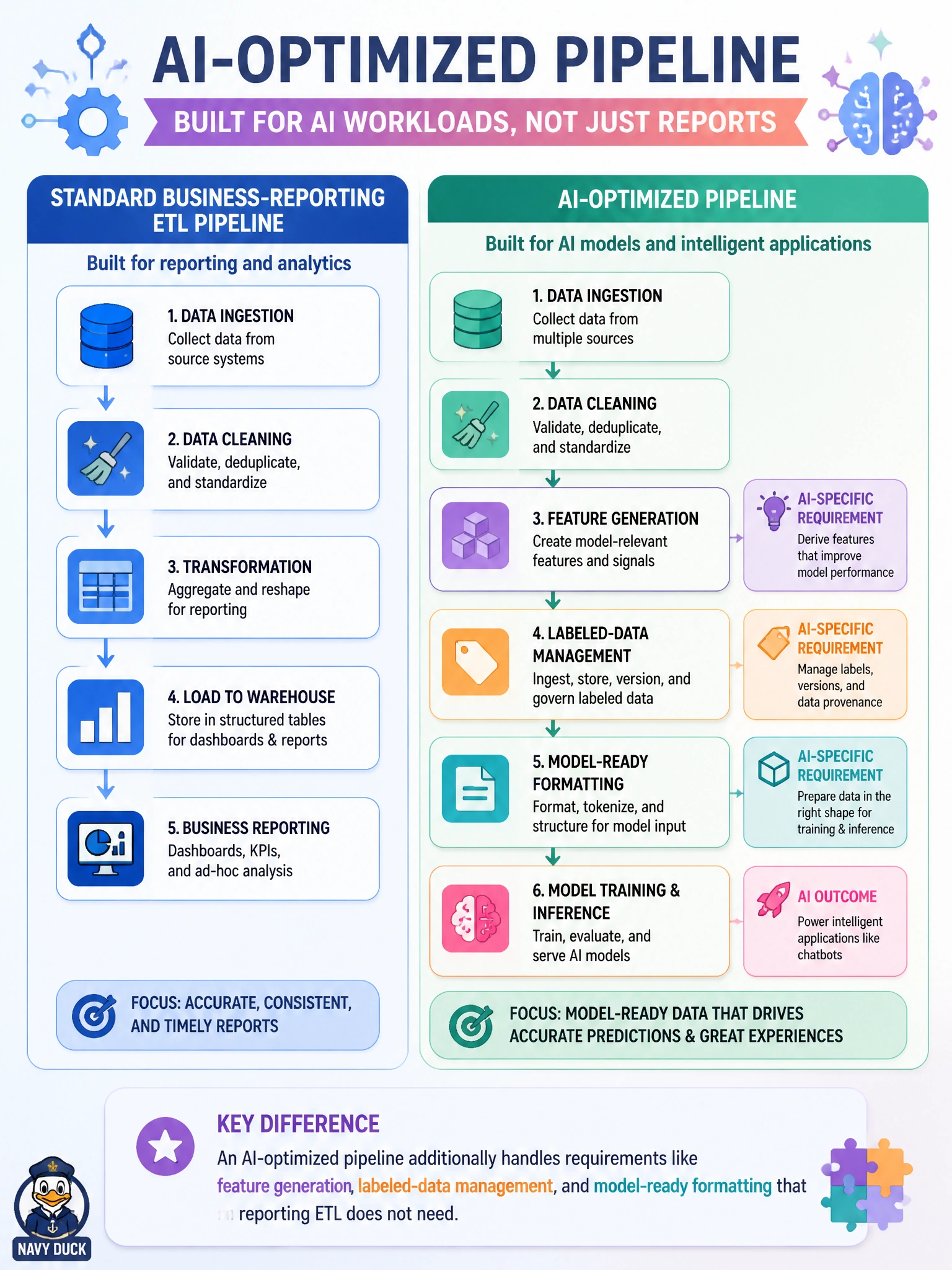
A reporting ETL pipeline just needs numbers to land in a dashboard-friendly shape. An AI pipeline has extra jobs — turning raw data into features, keeping labels attached, and shaping everything the way the model expects — that a generic pipeline was never built to do.
Full Explanation
Constructing data pipelines optimized for AI workloads means the pipeline does more than a standard reporting ETL: it must support feature engineering, preserve and manage labeled training data, handle model-specific input formatting, and often support both batch training and low-latency inference paths. A generic reporting pipeline, built to populate dashboards, typically doesn't handle labels or produce model-ready feature vectors. Option A wrongly assumes plug-and-play equivalence, ignoring the additional, AI-specific requirements the outline calls out. Option C is an overstatement — transformation steps exist in both pipeline types, so 'AI pipelines require no transformation' is simply false. Option D trivializes a substantive engineering distinction into a cosmetic one. For the exam, remember that reusing an existing BI/reporting pipeline unmodified for an AI initiative is a common project pitfall — the pipeline must be purpose-built or substantially adapted for AI-specific needs like labeling and feature generation.