
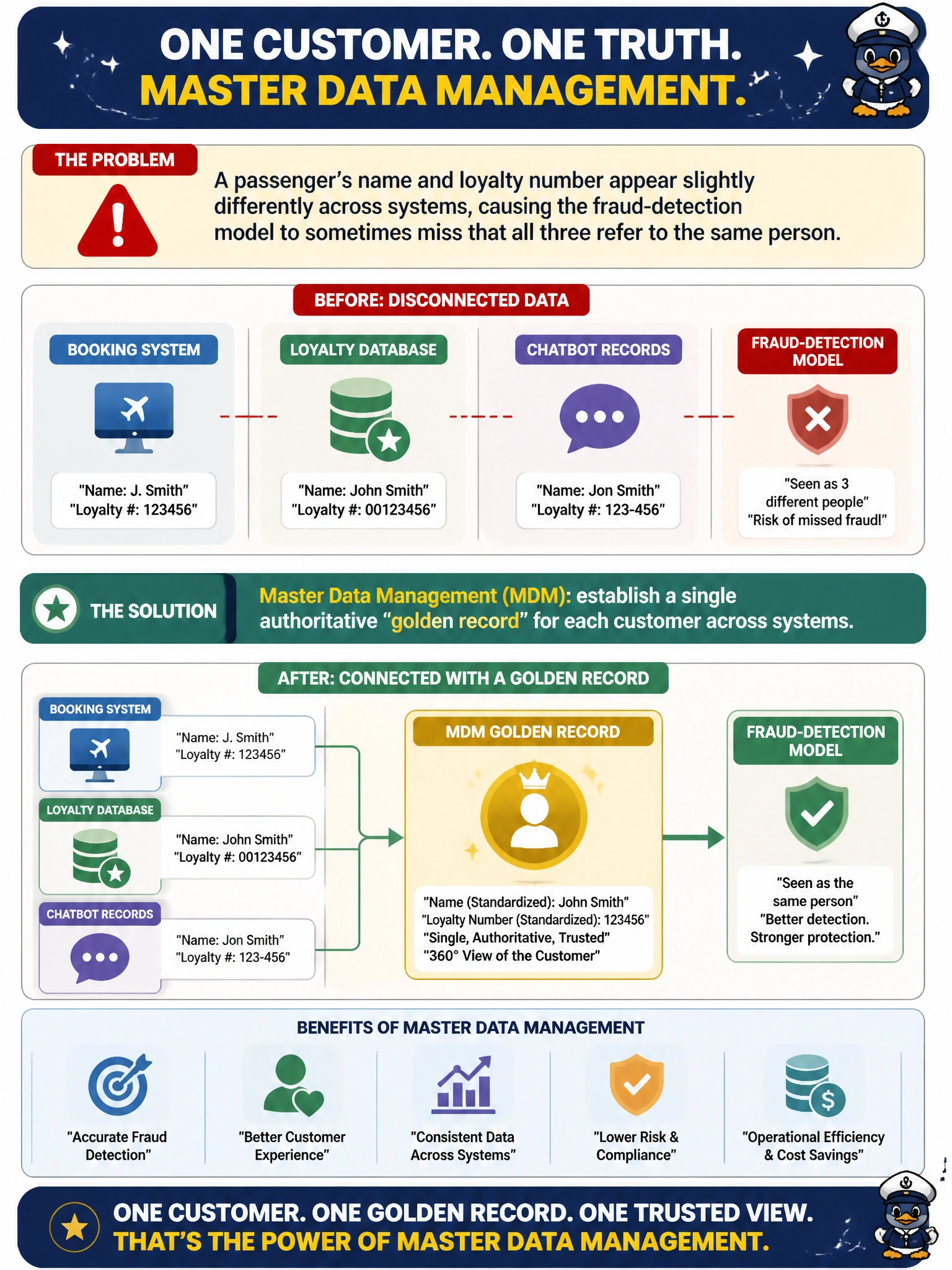
A passenger's name and loyalty number appear slightly differently across Meridian's booking system, the loyalty database, and the customer-service chatbot's records, causing the fraud-detection model to sometimes miss that all three refer to the same person. Which practice should the PM push the team to implement to fix this?
Select an answer to reveal the explanation.
Short Explanation
Three slightly different versions of the same passenger across three systems is a classic master-data problem — not a model problem. You fix it by reconciling to one golden record, not by throwing more training runs at it.
Full Explanation
Master data management (MDM) establishes a single, authoritative 'golden record' for core entities like customer identity, reconciling inconsistent representations across multiple source systems (booking, loyalty, chatbot). This directly addresses Meridian's problem: the fraud-detection model is fed the same real person as three near-duplicate identities, degrading its ability to link suspicious activity to one account. Option B, data augmentation, addresses a different problem entirely — increasing training-data diversity or volume, not resolving conflicting identity records; it wouldn't fix the underlying data quality issue. Option C treats the symptom (model performance) without addressing the root cause (inconsistent master data), so the same issue would persist after retraining. Option D is an operationally destructive non-solution that would break legitimate business systems rather than reconcile records. For the exam, recognize MDM as the named practice for cross-system identity/entity consistency, distinct from lineage (transformation history) and stewardship (ownership/accountability).