
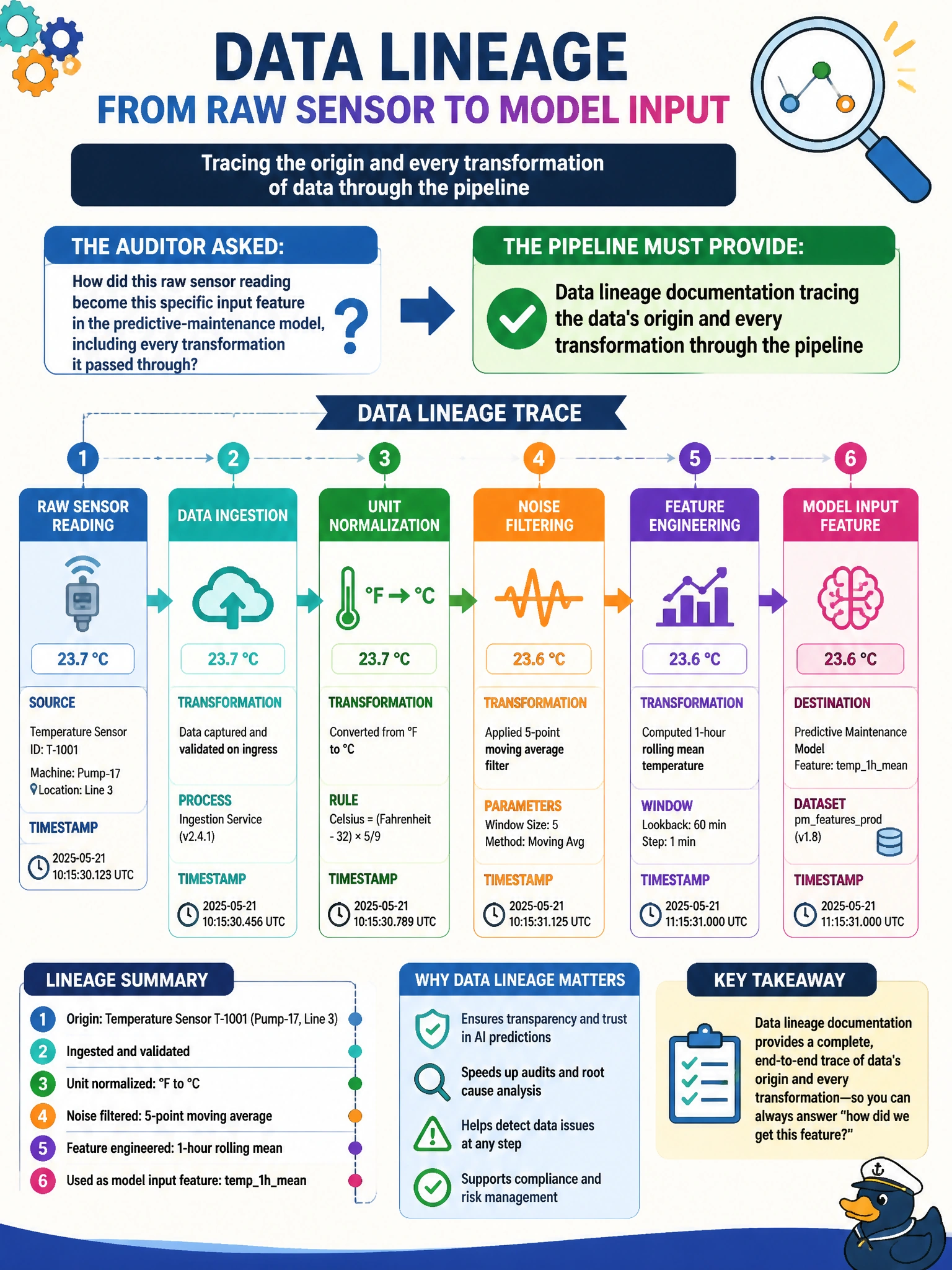
An auditor asks Meridian's AI team to show exactly how a raw sensor reading became a specific input feature used by the predictive-maintenance model, including every transformation it passed through. Which capability must the pipeline have provided for the team to answer this?
Select an answer to reveal the explanation.
Short Explanation
When an auditor asks where a number came from and what happened to it, that's a lineage question. If you can't trace a feature back through every transformation to its raw source, you can't answer it — no matter how good the model is.
Full Explanation
Data lineage documentation is the documented trail showing where data originated and every transformation it underwent on its way to becoming a model input — exactly what an auditor needs to verify how a raw sensor reading became a specific feature. Without lineage documentation, the team cannot demonstrate traceability, which undermines both trust and auditability of the AI pipeline. The data augmentation records showing synthetic images generated for the computer-vision system concern data augmentation, a different Task 4 concept focused on synthetic data generation for robustness, not traceability of an existing feature's history. The marketing summary of the AI initiative's business benefits is irrelevant to a technical audit request — it answers 'why,' not 'how did this data get here.' The vendor's confidential model architecture diagram is also off-target: it describes the algorithm, not the data's provenance and transformation history, and an audit of data handling wouldn't require exposing proprietary model internals anyway. For the exam, keep lineage distinct from stewardship (who owns it) and from a data management plan (the policy) — lineage is specifically the traceable record of data's journey and transformations.
Prefer to study offline? Printable PDF study book + test engine ($7.50, unofficial). These questions stay free here.