
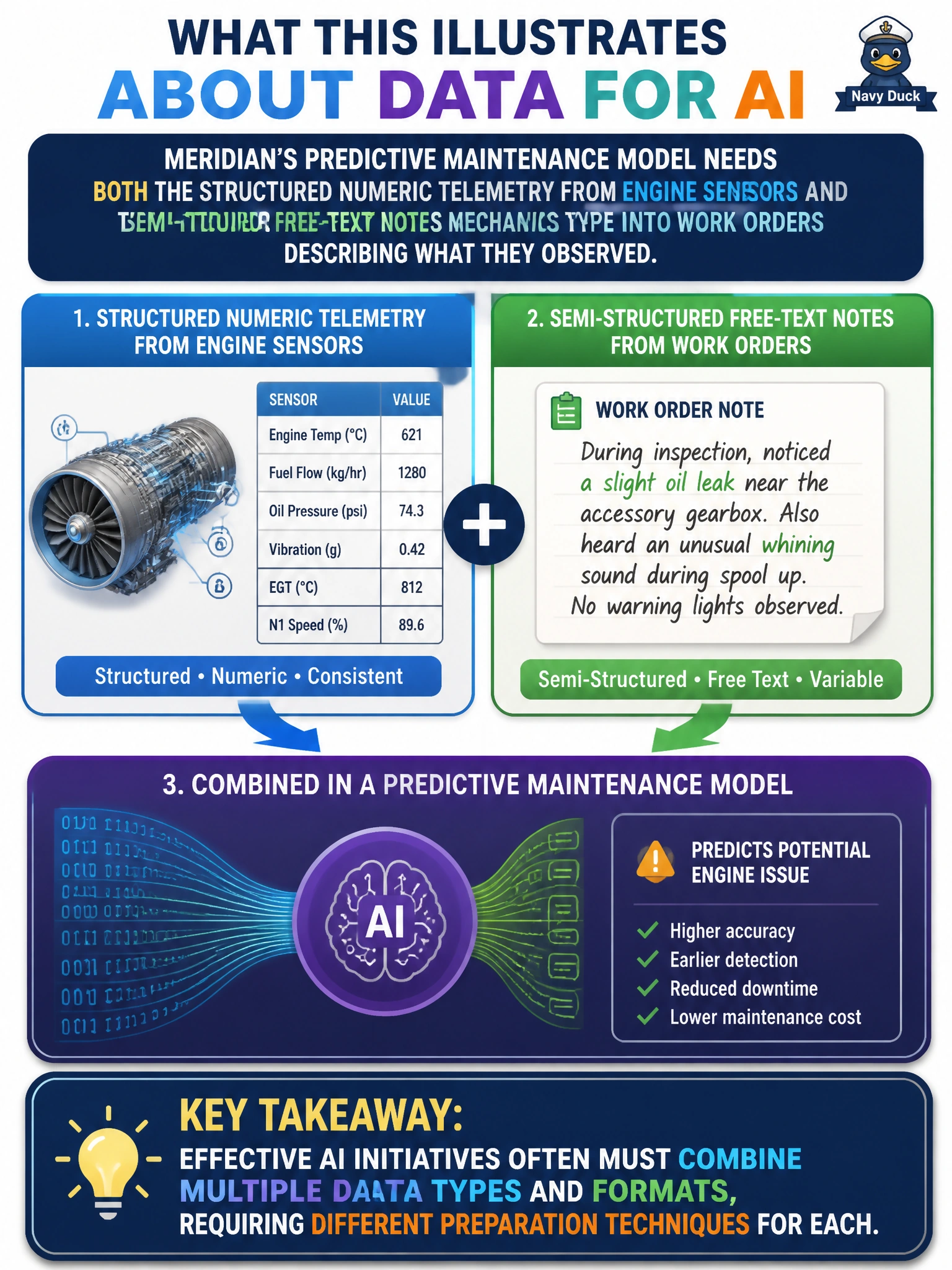
Meridian's predictive maintenance model needs both the structured numeric telemetry from engine sensors and the semi-structured free-text notes mechanics type into work orders describing what they observed. What does this combination best illustrate about data for AI at Meridian?
Select an answer to reveal the explanation.
Short Explanation
Real-world AI projects rarely run on one tidy data type. Numeric sensor readings need different handling than a mechanic's handwritten note, and the team has to prepare both and bring them together, not pick just one.
Full Explanation
A recurring reality in Data for AI is that meaningful AI use cases draw on a mix of data types — structured telemetry, semi-structured logs, unstructured text or images — each requiring its own preparation approach (e.g., normalization for numeric sensor data, tokenization or NLP feature extraction for mechanic notes) before being combined into a unified feature set. Option A wrongly dismisses the free-text notes, which often contain early qualitative signals a sensor alone won't capture. Option C reflects the same 'unstructured data is unusable' misconception addressed in Q143 — text is processable with the right technique, not disqualifying. Option D is an unnecessary and impractical constraint; the whole point of a mature data pipeline is to bring heterogeneous data together into one model-ready dataset, not silo it permanently. For the exam, recognize that 'data variety' isn't just a Big-Data buzzword — it directly shapes what data-preparation work (Task 4 of this domain) a PM must plan and staff for.