
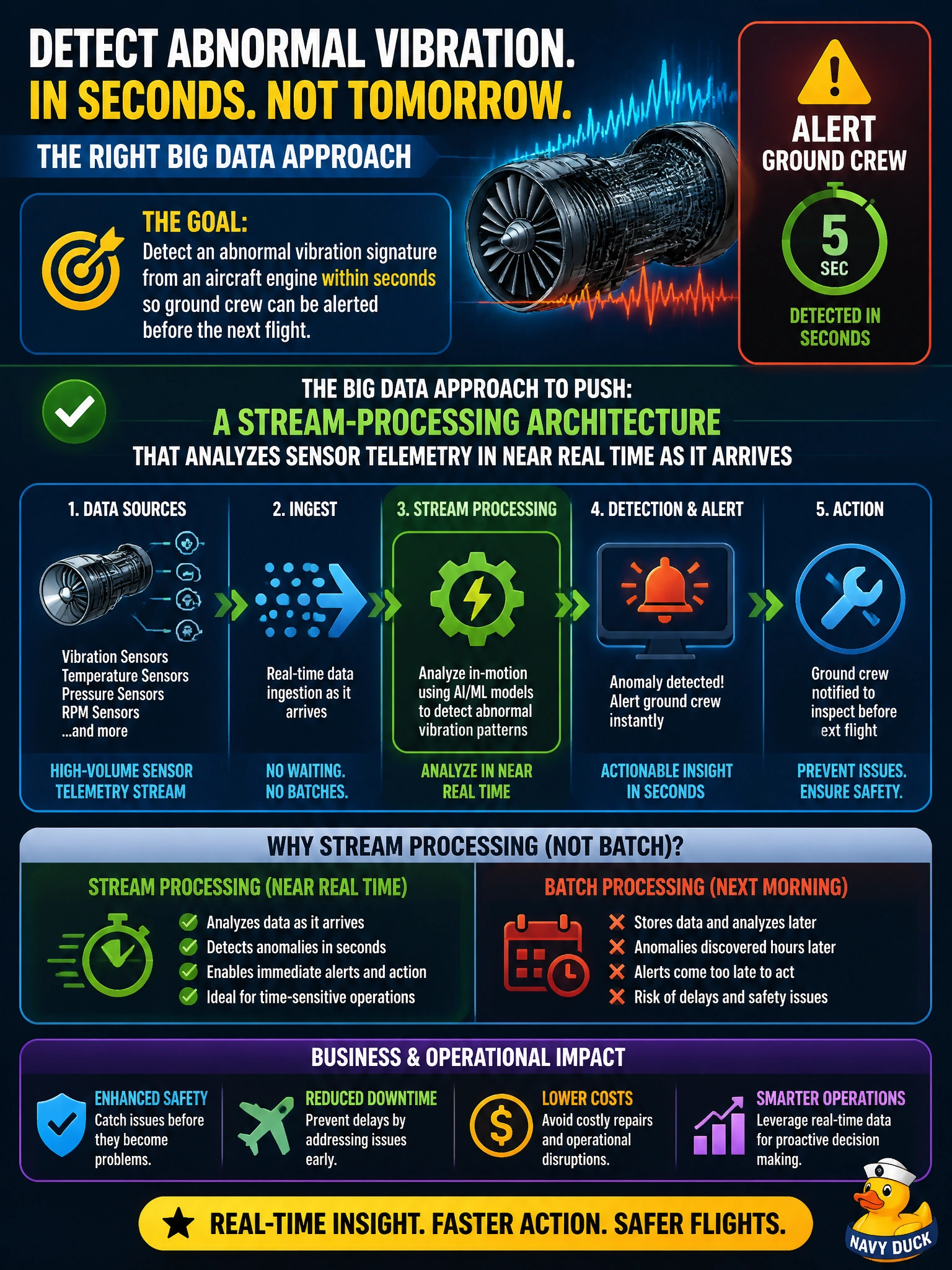
Meridian's engineering team needs to detect an abnormal vibration signature from an aircraft engine within seconds so ground crew can be alerted before the next flight, rather than discovering the anomaly in a report the next morning. Which Big Data approach should the PM push the team toward to enhance this AI capability?
Select an answer to reveal the explanation.
Short Explanation
If the business need is 'alert us within seconds,' a nightly batch job is the wrong architecture no matter how good the model is. Real-time detection needs a streaming pipeline, full stop.
Full Explanation
Applying Big Data approaches to enhance AI capability means matching the data architecture to the latency the business need actually requires. Meridian's requirement — seconds-level anomaly alerts — demands stream processing, where telemetry is analyzed as it arrives rather than aggregated later. Option A (nightly batch) directly fails the stated business requirement: a report the next morning is too late to prevent the next flight's risk, illustrating a common AI-project failure mode of solving the wrong latency problem. Option C ignores the value of the sensor data entirely and reverts to a manual process, defeating the purpose of the initiative. Option D would support only initial model training, not the ongoing production need for continuous detection — it conflates training-time and inference-time data needs, a distinction this domain tests directly under 'separate training and inference data pipelines.' The exam-relevant judgment: a PM must translate a business latency requirement into the right Big Data processing pattern, streaming versus batch, before the team commits to an architecture.