
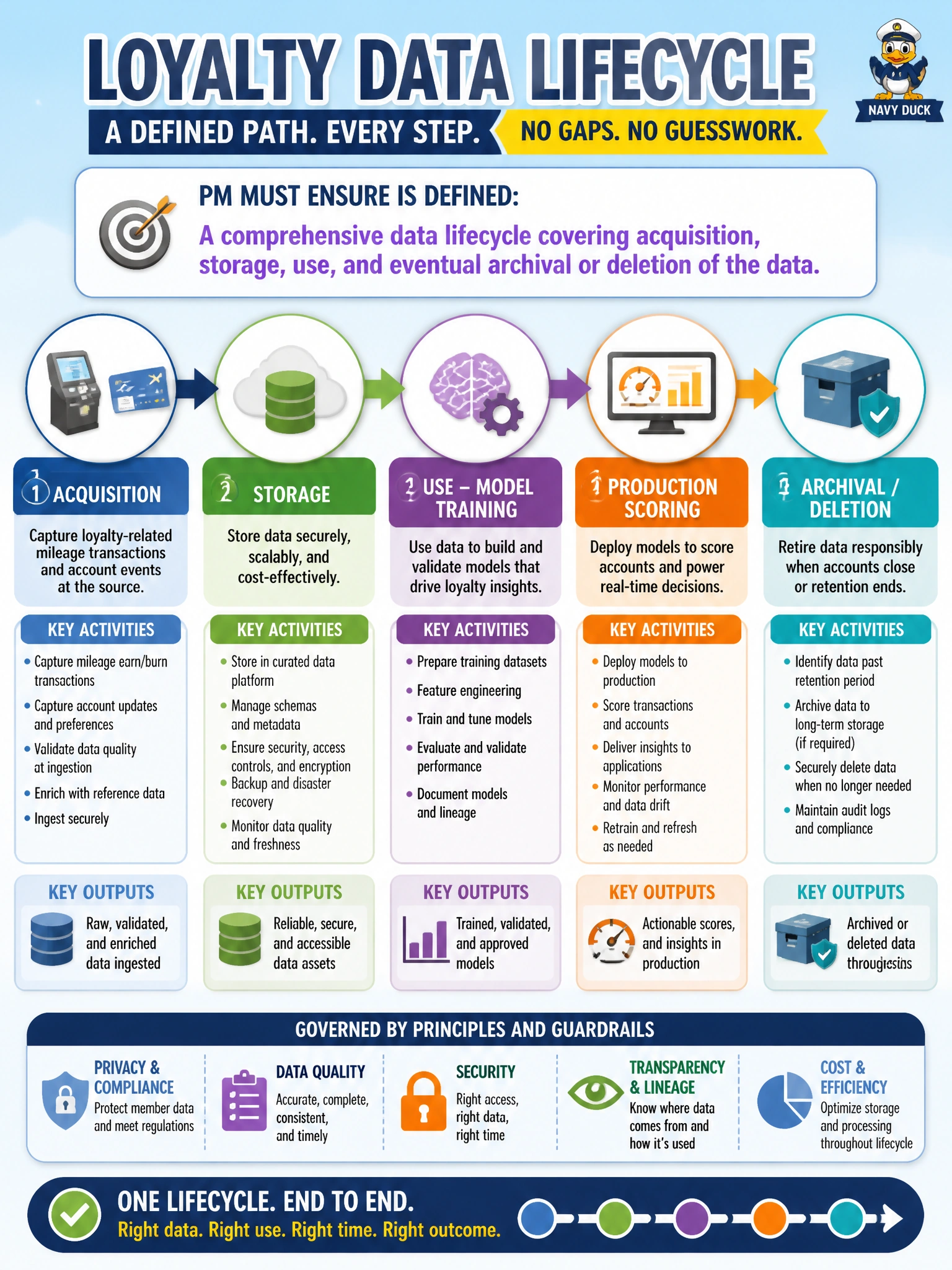
Meridian's loyalty-program data — from initial mileage-transaction capture through model training, production scoring, and eventual archival once accounts close — needs a defined path so nothing is ingested, used, or retired inconsistently. What should the PM ensure is defined to manage this end to end?
Select an answer to reveal the explanation.
Short Explanation
Data has a whole life, not just a moment of use — it's born (captured), it lives (stored, used, updated), and eventually it retires (archived or deleted). A PM has to plan for the whole arc, not just the training step.
Full Explanation
Designing a comprehensive data lifecycle means explicitly defining every stage data moves through for an AI application: acquisition/capture, storage, transformation and use (including model training and production inference), and eventual archival or deletion when data is no longer needed or a customer account closes. This is a named CPMAI Data for AI enabler because AI initiatives that skip lifecycle planning end up with stale data, compliance gaps, or unmanaged growth. Option A fails because an informal, single-person task list isn't a governed lifecycle and creates a bus-factor risk. Option C addresses only the training moment and ignores ongoing production use and retirement, which is exactly the gap a lifecycle plan closes. Option D is an overcorrection — immediate deletion after training would break the loyalty program's ongoing fraud-detection scoring, which needs continuing access to relevant data, not none at all. For the exam, connect data lifecycle design to real governance obligations: retention rules interact directly with privacy requirements covered in Domain VI.