
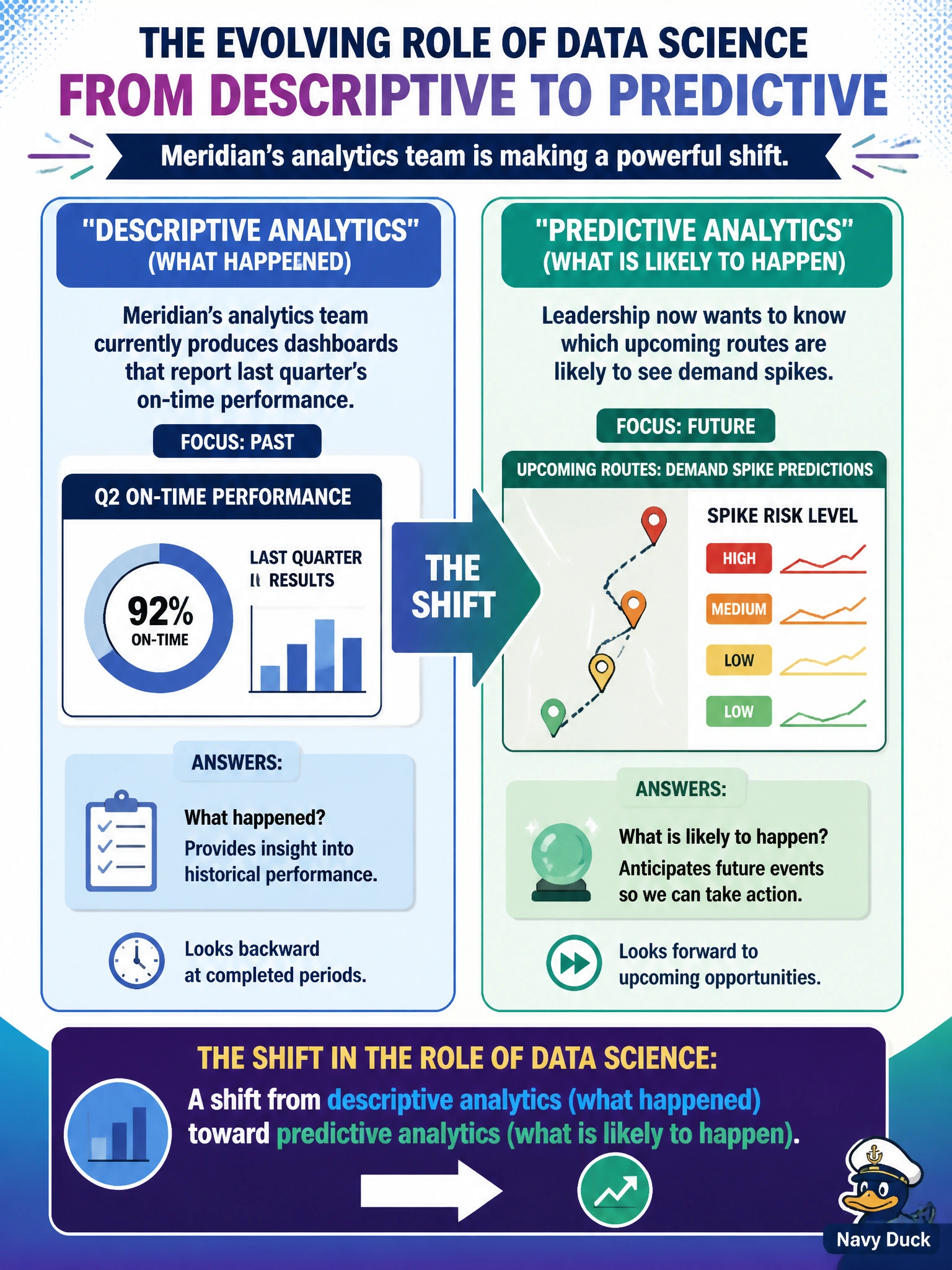
Meridian's analytics team currently produces dashboards that report last quarter's on-time performance (descriptive analytics). Leadership now wants to know which upcoming routes are likely to see demand spikes. Which shift in the role of data science does this represent?
Select an answer to reveal the explanation.
Short Explanation
Descriptive analytics tells you what already happened; predictive analytics tells you what's likely to happen next. Moving from 'here's last quarter's on-time rate' to 'here's which routes will spike' is exactly that step up the analytics maturity ladder.
Full Explanation
Data science spans a spectrum: descriptive analytics (summarizing past events, e.g. on-time performance dashboards), diagnostic analytics (why something happened), predictive analytics (forecasting future outcomes, e.g. demand spikes), and prescriptive analytics (recommending actions). Meridian's request to forecast route-level demand is a move from descriptive toward predictive analytics, requiring statistical or machine-learning models rather than simple reporting. Option A reverses the maturity order — prescriptive is more advanced than descriptive, not the reverse, and dashboards are not prescriptive. Option B is false; predictive analytics requires model training and validation techniques that plain descriptive reporting does not use. Option D wrongly claims forecasting needs no modeling, which contradicts the entire premise of demand forecasting as an ML use case described in the intake framing. For the exam, know the descriptive-diagnostic-predictive-prescriptive spectrum and be able to place a stated business ask correctly on it — this is a recurring way CPMAI tests data-science literacy at PM depth.